Melatonin Gummies in Menopause: What's Really Inside
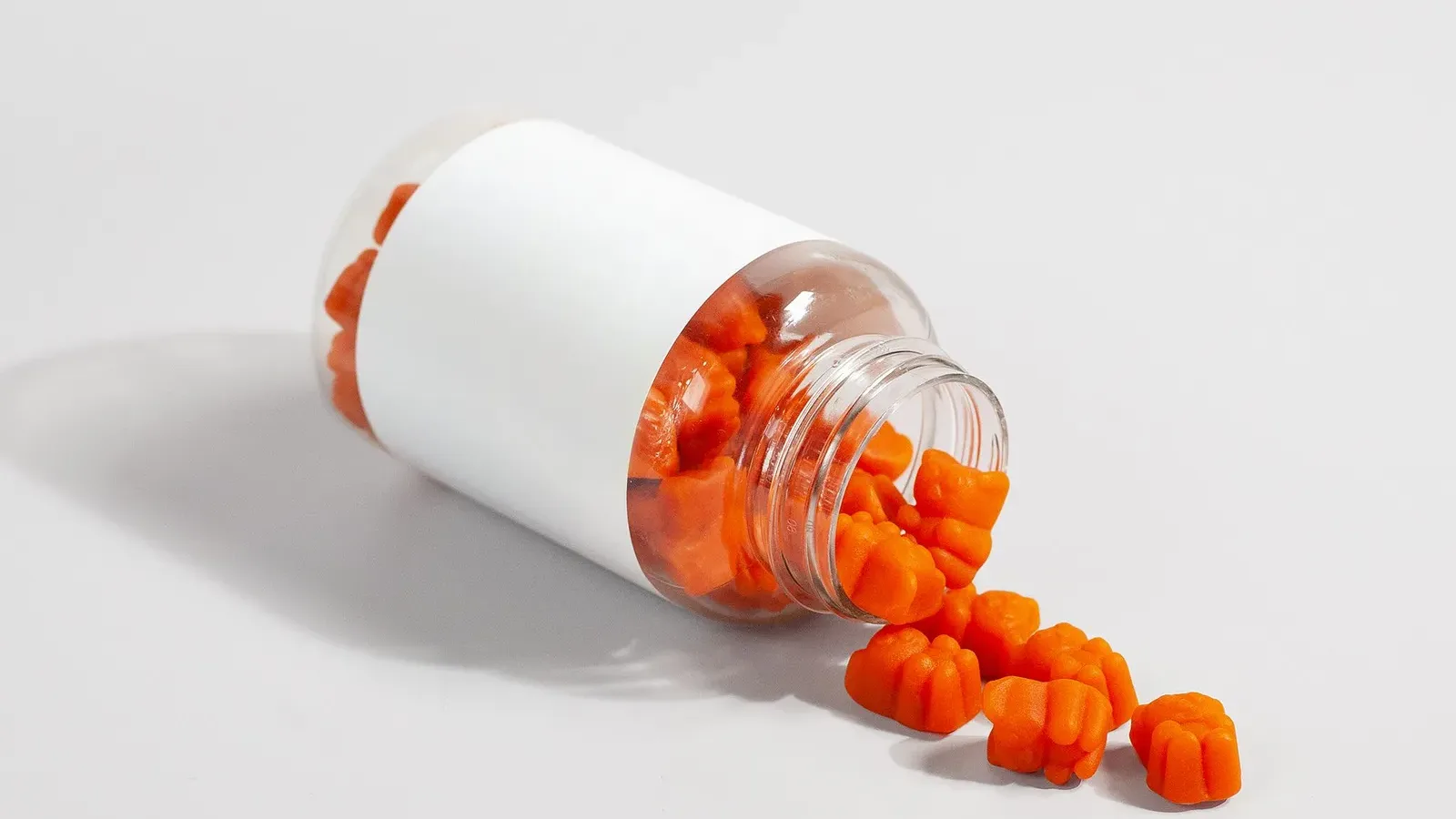
Melatonin gummies are the easiest sleep supplement to take and the hardest one to read. They taste like candy, the label says "5 mg" in big letters, and what's actually inside can be very different from that number.
If you're in perimenopause or menopause and a bottle of gummies is sitting on your nightstand, here's what I found when I read the testing, the label database and the safety reports. I'm not a doctor; I read the research so you can ask better questions.
Melatonin gummies are a flavored form of a supplement the American Academy of Sleep Medicine suggests not using for chronic insomnia. The bigger problem is the label: a 2023 JAMA test found 22 of 25 gummy products inaccurately labeled, with 74% to 347% of the stated melatonin. Check the dose per serving, the sugar, and keep them away from children.
What makes melatonin gummies different from other forms?
Melatonin gummies differ from tablets and capsules in how the dose is packaged, not in the hormone itself. A gummy is a chewable made with sweeteners, gelling agents and flavor, so each piece carries a small amount of melatonin plus sugar, and the label's "serving" is often more than one piece. That is where most of the confusion starts.
This article is about the gummy format only. For whether melatonin helps menopause sleep in the first place, the right timing, and the general side effects, start with our main guide on whether melatonin works for menopause insomnia. If you're weighing a blended product, our review of OLLY Sleep goes through that brand's versions.
Three things set gummies apart, and the rest of this article takes them in turn:
- Accuracy: independent testing has found large gaps between the label and the gummy.
- Dose math: the milligrams on the front may be per serving, not per gummy.
- Candy appeal: sugar for you, and a real poisoning risk for children.
Do melatonin gummies contain what the label says?
Often they don't. In a 2023 JAMA research letter, scientists tested 25 melatonin gummy products sold in the US and found that 22 of them (88%) were inaccurately labeled. Only 3 products held a quantity of melatonin within 10% of the declared amount. Actual content ranged from 74% to 347% of the label.
The sample came from 30 brands listed in the NIH Dietary Supplement Label Database in 2021. Four were unavailable and one had no melatonin on its label, which left 25. The authors tested a single sample of each brand, and they note the small sample size and that the results can't be assumed to apply to tablets or capsules.
One finding stands out: a product labeled with melatonin and 30 mg of CBD had no detectable melatonin but 31.3 mg of CBD. Five products declared CBD, and their measured CBD ranged from 10.6 to 31.3 mg per serving, or 104% to 118% of the label. Serotonin, which has turned up in melatonin products before, was not detected in any of the 25. Our guide to CBD for sleep in menopause covers that ingredient on its own.
An earlier study found the same kind of problem in a mix of forms. In 2017, Erland and Saxena analyzed 31 melatonin supplements and found content ranging from -83% to +478% of the label. Lot-to-lot differences within one product reached 465%, and more than 71% of the supplements fell outside 10% of the label claim. Serotonin was found in eight of them, at 1 to 75 micrograms.
None of this means every gummy is off. It means the number on the front is a claim, not a measurement. The NIH's National Center for Complementary and Integrative Health notes that in the US melatonin is regulated as a dietary supplement, under looser rules than drugs, and that FDA generally can't review supplements for safety and effectiveness before they're sold.
How much melatonin is really in one gummy?
The amount in one gummy is often smaller than the big number on the bottle, because many labels state melatonin per serving, and a serving can be two or even four gummies. Divide the milligrams by the number of gummies before you compare products. Here is how it works out on six real label entries.
| Label (NIH database entry) | Serving | Melatonin per serving | Per gummy | Sugar per serving |
|---|---|---|---|---|
| Nature's Truth Low Dose 1 mg (entered 2025) | 1 gummy | 1 mg | 1 mg | 2 g (all added) |
| Carlson 2.5 mg (entered 2024; listed off market 2025) | 1 gummy | 2.5 mg | 2.5 mg | 1 g (all added) |
| Konsyl Deep ZZZ 5 mg (entered 2022) | 2 gummies | 5 mg | 2.5 mg | 4 g added |
| GNC 5 mg (entered 2024) | 2 gummies | 5 mg | 2.5 mg | 3 g (all added) |
| Natrol 10 mg (entered 2017; listed off market 2019) | 4 gummies | 10 mg | 2.5 mg | 6 g sugar |
| Vitamatic 20 mg (entered 2023) | 2 gummies | 20 mg | 10 mg | 4 g (all added) |
Source: NIH Dietary Supplement Label Database entries. These are records of labels as photographed on the entry date, so a bottle you buy today may have changed. I didn't test any of these products, and the list is an example of how labels vary, not a ranking.
Look at rows two to five. Four products with three different bottle claims (2.5 mg, 5 mg and 10 mg) all work out to 2.5 mg per gummy, while one "20 mg" product is 10 mg in every gummy. The directions also differ: the labels I read said to take the serving anywhere from 20 minutes to one to two hours before bed.
Now put the JAMA range on top. If a 5 mg label landed anywhere from 74% to 347% of its claim, that serving would hold roughly 3.7 mg to 17 mg. That is my arithmetic applied to one label, not a finding for any real brand, but it shows why "5 mg" is a starting point, not a guarantee.
For perspective, the JAMA authors compare these gummies with a 0.1 to 0.3 mg dose that has been shown to raise night-time melatonin levels in young adults, and note that a serving of the products tested held far more than that. Our main guide explains why many sleep specialists start low; the point here is that gummies make low dosing harder, because you can't easily cut one in half.
Read "per serving" twice. One label I read (Konsyl, 5 mg per 2 gummies) says not to exceed 8 gummies in 24 hours. That is four servings, or 20 mg of melatonin, which is a lot more than the front of the bottle suggests. More gummies is not a safer way to try a higher dose.
How much sugar is in a melatonin gummy?
A melatonin gummy typically carries 1 to 4 grams of added sugars per serving on the labels I read, with one four-gummy serving listing 6 grams of sugar. That's small next to the American Heart Association's limit of 25 grams (about 6 teaspoons, or 100 calories) of added sugar a day for women, but it counts.
One serving is roughly 4% to 16% of that daily limit (1 to 4 g out of 25 g), and 6 g is 24% of it. Calories were low, between 10 and 30 per serving. The sugar matters mostly if gummies are one of several sweet things you reach for at night, or if you're watching your blood sugar. Our article on blood sugar and menopause sleep explains why night-time sugar is worth thinking about.
I didn't find evidence that the sugar in a gummy affects sleep on its own, so I won't claim that. What the label can tell you is whether the product contains common allergens: the labels I read mentioned coconut (a tree nut) in one, and milk in another facility warning. If you have a food allergy, read the allergen line and not just the front.
Why are melatonin gummies a risk around children?
Melatonin gummies are a risk around children because they look and taste like candy, and poison centers have seen a steep rise in accidental ingestions. A CDC report found that pediatric melatonin ingestions reported to US poison centers rose 530%, from 8,337 in 2012 to 52,563 in 2021. Store them like any medicine.
The same report found the most variation in melatonin content in the chewable formulation, "which is most likely to be used by children." It advises health care providers to counsel parents about safe storage, and says child-resistant packaging should be considered. A later CDC estimate, cited by NCCIH, put emergency department visits at about 11,000 from 2019 to 2022 for unsupervised melatonin ingestion by children 5 and younger, many involving gummies.
The JAMA authors add a dosing point: taking the gummies as directed could expose children to between 40 and 130 times more melatonin than the 0.1 to 0.3 mg dose shown to raise night-time levels in young adults. So there are two separate rules for a household. Keep your own bottle out of reach, and don't hand a child a gummy made for adults.

If a child may have swallowed melatonin gummies, call Poison Control at 1-800-222-1222 in the US. It is free and answered around the clock.
How can you read a gummy label more carefully?
Reading a melatonin gummy label carefully means checking five things on the Supplement Facts panel before you buy: the melatonin per serving, how many gummies make a serving, the sugar, any other ingredients, and whether a third-party seal appears. None of these guarantees accuracy, but together they filter out the most confusing products.
- Per serving versus per gummy: divide by the serving size, as in the table above.
- Other ingredients: many sleep gummies add L-theanine, chamomile, passionflower or lemon balm. That changes what you're taking; see our L-theanine and herbal sleep supplements articles.
- CBD or other extras: if the label doesn't mention them, you shouldn't be getting them.
- Seals: some labels carry a third-party seal such as NSF Contents Certified. I couldn't open the certifier's own page, so I can't tell you exactly what each seal covers; check the seal's website. Seals also vary within a brand: of two OLLY entries I read, one listed an NSF seal and the other didn't.
- Warnings: look for the instructions on alcohol, driving and chewing. The labels I read said not to use melatonin with alcohol, when driving or when operating machinery, and some said to chew thoroughly.
A seal or the word "verified" on a bottle is a reason to look closer, not proof. NCCIH cautions that terms like "standardized," "verified" or "certified" used by a manufacturer don't necessarily guarantee quality or consistency. If you're also taking other supplements, our guide to combining supplements safely shows how to keep track of what you take.
Are gummies a good choice for menopause sleep?
Gummies are a convenience choice, not a menopause-specific one. I found no trial that tested melatonin gummies in menopausal women, or that compared gummies with tablets. The 2017 American Academy of Sleep Medicine guideline suggests clinicians not use melatonin for sleep onset or sleep maintenance insomnia in adults, a weak recommendation.
NCCIH likewise says there isn't enough strong evidence for melatonin in chronic insomnia, and notes that American College of Physicians guidelines strongly recommend cognitive behavioral therapy for insomnia as the first treatment. If hot flashes or night sweats are what wake you, a clock-setting supplement may not touch the cause; our menopause sleep guide covers the main causes.
For a non-supplement route, see our CBT-I guide. If you've been told a prescription is an option, ramelteon (Rozerem) is a prescription drug that works on the same melatonin receptors, with a labeled dose and quality controls that a supplement doesn't have. A different, food-based experiment is tart cherry juice.
Who should not take melatonin gummies without checking first?
Several groups should talk to a health professional before taking melatonin gummies. NCCIH says people with epilepsy or who take blood thinners need medical supervision, that research on safety in pregnant or breastfeeding women is lacking, and that guidelines recommend against melatonin for people with dementia. Interactions with other medicines are possible.
- Pregnancy or breastfeeding: perimenopause doesn't rule pregnancy out. Safety research is lacking, so ask first.
- Epilepsy or blood thinners: medical supervision is advised.
- Older adults and dementia: melatonin may cause daytime drowsiness; guidelines recommend against use in people with dementia.
- Autoimmune conditions, diabetes or other endocrine disorders: one gummy label I read lists these among the reasons to consult a practitioner first.
- Children: adult gummies are not for them; see the section above.
- Anyone who drives or works with machinery soon after: labels warn about drowsiness.
What are the possible side effects of melatonin gummies?
The side effects of melatonin gummies are those of melatonin, plus anything in the gummy base. NCCIH reports that in short-term studies, summarized in a 2015 review, the side effects were mild: headache, dizziness, nausea and sleepiness. Long-term effects are unclear, because long-term safety information is lacking.
Drowsiness is the one the labels stress: several say not to use it with alcohol, when driving or when operating machinery. Our article on alcohol and menopause sleep explains why alcohol and night-time sleep products are a poor mix.
If you take more than the label's amount, expect these effects to be more likely, and remember that the real amount per gummy can differ from the printed one. A reaction such as hives, swelling or trouble breathing needs urgent care, as with any ingredient.
Talk to your doctor if...
Talk to your doctor or pharmacist about melatonin gummies if you take any prescription medicine, if your sleep problem has lasted more than a few weeks, or if you're considering a higher dose. NCCIH advises telling your health care providers about all supplements you take, including well before any surgery.
- You take blood thinners or seizure medicines, or you're not sure whether your other medicines interact.
- You are pregnant, could be pregnant, or are breastfeeding.
- You still wake exhausted after several weeks of trying a gummy; snoring, restless legs, depression and anxiety are all things your clinician can check for.
- You have taken more than the label says or a child got into the bottle.
- You feel unusually drowsy, dizzy or foggy the next day.
Where to go from here
If you're deciding whether to try melatonin at all, start with the main melatonin guide. If you want to compare it with a mineral, see magnesium for sleep. For the full picture of midlife sleep, read the perimenopause and menopause sleep guide.
Key takeaways
- The label is a claim: in a 2023 JAMA test, 22 of 25 gummy products were mislabeled, with 74% to 347% of the stated melatonin.
- Do the division: labels state melatonin per serving, and a serving can be 1 to 4 gummies.
- Sugar is small but real: 1 to 4 g of added sugars per serving on the labels I read.
- Treat them like medicine: pediatric melatonin ingestions rose 530% from 2012 to 2021.
- Evidence is the same as for any melatonin: a weak guideline recommendation against use for chronic insomnia; no gummy-specific menopause trials found.
Frequently asked questions
Are melatonin gummies accurately labeled?
Often not. In a 2023 JAMA analysis of 25 gummy products sold in the US, 22 (88%) were inaccurately labeled, and only 3 held melatonin within 10% of the declared amount. Actual content ranged from 74% to 347% of the label. The authors tested one sample per brand, so it is a snapshot, not a ranking.
How much melatonin is in one gummy?
It depends on the brand, and the number on the front can mislead. On the NIH label database entries I read, one gummy held anywhere from 1 mg to 10 mg, and a "serving" ranged from 1 to 4 gummies. Check the Supplement Facts panel for the amount per serving and how many gummies a serving is.
Is the sugar in melatonin gummies a problem?
Usually a small amount, but it counts. The labels I read listed 1 to 4 grams of added sugars per serving, against the American Heart Association's limit of 25 grams a day for women. One serving rarely breaks that limit; a bedtime habit of extra gummies, plus sweet snacks, can add up.
Can I take my child's melatonin gummies instead?
No. Don't borrow a child's product, and don't leave yours where a child can reach it. A CDC report found pediatric melatonin ingestions reported to poison centers rose 530% between 2012 and 2021. Gummies look like candy, so store them locked and out of sight, like any medicine.
Do melatonin gummies work better than pills for menopause insomnia?
I found no trial that tested gummies against pills in menopausal women. The form is mostly a convenience choice. The bigger question is whether melatonin helps your type of sleep problem at all: the American Academy of Sleep Medicine suggests clinicians not use it for chronic insomnia in adults.
Can melatonin gummies contain CBD?
Some do. In the 2023 JAMA analysis, five of the 25 products declared CBD, and their measured CBD was 104% to 118% of the label. One of them, labeled with melatonin and 30 mg of CBD, had no detectable melatonin but 31.3 mg of CBD. If you don't want CBD, read the Supplement Facts, not just the front.
Sources cited
- Cohen PA, Avula B, Wang YH, Katragunta K, Khan I. Quantity of melatonin and CBD in melatonin gummies sold in the US. JAMA. 2023;329(16):1401-1402. pmc.ncbi.nlm.nih.gov
- Erland LA, Saxena PK. Melatonin natural health products and supplements: presence of serotonin and significant variability of melatonin content. J Clin Sleep Med. 2017;13(2):275-281. pubmed.ncbi.nlm.nih.gov
- Lelak K, Vohra V, Neuman MI, Toce MS, Sethuraman U. Pediatric melatonin ingestions — United States, 2012–2021. MMWR Morb Mortal Wkly Rep. 2022;71(22):725-729. cdc.gov
- National Center for Complementary and Integrative Health. Melatonin: what you need to know. nccih.nih.gov
- National Center for Complementary and Integrative Health. Using dietary supplements wisely. nccih.nih.gov
- Sateia MJ, Buysse DJ, Krystal AD, Neubauer DN, Heald JL. Clinical practice guideline for the pharmacologic treatment of chronic insomnia in adults. J Clin Sleep Med. 2017;13(2):307-349. pmc.ncbi.nlm.nih.gov
- NIH Office of Dietary Supplements. Dietary Supplement Label Database (DSLD), label entries 339756, 304811, 272244, 318193, 78157, 283042, 322925, 310256, 315980. dsld.od.nih.gov
- American Heart Association. How much sugar is too much? heart.org
- U.S. Food and Drug Administration. Dietary supplements. fda.gov
How this article was checked
The JAMA figures come from the full text of the research letter on PubMed Central. The Erland and Saxena figures come from the abstract on PubMed. The CDC figures come from the MMWR report; its 2022 erratum corrects the asymptomatic-children figure, which this article does not use. The 2024 emergency-visit estimate is quoted from NCCIH's page, not read in the original CDC report. The AASM recommendation was read as a one-line statement; the evidence discussion was not read. Label facts come from NIH Dietary Supplement Label Database entries dated on the pages and may differ from current bottles. The NIH Office of Dietary Supplements fact sheet could not be opened.
It has not been reviewed by a clinician. Ellen Hayes is a researcher and writer, not a doctor, and nothing here is a diagnosis or a substitute for being seen by one.

Ellen Hayes
Health & Wellness Writer and Researcher
Hi — I'm Ellen. I'm not a doctor; I read the research and the labels. What surprised me most here was how easily the number on the front of a gummy bottle can mean something different from what's in a serving.
I'm not a doctor. I'm not an expert — and I'm never going to talk down to you like one. I'm a woman in the middle of perimenopause who got tired of vague answers, started reading the actual research, and writes it down here in plain English, the way I'd explain it to a friend over coffee. More about Ellen →