Blood Sugar and Menopause Sleep: Does It Wake You at 3 AM?
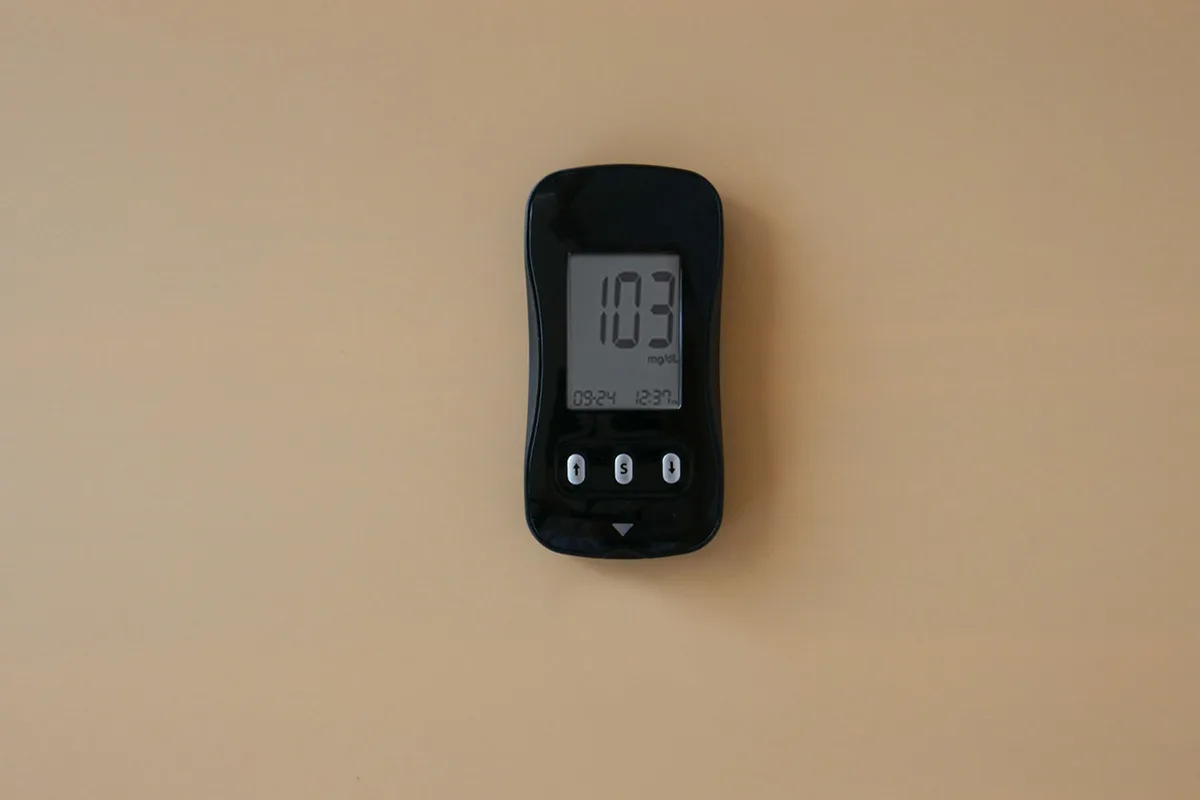
In women without diabetes, a blood sugar crash big enough to wake you is uncommon, and specialists say symptoms blamed on low glucose usually are not matched by low glucose. The better-documented link runs the other way: short sleep measurably worsens insulin sensitivity, including in postmenopausal women.
I have lost count of how many times I have read that the reason midlife women wake at three in the morning is a blood sugar crash. It is in the articles, the podcasts, the reels, the comment sections. It has the shape of a good explanation: something drops, your body panics, you wake up.
I believed it for a long time, and I ate a small bowl of oats before bed for months on the strength of it. Then I went looking for the study behind the claim, and what I found was not what I expected — not because the claim is silly, but because the arrow is pointing the wrong way.
Before we start: if you take insulin or a diabetes medication, this article is not about you. Overnight lows are real, documented and important in that situation, and nothing here should change how you manage them. Talk to whoever prescribes them.
Where does the "blood sugar crash at 3 AM" idea come from?
From diabetes medicine, where it is real. In people taking insulin or certain diabetes tablets, overnight lows genuinely happen and genuinely wake people. Menopause content borrowed the mechanism, dropped the medication, and applied it to everyone. The story is vivid, easy to explain, and mostly untested in women without diabetes.
You can see why it travelled so well. It comes with a satisfying chain of events: sugary dinner, insulin spike, glucose falls too far, the body releases adrenaline and cortisol to rescue it, and those stress hormones jolt you awake. Every link in that chain is a real physiological thing. The question is whether the chain actually assembles itself in a healthy woman's bedroom at three in the morning.
It also travelled well because it is actionable. "Eat differently" is something you can do tonight. "Your sleep is fragmenting because of a hormonal transition" is not. When an explanation offers a lever and the accurate one does not, the explanation with the lever wins, whether or not it is right.
Does low blood sugar actually wake you up?
It can, when it is genuinely low. In laboratory studies where blood sugar was deliberately dropped, most healthy volunteers woke up. But that is induced hypoglycemia, not what happens spontaneously in a healthy woman after dinner. Endocrine specialists require a documented low reading before accepting the diagnosis at all.
That last point is the one that changed my mind, and it deserves spelling out. The Endocrine Society's guidance is that you do not diagnose low blood sugar from symptoms. You diagnose it from something called Whipple's triad: symptoms that fit, a low glucose reading taken while those symptoms are happening, and relief once the glucose comes back up. All three, or it is not that.
Almost nobody who has been told their 3 AM waking is a sugar crash has ever had that middle step done. The reading is not taken. And when researchers have put continuous glucose monitors on people without diabetes, the overnight swings turn out to be modest — described in one study of healthy adults as small enough to be unlikely to matter functionally.
So the honest position is not "that never happens." It is: the thing being confidently described to you has, in your case, almost certainly never been measured, and when it is measured in people like you, it usually is not there.
The one test that costs nothing: a genuine low is relieved by eating, and fairly quickly — within about fifteen minutes. If you wake at three, eat something, and still lie there wide awake forty minutes later, glucose was probably not what woke you. That is not proof, but it is a much better clue than the internet has given you.
What does the evidence actually show?
That sleep moves glucose more reliably than glucose moves sleep. Restrict healthy people to four hours a night and glucose tolerance drops by about a third. In a trial run specifically in postmenopausal women, four nights of five-hour sleep cut insulin sensitivity by twenty percent.
The bigger literature has been saying this for twenty-five years. The landmark work from Van Cauter's laboratory in 1999 put healthy young men on four hours of sleep for six nights and found their glucose tolerance dropped into a range the researchers described as resembling early diabetes — in men who had been perfectly healthy the week before. Later work found sleep restriction impairs insulin signalling right down at the level of the fat cell.
Notice what that does to the popular story. It does not say food is irrelevant. It says that if you are looking for the thing in this picture with the strongest, most repeatable effect, it is not your dinner. It is the sleep itself.

What does menopause do to blood sugar?
It shifts the metabolic ground under you. Across the transition, body composition changes, fat redistributes toward the middle, and insulin sensitivity tends to fall independently of aging. SWAN also found that a later bedtime than usual tracked with more insulin resistance, which puts sleep timing right in the middle of this.
This is the part that makes the popular claim feel true, and it is worth being generous about. Something metabolic really is changing in midlife. Women really are more insulin resistant after the transition than before it. So when someone tells you your nights and your blood sugar are connected, they are not making that up.
Where it goes wrong is the leap from "these two things are related" to "this specific mechanism is waking you at a specific hour." That leap is the same one we ran into with magnesium and with vitamin D: a real association gets promoted into a precise causal story that nobody actually tested.
SWAN is also where the sleep half of this gets its numbers. Difficulty sleeping rises from roughly 30% of women before the transition to around 45% in late perimenopause. That is a very large number of women, all of whom are being offered the same tidy explanation.
So is it a loop, and where do you break in?
Probably yes, and you break in at sleep. If poor sleep worsens glucose control, and worse glucose control is uncomfortable, the two feed each other. But only one end of that loop has a treatment with strong evidence behind it, and it is not a diet — it is fixing the sleep.
I want to be careful here, because "it's a loop" can be a way of avoiding a recommendation. So let me be concrete about what that means in practice.
The treatment with the best evidence for chronic insomnia is CBT-I. It beats sleeping tablets in head-to-head trials, it holds up when compared against proper control conditions, and several formats cost nothing. If your nights have been broken for months, that is the intervention with the most behind it — not a change to your evening carbohydrates.
The other high-value move is unglamorous: a consistent bedtime. The SWAN finding on delayed bedtimes and insulin resistance points at timing, not just duration, and consistency is one of the few sleep behaviours that shows up repeatedly in metabolic data.
A fair warning about causation: the SWAN observations are associations, not experiments — women who go to bed late may differ in other ways. The sleep-restriction trials are experiments, which is why I lean on them for the direction of the arrow. I am telling you which parts of this are which, because most articles on this subject do not.
Does that mean your evening meal doesn't matter?
No — it matters, just not for the reason you were given. A very large or very late meal disturbs sleep through reflux, body temperature and digestion, and alcohol fragments the second half of the night. Those effects are well documented. They simply are not a glucose crash.
This distinction is worth more than it sounds, because it changes what you would fix. If you believe the problem is a sugar crash, you eat a bedtime snack. If the problem is actually reflux or a late heavy meal, a bedtime snack makes it worse. Same symptom, opposite action.
- Alcohol is the single best-evidenced dietary disruptor of the second half of the night, and its timing lines up almost perfectly with the 3 AM waking people blame on sugar. We cover the mechanism in alcohol and menopause sleep.
- Reflux rises in midlife and is worse lying down. If your waking comes with a sour taste, a cough or a burning chest, read menopause and acid reflux at night instead of this.
- Meal size and timing genuinely affect sleep, which is why what you put on your evening plate is still worth getting right — for digestion and temperature, not for a crash.
- A bedtime snack has no trial behind it for preventing night waking in women without diabetes. If it helps you, that is a perfectly good reason to keep it. Just don't expect it to fix something it was never shown to fix.

When is low blood sugar at night a real medical issue?
When you take medication that can lower it, or when the pattern is extreme. Insulin and sulfonylureas cause genuine overnight lows. So can the years after bariatric surgery. Drenching sweats with confusion, palpitations and relief the moment you eat deserve a proper test, not a diet change.
The specific things worth taking to a doctor rather than to a search engine:
- You take insulin, a sulfonylurea (glipizide, glyburide, gliclazide) or any medication you have been warned can cause lows.
- You have had gastric bypass or sleeve surgery — reactive lows can appear years afterwards and are genuinely documented in that group.
- Episodes involve confusion, slurred speech, or someone else noticing you were not making sense.
- Eating reliably fixes it within about fifteen minutes, every time, in a way that feels dramatic rather than comforting.
- You are losing weight without trying, or the episodes are getting more frequent.
If any of those fit, the useful thing is a glucose measurement during an episode — which is exactly the step the internet version of this story always skips.
One thing not to do: do not start skipping meals, cutting carbohydrates hard, or adding sugar at bedtime to manage a diagnosis nobody has confirmed. In midlife, under-eating in the evening is its own route to broken sleep, and a restrictive evening plan is a slow way to make the original problem worse.
Where to go from here
If you were sent here by advice about eating for better sleep, the Mediterranean diet and menopause sleep covers the whole-pattern version of that claim and how much of it holds up.
If the waking itself is what you want to solve, how to fall back asleep at 3 AM is the practical companion to this one. If it comes with heat, how to stay cool at night covers the far more likely explanation for a 3 AM waking in midlife.
For the treatment with the strongest evidence behind it, start with CBT-I for menopause insomnia. And if the exhaustion is the worst part, menopause fatigue takes it from the other end. If it's your actual diabetes risk you're trying to understand, rather than a single night's reading, menopause and diabetes covers what the longer-term research shows. For how everything fits together, begin at the complete perimenopause and menopause sleep guide.
Key takeaways
- The 3 AM blood sugar crash comes from diabetes medicine, where overnight lows are real — the mechanism was borrowed and applied to women who take no such medication.
- Endocrine specialists require a documented low glucose reading taken during symptoms before diagnosing hypoglycemia; post-meal symptoms without it are explicitly not caused by low glucose.
- In healthy adults wearing continuous monitors, overnight glucose swings are small enough to be unlikely to matter functionally.
- The reverse direction is far better evidenced: four nights of five-hour sleep cut insulin sensitivity by about 20% in postmenopausal women, and six nights of four-hour sleep dropped glucose tolerance by roughly a third in healthy adults.
- Menopause does shift metabolism — insulin sensitivity falls across the transition — which is why the claim feels true even where the specific mechanism is not established.
- Your evening meal still matters, through reflux, temperature, digestion and alcohol. Those are documented; a crash is not.
- Take it seriously if you use insulin or a sulfonylurea, have had bariatric surgery, or your episodes involve confusion and dramatic relief from eating.
Frequently asked questions
Does a blood sugar crash wake you up at 3 AM?
In women without diabetes it is uncommon. Endocrine specialists will not accept a diagnosis of low blood sugar unless a genuinely low reading is documented at the moment of symptoms, and in most people who blame night waking on glucose, that reading is never taken or comes back normal.
Can low blood sugar cause night sweats in menopause?
It can cause sweating, but so can a hot flash, and hot flashes are far more common in midlife women. The distinguishing feature of a true low is that eating relieves it within about fifteen minutes. If food makes no difference, glucose is unlikely to be the cause.
Does poor sleep affect blood sugar in menopause?
Yes, and this direction has much stronger evidence. In a crossover trial in postmenopausal women, four nights of five-hour sleep reduced insulin sensitivity by about twenty percent. Sleep restriction studies in healthy adults show glucose tolerance falling by roughly a third.
Should I eat a snack before bed to stop waking at 3 AM?
There is no good trial showing a bedtime snack prevents night waking in women without diabetes. It is unlikely to harm you, but if it helps, the reason may be routine rather than glucose. A large or very late meal is more likely to disturb sleep than protect it.
When is night-time low blood sugar a real medical problem?
When you take insulin or a sulfonylurea, in the years after bariatric surgery, or when episodes involve confusion, drenching sweats and rapid relief from eating. Those warrant a proper glucose measurement during an episode rather than a change to your diet.
Sources cited
- Cryer PE, Axelrod L, Grossman AB, et al. Evaluation and management of adult hypoglycemic disorders: an Endocrine Society clinical practice guideline. J Clin Endocrinol Metab. 2009;94(3):709–728. academic.oup.com
- Singh P, Beyl RA, Stephens JM, et al. Effect of sleep restriction on insulin sensitivity and energy metabolism in post-menopausal women: a randomized, crossover trial. Obesity (Silver Spring). 2023;31(5):1204–1215. pubmed.ncbi.nlm.nih.gov
- Spiegel K, Leproult R, Van Cauter E. Impact of sleep debt on metabolic and endocrine function. Lancet. 1999;354(9188):1435–1439. pubmed.ncbi.nlm.nih.gov
- Buxton OM, Pavlova M, Reid EW, Wang W, Simonson DC, Adler GK. Sleep restriction for 1 week reduces insulin sensitivity in healthy men. Diabetes. 2010;59(9):2126–2133. pubmed.ncbi.nlm.nih.gov
- Broussard JL, Ehrmann DA, Van Cauter E, Tasali E, Brady MJ. Impaired insulin signaling in human adipocytes after experimental sleep restriction: a randomized, crossover study. Ann Intern Med. 2012;157(8):549–557. acpjournals.org
- El Khoudary SR, Greendale G, Crawford SL, et al. The menopause transition and women's health at midlife: a progress report from the Study of Women's Health Across the Nation (SWAN). Menopause. 2019;26(10):1213–1227. pmc.ncbi.nlm.nih.gov

Ellen Hayes
Health & Wellness Writer and Researcher
Hi — I'm Ellen. I ate oats before bed for months because of this theory, and never once thought to ask whether anyone had measured it. Writing this was another lesson in how convincing a mechanism can sound when nobody has tested it.
I'm not a doctor. I'm not an expert — and I'm never going to talk down to you like one. I'm a woman in the middle of perimenopause who got tired of vague answers, started reading the actual research, and writes it down here in plain English, the way I'd explain it to a friend over coffee. More about Ellen →