Ramelteon for Menopause Insomnia: What Rozerem Can Do

You are tired enough to want bed, yet falling asleep takes much longer than it used to. A search brings up ramelteon, also sold as Rozerem, and the phrase "melatonin receptor agonist." It sounds familiar, but that does not tell you whether it fits your nights.
I compared the current prescribing information, patient guidance and a small study involving menopausal women. The useful distinction is between helping sleep begin and treating everything that can disturb sleep in midlife. This guide keeps those questions separate.
Ramelteon, sold as Rozerem, is a prescription melatonin receptor agonist for trouble falling asleep. It is not a melatonin supplement or hormone therapy. A small uncontrolled menopause study reported improvement, but cannot prove benefit. Interactions, liver disease and daytime drowsiness still matter, even though ramelteon is not a controlled substance.
Which sleep problem does ramelteon actually target?
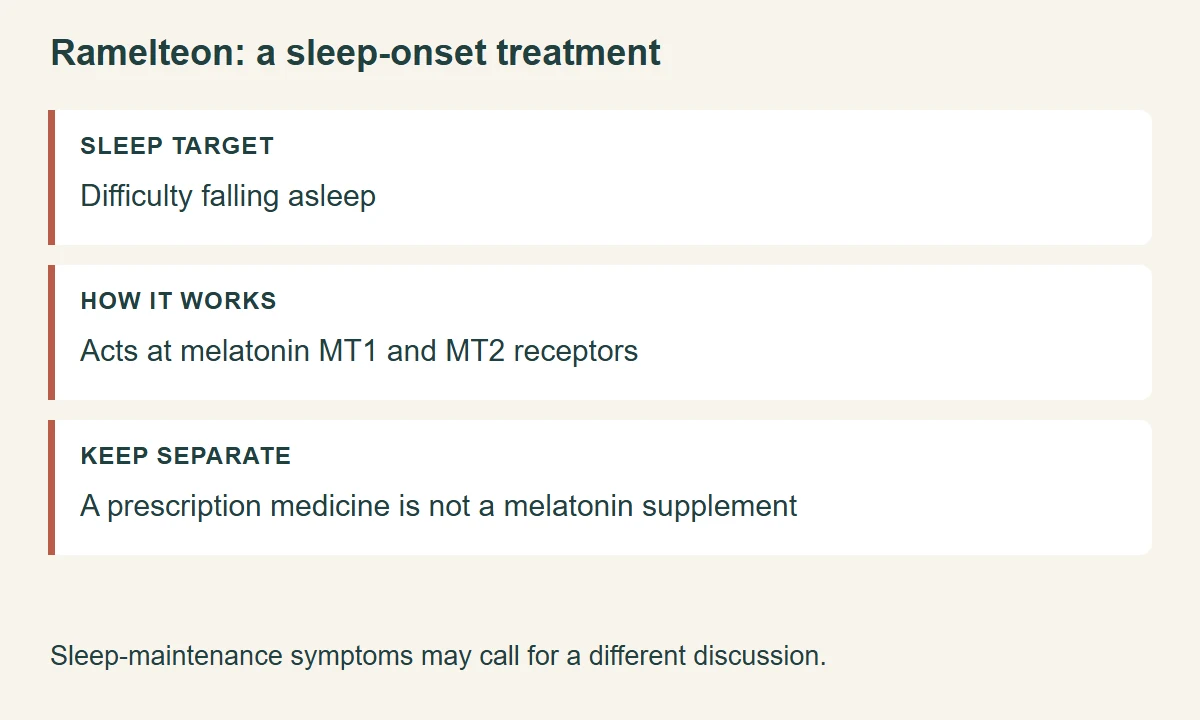
Ramelteon targets sleep-onset insomnia: difficulty falling asleep at the beginning of the night. Its indication does not promise to stop repeated awakenings or treat hot flashes. Describing when you are awake helps your clinician decide whether that target fits, rather than treating every midlife sleep complaint as the same problem.
MedlinePlus identifies ramelteon as a melatonin receptor agonist. That means it acts at receptors involved in the body's sleep signaling. The name describes a drug class, not a guarantee that the medicine will make sleep effortless.
For an appointment, try finishing this sentence: "My hardest part is ..." You might say falling asleep, returning to sleep after sweating, or staying awake enough the next morning. If more than one answer applies, say so. A description can be useful without becoming your own diagnosis.
A short record can include your approximate bedtime, when sleep seems to begin, any waking you remember and the following day's functioning. Estimates are enough for a starting conversation. You do not need to watch the clock all night to produce a convincing account of a real problem.
Our menopause insomnia guide covers that wider assessment. A medicine page answers a narrower question. Reading the two together can help you arrive with a clear account of your nights rather than only the name of a drug you found online.
How is Rozerem different from a melatonin supplement?
Rozerem contains ramelteon, a prescription medicine that acts at melatonin receptors. A melatonin supplement contains a different substance. They should not be treated as interchangeable products or compared milligram for milligram. Ask the pharmacist what was prescribed and whether any supplements already in your routine should change before starting it.
The Rozerem prescribing information describes action at MT1 and MT2 receptors. It is not estrogen, progesterone or a replacement for either. Calling it a hormone-balancing treatment would go beyond the medicine's indication.
| Question | Ramelteon or Rozerem | Why it matters |
|---|---|---|
| What is in the product? | Prescription ramelteon | It is not a bottle of supplemental melatonin. |
| What sleep target is labeled? | Difficulty with sleep onset | Match the target to the complaint. |
| Is it hormone therapy? | No | Discuss menopause symptoms separately. |
Before the appointment, take a photograph of every sleep product's ingredient panel. Two boxes can have similar names while containing different ingredients. A list that says only "night tablet" or "natural sleep pill" can leave the pharmacist guessing about what you actually use.
Our melatonin and menopause article addresses the supplement question. It is a separate discussion, not an invitation to combine products. If you have already tried a supplement, describe what you used and what happened without assuming that experience predicts a prescription's effects.
What did the study in menopausal women find?
A small six-week study of ramelteon in menopausal women reported improvements in sleep diaries and self-rated functioning. It was open-label and had no comparison group. Those limitations prevent a firm conclusion that ramelteon caused the changes. The study is a reason for further investigation, not proof that this medicine treats menopausal insomnia.
The abstract reports improvements in diary-recorded time to fall asleep, total sleep time and sleep efficiency, alongside several self-reported measures. I read the abstract, not the full study report. It does not establish that ramelteon corrects hormonal changes, treats hot flashes or works equally well for every woman in midlife.
When a study has no control group, an improvement can have more than one explanation. The design cannot separate a medicine's contribution from expectations, changes during follow-up or other influences. That is why the design deserves space next to the encouraging result, rather than being hidden in a footnote.
If the trial appears in advertising or a search summary, ask what was compared with what. "Studied in menopause" and "proved effective in a large randomized trial" are different statements. Keeping that distinction visible makes the evidence easier to discuss without dismissing it or overselling it.
How strong is the wider evidence for ramelteon?
The 2017 American Academy of Sleep Medicine guideline gives ramelteon a weak recommendation for adult sleep-onset insomnia. Its review judged the overall evidence very low quality and found modest average benefits. That is not a strong endorsement or a declaration of ineffectiveness. Individual preferences and clinical circumstances still shape the decision.
The AASM guideline's ramelteon section explains why uncertainty matters: studies differed, estimates were imprecise, and industry funding raised concern about publication bias. A recommendation's strength describes confidence in a treatment choice across patients; it does not forecast your personal response.
The same guideline identifies cognitive behavioral therapy for insomnia, or CBT-I, as a primary intervention for chronic insomnia. Our CBT-I guide explains the practical treatment. Asking about access to it is useful even when the immediate conversation is about a prescription.
A helpful comparison might start with three questions: what problem are we treating, what benefit would be meaningful to me, and what burden or risk am I prepared to accept? Your answers may differ from another person's. A modest average result can matter differently when a person's needs and circumstances differ.
It also helps to agree on the outcome before judging the medicine. "Sleep better" is understandable but broad. "Spend less time trying to fall asleep and feel able to function the next morning" gives the review a clearer purpose. It leaves room to notice an improvement that does not solve every difficulty.
What should you ask about timing, meals and the prescription?
The Rozerem label describes an adult dose of 8 mg within 30 minutes of bedtime, avoiding a high-fat meal immediately before it. MedlinePlus says to allow seven to eight hours for sleep. These are labeling details to review with your clinician, not directions to add doses or redesign an existing prescription.
Check the medicine name, strength and instructions on the pharmacy label against the plan you discussed. If anything seems inconsistent, ask before using it. A clear prescription is more useful than trying to reconstruct instructions from a search result, an old bottle or another person's experience.
Ask what to do about a missed dose and whom to contact with an uncertainty. Do not decide on an extra tablet because you remain awake. MedlinePlus advises swallowing the tablet whole. The pharmacist can explain the directions for your exact product, including questions about meals and the time available for sleep.
A brief written plan can prevent a lot of late-night guesswork. It might include the prescribed timing, the products you should avoid combining, the first review date and the contact route for side effects. Keeping that information together is more practical than relying on memory when you are already tired.
Who needs an especially careful medication and health review?
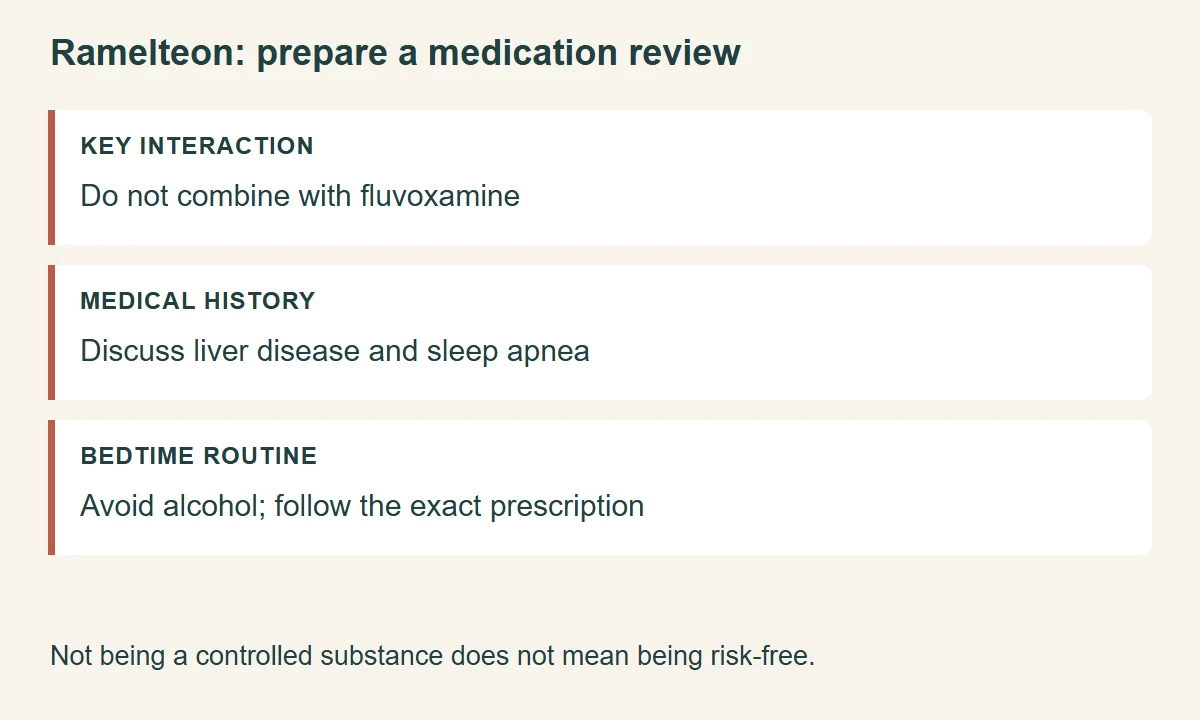
Ramelteon must not be combined with fluvoxamine. Liver disease, breathing problems, pregnancy, breastfeeding and a history of reactions to the medicine also need discussion. The label advises against use in severe hepatic impairment and severe sleep apnea. A pharmacist should check the complete medicine list, including occasional and nonprescription products.
Do not confuse fluvoxamine with similarly named medicines. Read the name from the container or provide the pharmacist with the complete list. An interaction is not necessarily solved by taking the products at different times, and stopping a regular medicine without advice can create a separate problem.
The prescribing information also flags other interactions, including with doxepin. Our doxepin guide is a comparison of a different medicine, not a combination plan. A list of possible options should not become a collection of products taken together when one night is difficult.
If several clinicians are involved in your care, ask who will reconcile the list. Include the reason you take each medicine if you know it, plus anything used only occasionally. Saying that an item is "only as needed" does not make it irrelevant to the safety check.
Tell the clinician about possible pregnancy or breastfeeding rather than assuming that the word perimenopause settles those questions. You can also ask what information would change the decision. The aim is a prescription based on your circumstances, not a checklist you must interpret alone.
Does being noncontrolled mean ramelteon has no important risks?
Ramelteon is not a controlled substance, but it can still cause drowsiness, dizziness and other adverse effects. Do not drink alcohol during treatment or drive until you know how it affects you. Unusual sleep activities, new behavior changes or possible allergic reactions require prompt action rather than assuming a noncontrolled medicine is harmless.
Patient guidance says to call your doctor right away after activities such as driving while partly asleep. The label also warns about behavioral changes. If someone tells you that you did something unusual overnight, include their account when contacting the prescriber instead of dismissing it because you do not remember.
For trouble breathing or swelling of the tongue or throat, seek emergency care. Ask the prescribing team in advance how they want other side effects reported. A prepared contact plan is easier to follow than deciding in the middle of the night which symptom deserves attention.
The label includes possible reproductive hormone effects, and patient guidance lists unexplained menstrual changes, nipple discharge and reduced sexual desire among symptoms to report. In midlife, it is worth bringing new symptoms to the clinician rather than automatically attributing every change to menopause.
Discuss the mornings as well as the nights. A shorter wait for sleep is not the only outcome that matters if you feel unsteady or unable to concentrate afterward. The person reviewing the prescription needs to hear about both benefit and difficulty, not only whether you managed to fall asleep.
How should you review whether the treatment is helping?
A ramelteon review should consider time to fall asleep, next-day functioning, adverse effects and whether the original sleep target still fits. MedlinePlus advises contacting the doctor if insomnia has not improved within seven to ten days or gets worse. Do not wait for a routine appointment when a serious reaction or immediate danger occurs.
Bring back the same simple observations you used at the start. Comparing entirely different measures can make a review harder: one week you count waking, another you track a device score, and another you remember only the worst night. Consistent notes can make it easier to explain the overall experience.
Include what remains unresolved. Perhaps falling asleep is easier but sweating still wakes you, or the nights are shorter yet the mornings feel worse. That does not tell you which change to make yourself. It tells the clinician which part of the original plan needs another look.
Our sleeping-pills comparison can help organize questions about other mechanisms. Read it as background for a discussion, rather than a ranking to work through independently. There is no need to arrive asking for the next medicine before reviewing what happened with the current plan.
Before leaving the review, ask how long the plan will continue and what the next check will cover. Make sure you understand whom to contact if circumstances change. A prescription can be one part of care, but it should come with a way to assess benefit, revisit the explanation and address the rest of your sleep concerns.
Where to go from here
Start with the menopause insomnia guide and CBT-I guide for the larger treatment plan. Our medicine comparison explains different sleep targets. For a sleep-maintenance discussion, read low-dose doxepin; for a different mechanism, see Dayvigo and lemborexant. These links explain options, not combinations.
Key takeaways
- Ramelteon and Rozerem refer to a prescription sleep-onset medicine, not a melatonin supplement.
- The menopause-specific study was a small uncontrolled pilot; it cannot establish a guaranteed treatment effect.
- The 2017 AASM recommendation is weak, with very low overall evidence quality in its ramelteon review.
- Fluvoxamine, liver disease, alcohol and morning alertness belong in the safety conversation.
- Ask about CBT-I, a clear prescription and a planned review rather than combining sleep products yourself.
Frequently asked questions
What is ramelteon used for?
Ramelteon is a prescription medicine for sleep-onset insomnia, meaning difficulty falling asleep. Rozerem is a brand name. Its indication does not promise relief from every cause of waking or from menopausal hot flashes. Describe your sleep pattern and daytime difficulties so a clinician can assess whether this target fits.
Is ramelteon the same as melatonin?
No. Ramelteon acts at melatonin receptors but is a different substance from supplemental melatonin. They should not be compared milligram for milligram or combined without advice. Bring supplement labels to the pharmacist, check the exact prescription and ask which existing products need review before you start the medicine.
Has ramelteon been studied in menopausal women?
Yes. A six-week open-label pilot enrolled twenty healthy perimenopausal and postmenopausal women with insomnia and reported improvements in sleep diaries and self-reports. There was no comparison group. The abstract supports describing a preliminary finding, not claiming that a randomized trial proved effectiveness or that the medicine treats hormonal changes.
Can I take ramelteon with fluvoxamine or alcohol?
Ramelteon must not be taken with fluvoxamine, and patient guidance advises avoiding alcohol during treatment. Other interactions also need checking. Give the prescriber and pharmacist your full list of medicines and supplements. Do not stop another medicine or try spacing products apart to manage an interaction on your own.
Can a noncontrolled medicine still cause daytime drowsiness?
Yes. Ramelteon is not a controlled substance, but drowsiness and dizziness can occur. Do not drive until you know how it affects you, and discuss any difficulty with morning alertness. The noncontrolled classification does not mean a medicine has no interactions, serious reactions or need for a careful prescription review.
When should I contact the prescriber about ramelteon?
Contact the doctor if insomnia does not improve within seven to ten days or worsens. Call promptly about unusual sleep activities or behavior changes. Seek emergency care for breathing difficulty or tongue or throat swelling. Ask for clear instructions about other side effects, missed doses and the timing of your next review.
Sources cited
- Rozerem prescribing information, updated April 15, 2026; relevant sections read — Read source
- MedlinePlus: Ramelteon, patient guidance read — Read source
- Dobkin et al., Ramelteon for the treatment of insomnia in menopausal women, 2009; abstract read — Read source
- Sateia et al., AASM pharmacologic guideline, 2017; ramelteon and treatment framework sections read — Read source

Ellen Hayes
Health & Wellness Writer and Researcher
I compare prescribing information and research so the differences are easier to discuss with a clinician. This article is a research summary, not a medical review or a personal treatment recommendation. About Ellen and the site.