OLLY Sleep for Menopause: What Each Gummy Really Contains

You know the 2 a.m. math: how many hours are left, and whether the little blackberry gummy in the bathroom cabinet is worth a try. OLLY Sleep is easy to find on US store shelves, and plenty of women in midlife are wondering about it.
I wanted to know exactly what is in it, so I read the labels for each version on OLLY's product pages and in the NIH's database, along with the research on every ingredient. Here is what I found, including what nobody has tested yet.
OLLY Sleep is a melatonin gummy that also contains L-theanine, chamomile, passionflower and lemon balm. The standard version has 3 mg of melatonin per two gummies; Extra Strength has 5 mg. I found no trial of any OLLY product in menopausal women, and the label says it is not intended to treat insomnia.
What is in OLLY Sleep, version by version?
OLLY makes several sleep products, and the amounts differ more than the names suggest. The standard OLLY Sleep gummy has 3 mg of melatonin per serving of two gummies, Extra Strength has 5 mg, and the Ultra Strength Sleep softgel label says 10 mg per two softgels. All three add L-theanine and the same three herbal extracts.
This table comes from the Supplement Facts panels on OLLY's own product pages, checked in November 2026, plus older entries in the NIH Dietary Supplement Label Database. Older bottles may still list 100 mg of L-theanine, so check the bottle you hold.
| Version (label source) | Melatonin | L-theanine | Botanical extracts | Serving |
|---|---|---|---|---|
| Sleep, Blackberry Zen gummy (OLLY.com label, Nov 2026) | 3 mg | 50 mg | Chamomile 17 mg, passionflower 17 mg, lemon balm 16 mg | 2 gummies |
| Sleep, Strawberry Sunset gummy (2023 database label) | 3 mg | 100 mg | Same three, same amounts | 2 gummies |
| Extra Strength Sleep gummy (OLLY.com label, Nov 2026) | 5 mg | 50 mg | Same three, same amounts | 2 gummies |
| Maximum Strength Sleep gummy (OLLY.com label, Nov 2026) | 10 mg | 100 mg | Same three, same amounts; sugar free | 2 gummies |
| Ultra Strength Sleep softgel (OLLY.com label, Nov 2026) | 10 mg per 2 softgels (5 mg each) | 100 mg | Same three, plus 150 mg magnesium | 2 softgels (start with 1) |
| Sleep Mochi Bites (OLLY.com label, Nov 2026) | 5 mg | None | Chamomile 30 mg, plus 100 mg magnesium | 2 bites |
| Relaxing Sleep fast-dissolve tablet, Apple Berry (2024 database label) | 3 mg | 50 mg | None listed | 1 tablet |
| Sleep fast-dissolve tablet, Strawberry (2023 database label) | 3 mg | None listed | Lemon balm 16 mg | 1 tablet |
The current Sleep and Extra Strength labels list two gummies per serving, with 10 to 15 calories, 3 to 4 g of carbohydrate and 2 g of sugars. The Ultra Strength softgel lists 10 mg of melatonin per two softgels, so one softgel is 5 mg, and the label says to start with one.
OLLY's sleep page lists 12 products. Two more show melatonin amounts on their current labels: Maximum Strength Sleep has 10 mg per two sugar-free gummies with 100 mg of L-theanine, and Sleep Mochi Bites have 5 mg per two bites with chamomile and magnesium. I have not covered the kids' or combination products.
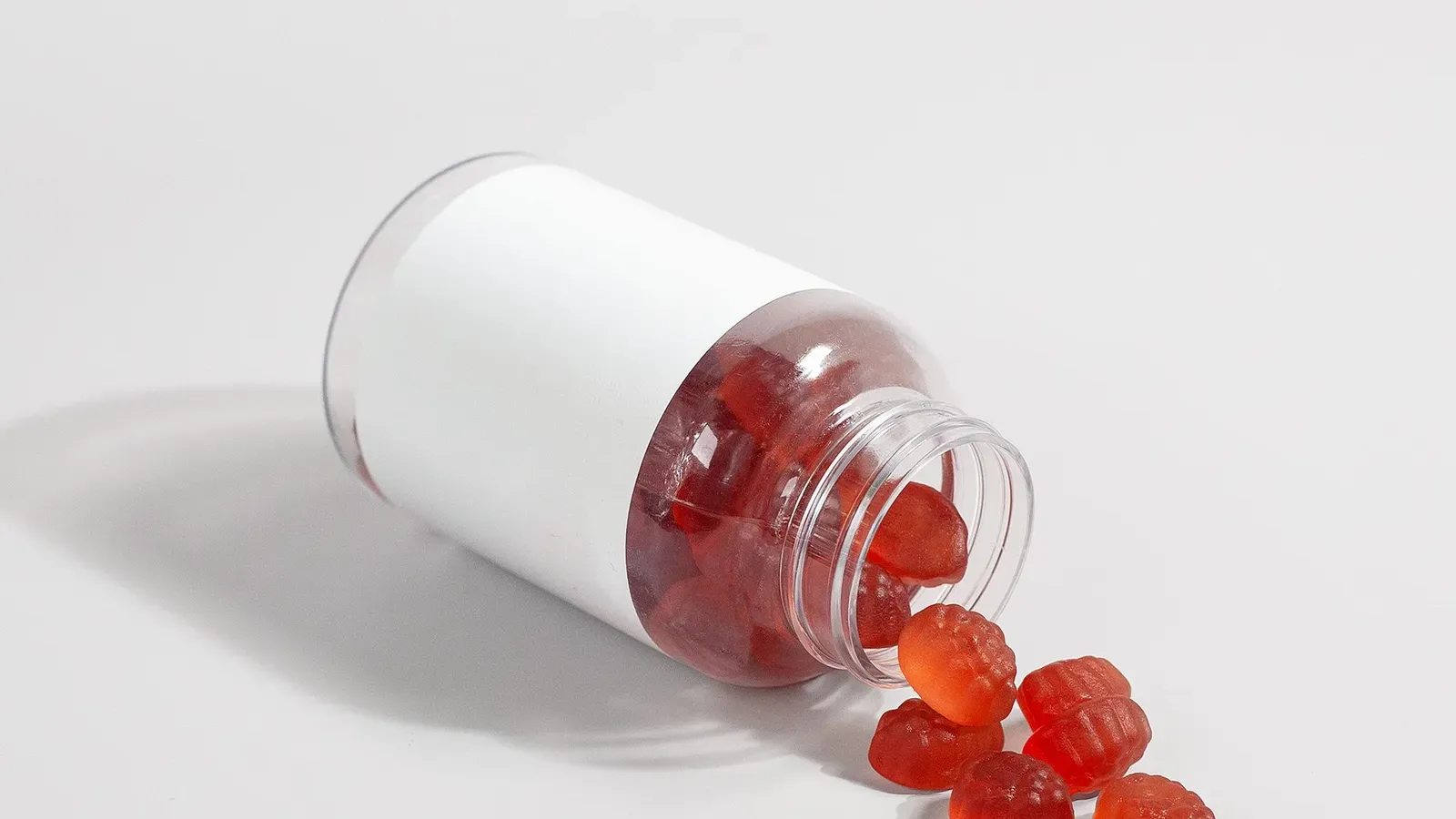
Is 3, 5 or 10 mg of melatonin the right amount?
No one has shown that 3, 5 or 10 mg is the right melatonin amount for menopause sleep. The American Academy of Sleep Medicine's 2017 guideline suggests clinicians not use melatonin to treat sleep onset or sleep maintenance insomnia, a weak recommendation. The NIH says safety information at doses above what the body makes is limited.
That does not mean melatonin does nothing. It means the research is thin for chronic insomnia, and the larger doses in these products have been studied even less. Our article on whether melatonin works for menopause insomnia goes through the menopause-specific evidence and dosing questions in detail.
One piece of label arithmetic: the Extra Strength gummy carries a bit under twice the melatonin of the standard one. If the standard version does not seem to do much for you, that is a question for your doctor or pharmacist, not a reason to jump straight to the highest dose.
What do L-theanine, chamomile, passionflower and lemon balm add?
L-theanine, chamomile, passionflower and lemon balm are OLLY's add-ons to melatonin, but the label amounts are small compared with doses used in studies. The standard and Extra Strength gummies list 50 mg of L-theanine, 17 mg of chamomile extract, 17 mg of passionflower extract and 16 mg of lemon balm extract per serving of two.
L-theanine has the best support of the four. A 2026 systematic review of 13 trials (550 people) concluded that 200 to 450 mg a day appears safe and effective for supporting healthy sleep in adults. A four-week crossover trial in 30 adults (average age 48) used 200 mg a day, and sleep-quality scores improved after L-theanine. The standard and Extra Strength gummies' 50 mg is a quarter of the lowest dose in that range; Maximum Strength's 100 mg is half. Our L-theanine guide covers it more closely.
Chamomile is weaker. In a pilot trial of 34 adults with chronic insomnia, 270 mg of a standardized chamomile extract twice daily for 28 days did not produce significant differences in sleep diary measures compared with placebo. The extracts are not identical, so the numbers are not directly comparable, but OLLY's 17 mg is far below that.
Lemon balm has one menopause-specific trial, and it tested a combination. In 100 women aged 50 to 60 with sleep problems, a valerian and lemon balm product reduced sleep disorder scores compared with placebo. Because valerian was part of it, it cannot tell us what lemon balm alone does, and OLLY contains no valerian. See our lemon balm article for more.
Passionflower has mostly been studied for anxiety. A systematic review of nine trials, lasting from one day to 30 days, found that most reported reduced anxiety, with the effect less evident in people with mild anxiety. A separate 2020 review of plant extracts for sleep described evidence for each product as scarce.
Does a gummy contain what the label says?
Not always, for melatonin gummies as a category. A 2023 JAMA research letter tested 25 melatonin gummy products and, as the NIH summarizes, 22 of 25 were inaccurately labeled, with melatonin from 74% to 347% of the labeled amount. Only 3 of 25 were within 10% of the label, per Confectionery News; industry disputed the standard.
The NIH's own page on melatonin makes a similar point, noting that in one 2017 test of 31 supplements, most had melatonin amounts that did not match their labels. I could not read the full JAMA letter, so I cannot tell you whether OLLY was among the products tested, and I would not assume it was or was not.
OLLY's product pages show an NSF Certified badge, including on Extra Strength, though an older Extra Strength label in the NIH database showed only a B Corporation seal. I did not check NSF's own listings.
Has OLLY Sleep been studied in menopause?
I did not find a published trial of OLLY Sleep, or any OLLY product, in menopausal women. The ingredient evidence comes from other groups, and from tablets or extracts that are not the same as the gummy. That does not mean it cannot help you, only that nobody has measured it in women like you.
Midlife sleep problems also have causes a supplement does not touch, such as night sweats, anxiety, sleep apnea and restless legs. The OLLY label itself says the product is for occasional sleeplessness and is not intended to treat insomnia or other sleep disorders.
If you have trouble sleeping most nights, the NIH notes that American College of Physicians guidelines strongly recommend cognitive behavioral therapy for insomnia (CBT-I) as an initial treatment. Our CBT-I guide explains what that involves, and our sleeping pills article covers the prescription options.
Who should not take OLLY Sleep without checking first?
Several groups should not start OLLY Sleep without asking a clinician. The label says that if you have a medical condition, take medication, or are pregnant or nursing, seek advice from a qualified health care professional first. It also says the product is not intended for children and should not be taken when driving or operating machinery.
- Blood thinners or epilepsy: the NIH says people taking blood thinners or who have epilepsy need medical supervision with melatonin.
- Pregnancy or breastfeeding: the NIH notes a lack of research on melatonin safety in pregnant or breastfeeding women. Pregnancy is still possible in perimenopause, so this matters if your periods are irregular but not over.
- Other sleep aids and sedating medicines: I found no OLLY-specific data, but our guide to combining supplements and our article on ZzzQuil explain why stacking sleep products is worth a pharmacist's review.
- Allergies: the gummy labels say they are processed in a facility that may handle soy, egg, peanuts, tree nuts, milk, fish, shellfish, wheat and sesame, and the fast-dissolve tablets list wheat.
What are the possible side effects of OLLY Sleep?
The OLLY label warns that melatonin may cause drowsiness or sleepiness. The NIH says a 2015 review found only mild effects in short-term studies, including headache, dizziness, nausea and sleepiness, and that long-term effects are unclear. I did not find good data on side effects of the herbal extracts at these small label amounts.
Practical cautions from the label: do not drive or operate machinery after taking it, take it only as directed, and do not exceed the suggested use. The suggested use for the gummies is two, 30 minutes before bed, chewed thoroughly.
Talk to your doctor if...
Talk to your doctor or pharmacist before using OLLY Sleep if any of these are true for you. They can check your medicines and help work out why you are not sleeping, which a gummy cannot do. Bring the bottle so they can read the Supplement Facts.
- You take prescription medicines, especially blood thinners, seizure medicines, or any sedating drug.
- You are pregnant, trying to become pregnant, breastfeeding, or still having periods that could mean pregnancy.
- You have trouble sleeping most nights for more than a few weeks, or snore loudly or stop breathing in your sleep.
- You feel groggy, dizzy or foggy the next morning after taking it.
- Your sleep trouble comes with low mood, anxiety or night sweats that soak the sheets.
How should you think about choosing a sleep gummy?
Treat any sleep gummy as a short experiment, not a plan. Read Supplement Facts rather than the front label, ask your doctor which melatonin amount makes sense for you, and notice whether it changes anything. If it does not, the next step is a conversation, not a higher dose.
Where to go from here
If you are weighing the whole category, our herbal supplements for menopause sleep guide and our menopause supplements overview put these ingredients in context. For the wider picture, start with the complete sleep guide and our article on hot flashes.
Key takeaways
- It is melatonin plus extras: OLLY Sleep has 3 mg, Extra Strength 5 mg, and Maximum Strength and the Ultra softgel 10 mg per two, with 50 to 100 mg of L-theanine and small amounts of three herbs.
- The add-ons are small: label amounts of L-theanine, chamomile and lemon balm sit below the doses used in the studies I found.
- Not tested in menopause: I found no trial of an OLLY product in menopausal women, and the label says it is not for treating insomnia.
- Check before you start: blood thinners, epilepsy, pregnancy and other medicines are reasons to ask a professional first.
- Persistent insomnia needs more than a gummy: the NIH points to guidelines that strongly recommend CBT-I first.
Frequently asked questions
Does OLLY Sleep contain melatonin?
Yes. On the current label on OLLY's product page, OLLY Sleep has 3 mg of melatonin per serving of two gummies. OLLY Extra Strength Sleep has 5 mg, and the Ultra Strength Sleep softgel label says 10 mg per two softgels. Each also lists L-theanine, chamomile, passionflower and lemon balm.
How much melatonin is in OLLY Sleep Extra Strength?
The Extra Strength Sleep label lists 5 mg of melatonin per serving of two gummies. It also says that OLLY Extra Strength Sleep has 5 mg of melatonin per serving, compared with 3 mg in OLLY Sleep. The L-theanine and the three botanicals are listed at the same amounts in both versions.
Is OLLY Sleep safe to take every night?
The label says it is for occasional sleeplessness and to take it only as directed, so nightly use is not what it describes. The NIH says short-term melatonin use appears safe for most people, while long-term safety information is lacking. If you want to use it often, ask your doctor first.
Can I take OLLY Sleep with other medicines?
The OLLY label tells people on medication to ask a qualified health care professional first. The NIH adds that people taking medicine should consult their provider before using melatonin, and that people on blood thinners or with epilepsy need medical supervision. I found no OLLY-specific interaction data, so ask a pharmacist or doctor to check your list.
Has OLLY Sleep been tested in menopausal women?
I did not find any trial of an OLLY product in menopausal women. The research behind the ingredients is separate: small trials of L-theanine, chamomile and a valerian and lemon balm combination, plus general melatonin evidence. Whether this exact gummy helps midlife sleep has not been shown in a published study I could find.
Will OLLY Sleep help with night sweats or 3 a.m. waking?
The label does not claim it will. It says the product is not intended to treat insomnia or other sleep disorders, and it does not mention hot flashes. If heat or sweating is what wakes you, that cause deserves attention first, and your doctor can help you sort out what is waking you at night.
Sources cited
- OLLY Sleep Blackberry Zen label (entry 310256, 2024), NIH Dietary Supplement Label Database. dsld.od.nih.gov
- OLLY Extra Strength Sleep Blackberry Zen label (entry 315980, 2024), NIH Dietary Supplement Label Database. dsld.od.nih.gov
- OLLY Ultra Strength Sleep softgel label (entry 291376, 2023), NIH Dietary Supplement Label Database. The Strawberry Sunset (291292), Relaxing Sleep Apple Berry (303971) and Sleep Strawberry fast-dissolve (303972) entries are in the same database. dsld.od.nih.gov
- OLLY. Sleep products page. olly.com
- OLLY. Extra Strength Sleep product page, Supplement Facts. olly.com
- OLLY. Ultra Strength Sleep softgels product page, Supplement Facts. olly.com
- OLLY. Maximum Strength Sleep product page, Supplement Facts. olly.com
- OLLY. Sleep Mochi Bites product page, Supplement Facts. olly.com
- National Center for Complementary and Integrative Health. Melatonin: What You Need To Know. nccih.nih.gov
- Sateia MJ, Buysse DJ, Krystal AD, Neubauer DN, Heald JL. Clinical practice guideline for the pharmacologic treatment of chronic insomnia in adults: an American Academy of Sleep Medicine clinical practice guideline. J Clin Sleep Med. 2017;13(2):307-349. pmc.ncbi.nlm.nih.gov
- Cohen PA, Avula B, Wang YH, Katragunta K, Khan I. Quantity of melatonin and CBD in melatonin gummies sold in the US. JAMA. 2023;329(16):1401-1402 (figures from a Confectionery News summary). confectionerynews.com
- Cotter J, Caddick CE, Harper JL, Ebajemito JK. Examining the effect of L-theanine on sleep: a systematic review of dietary supplementation trials. 2026. europepmc.org
- Hidese S, Ogawa S, Ota M, et al. Effects of L-theanine administration on stress-related symptoms and cognitive functions in healthy adults: a randomized controlled trial. 2019. pubmed.ncbi.nlm.nih.gov
- Zick SM, Wright BD, Sen A, Arnedt JT. Preliminary examination of the efficacy and safety of a standardized chamomile extract for chronic primary insomnia: a randomized placebo-controlled pilot study. 2011. pmc.ncbi.nlm.nih.gov
- Taavoni S, Nazem Ekbatani N, Haghani H. Valerian/lemon balm use for sleep disorders during menopause. 2013. pubmed.ncbi.nlm.nih.gov
- Janda K, Wojtkowska K, Jakubczyk K, et al. Passiflora incarnata in neuropsychiatric disorders: a systematic review. 2020. pmc.ncbi.nlm.nih.gov
- Guadagna S, Barattini DF, Rosu S, Ferini-Strambi L. Plant extracts for sleep disturbances: a systematic review. 2020. pmc.ncbi.nlm.nih.gov
How this article was checked
The Supplement Facts amounts, directions and warnings are taken from the Supplement Facts panels on OLLY's product pages (November 2026) and older NIH Dietary Supplement Label Database entries. The melatonin guidance comes from NCCIH and the 2017 AASM guideline (recommendation text). The L-theanine, chamomile, lemon balm and passionflower studies were read as abstracts only, and the JAMA gummy study was read only through a trade-press summary. There are no affiliate links in this article.
It has not been reviewed by a clinician. Ellen Hayes is a researcher and writer, not a doctor, and nothing here is a diagnosis or a substitute for being seen by one.

Ellen Hayes
Health & Wellness Writer and Researcher
Hi — I'm Ellen. Before I form an opinion on a sleep supplement, I want to read its actual label and see what has been tested. This time I was surprised how much the versions differ, and how little anyone has studied them in women our age.
I'm not a doctor. I'm not an expert — and I'm never going to talk down to you like one. I'm a woman in the middle of perimenopause who got tired of vague answers, started reading the actual research, and writes it down here in plain English, the way I'd explain it to a friend over coffee. More about Ellen →