L-Theanine for Sleep in Menopause: Does It Really Work?
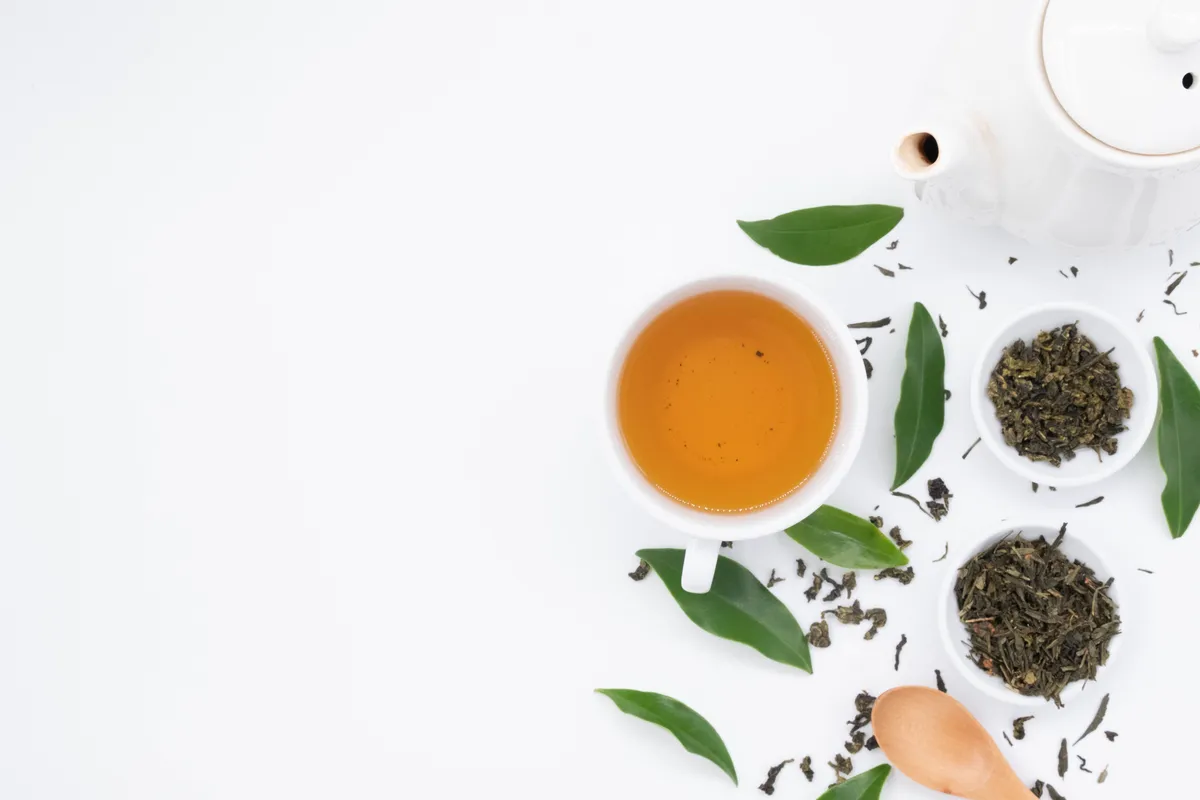
L-theanine is an amino acid from tea leaves that promotes calm without sedation. A 2025 review of 13 trials found 200 to 450 mg a day improved sleep quality and how rested people felt. No study has tested it in menopausal women specifically, so treat it as promising and low-risk — not proven for this.
I bought my first bottle for the least scientific reason imaginable: it was sitting on the shelf next to the magnesium, the label said "calm," and I was tired enough to try anything with that word on it. I took it for three weeks, decided it did nothing dramatic, and put it in the drawer with everything else.
Then I actually read the research, and realized I'd judged it against the wrong standard. I'd been waiting to feel sleepy. That isn't what this one does — and understanding what it does instead is the difference between "useless" and "quietly useful on the right kind of night."
What is L-theanine, and what does it do?
It's an amino acid found almost exclusively in tea leaves, and it produces calm without drowsiness. It crosses into the brain and increases alpha wave activity — the electrical pattern of a mind that's awake but settled, the state you're in while daydreaming. It also nudges the calming neurotransmitters GABA and serotonin.
That combination is unusual, and it explains the odd reputation tea has: the caffeine wakes you up while the theanine takes the jagged edge off. Researchers describe the effect as "relaxed alertness," which sounds like marketing until you notice it's exactly what a racing bedtime brain lacks. You're exhausted and wired — the same paradox behind midlife fatigue that flips at bedtime.
Does L-theanine actually help you sleep?
The evidence is genuinely encouraging and genuinely thin — both are true. A 2025 systematic review in Nutritional Neuroscience gathered every human trial of it alone and concluded that 200 to 450 mg daily appears a safe, effective way to support sleep in adults. But 13 trials totalling 550 people is a small body of evidence.
The single trial I find most relevant is smaller but closer to home. In 2019, Japanese researchers gave 30 healthy adults either 200 mg of L-theanine or a placebo daily for four weeks, then crossed them over. Sleep quality scores improved on theanine — specifically the components covering how long people took to fall asleep, how disturbed their nights were, and how often they reached for sleep medication.
Why that one matters here: the participants averaged 48 years old and 21 of the 30 were women. That is almost exactly the reader of this site. It's still a small crossover study in healthy adults rather than a menopause trial, and I won't pretend otherwise — but it's a far better match than most supplement research we get to look at.
Why might it suit menopause insomnia in particular?
Because the classic midlife wake-up is an anxious one, not a drowsy-deprived one. Many women fall asleep fine and then surface at 3 a.m. with a mind already running — a state driven by cortisol and adrenaline rather than lack of sleepiness. A compound that lowers arousal without sedating targets that specific problem more precisely than a sleeping pill does.
It also sits comfortably alongside the things that actually treat the root causes. It won't touch a hot flash, it won't replace hormones, and it certainly won't fix a sleep schedule in chaos. What it may do is take the edge off the anxiety loop that keeps you awake once you've woken — which, for a lot of us, is the part that turns a five-minute waking into two hours.
| If your problem is… | The better-matched option |
|---|---|
| A mind that won't stop spinning at bedtime or at 3 a.m. | L-theanine — calm without sedation |
| Body clock out of step: sleepy too late, awake too early | Melatonin — a timing signal, not a sedative |
| Restless legs, cramps, tension, low dietary intake | Magnesium — if you're actually low |
| Hot flashes and night sweats doing the waking | Cooling and vasomotor strategies first |
Can you get enough from drinking tea?
Honestly, no — and this is where the marketing quietly misleads. A cup of green tea delivers somewhere around 6 to 25 mg of L-theanine, depending on the leaf and how you brew it. To reach the 200 mg used in studies you'd need many cups, and you'd be drinking a substantial dose of caffeine along with them.
That doesn't make tea pointless. An unhurried cup in the evening is a genuine wind-down ritual, and rituals matter more than we credit. But if you're hoping for the effect the trials measured, that dose lives in a capsule. And if you're drinking green tea after mid-afternoon for its calming reputation, remember what else is in it — our piece on caffeine and menopause sleep explains why that cut-off time matters more now than it did at 30.
How much do you take, and when?
Trials that found a benefit mostly used 200 to 400 mg once a day, and the sleep studies typically had people take it 30 to 60 minutes before bed. Starting at 200 mg is sensible. Because the effect is calm rather than sedation, doubling the dose doesn't make you sleepier — it just makes the bottle empty faster.
A few practical notes from the research and from pharmacists' guidance:
- Timing is flexible. Some people take it in the evening for sleep; others use it during the day for stress. It doesn't need to be at night to work on anxiety.
- Give it more than one night. The trials ran four weeks or longer. A single dose tells you about tolerability, not effect.
- Buy it plain. Many "sleep formulas" bundle theanine with melatonin, valerian and more — if it works you won't know what worked, and if you react badly you won't know to what.
What are the side effects and interactions?
It's one of the better-tolerated things in this category. Trials lasting weeks report few adverse effects, and unlike sedatives there's no dependency, no next-morning hangover, and no evidence it flattens sleep architecture. Headache and mild digestive upset turn up occasionally, usually at higher doses.
Check with a doctor or pharmacist first if you: take blood pressure medication (L-theanine may lower blood pressure modestly), take sedatives, anti-anxiety medication or stimulants, are pregnant or breastfeeding, or are already taking a multi-ingredient sleep formula. "Natural" is not the same as "no interactions," and supplements aren't regulated the way medicines are.
One more caution that applies to this whole shelf: supplement quality varies enormously, and what's on the label isn't guaranteed to be in the bottle. Look for a product carrying independent third-party testing — and treat any product promising to "cure" menopause insomnia as a reason to put it back down.
My honest verdict after reading everything: L-theanine is a reasonable thing to try and a poor thing to pin your hopes on. It's cheap, it's safe, the evidence is real but modest — and it works on the anxious edge of insomnia, not on insomnia itself.
Where to go from here
If a spinning mind is the thing keeping you awake, the highest-value read isn't about a supplement at all — it's CBT-I, which outperforms medication over the long run, and the insomnia-anxiety loop. To place any supplement inside the bigger picture, start with the complete perimenopause and menopause sleep guide, and compare the shelf honestly using what the herbal options really do and whether ashwagandha helps.
Key takeaways
- L-theanine is an amino acid found almost only in tea leaves; it raises calming alpha brain waves and produces relaxation without sedation.
- A 2025 review of 13 trials in 550 adults concluded 200–450 mg daily is a safe and reasonable way to support sleep — while noting inconsistent results and impure products.
- A 2019 crossover trial of 200 mg for four weeks improved sleep quality scores; its participants averaged 48 years old and were mostly women, which is unusually close to this audience.
- No trial has tested L-theanine in menopausal women specifically, so it's promising and low-risk rather than proven for menopause insomnia.
- Green tea gives roughly 6–25 mg per cup, so reaching a studied dose by drinking tea would mean far too much caffeine.
- It suits the anxious, wide-awake-at-3-a.m. type of insomnia — not hot flashes, and not a body clock that's out of step.
Frequently asked questions
Does L-theanine help you sleep during menopause?
It may help you fall asleep more easily, though no trial has tested it in menopausal women specifically. A 2025 review of 13 studies found 200 to 450 mg daily supported sleep quality and how refreshed people felt on waking. It calms an active mind rather than sedating you.
How much L-theanine should I take for sleep?
Studies that found a benefit generally used 200 to 400 mg once daily, often taken 30 to 60 minutes before bed. Start at the lower end. Higher doses have not proven better for sleep, and because it is not sedating, more does not translate into feeling sleepier.
Can I get enough L-theanine from drinking green tea?
Realistically, no. A cup of green tea provides roughly 6 to 25 mg, so reaching a studied dose would mean drinking many cups, along with all their caffeine. Tea is a lovely calming ritual, but the amounts used in sleep research come from supplements, not the teapot.
Does L-theanine make you drowsy the next day?
It usually does not. L-theanine promotes a relaxed but alert state rather than sedation, which is why it is studied for daytime stress as well as sleep. Most people report no morning grogginess, though anyone starting something new should see how they respond before driving.
Is L-theanine safe to take every night?
Trials up to several weeks report few side effects, and it is generally well tolerated. Caution is warranted if you take blood pressure medication, sedatives, or stimulants, or if you are pregnant or breastfeeding. Check with your doctor or pharmacist before adding it to existing medication.
Sources cited
- Examining the effect of L-theanine on sleep: a systematic review of dietary supplementation trials. Nutritional Neuroscience. 2025. pubmed.ncbi.nlm.nih.gov
- Hidese S, Ogawa S, Ota M, et al. Effects of L-theanine administration on stress-related symptoms and cognitive functions in healthy adults: a randomized controlled trial. Nutrients. 2019;11(10):2362. pubmed.ncbi.nlm.nih.gov
- Rao TP, Ozeki M, Juneja LR. In search of a safe natural sleep aid. J Am Coll Nutr. 2015;34(5):436–447. pubmed.ncbi.nlm.nih.gov
- National Center for Complementary and Integrative Health (NIH). Green tea. nccih.nih.gov
- Sleep Foundation. L-theanine and sleep. sleepfoundation.org
- Mayo Clinic. Dietary supplements: what to know before you buy. mayoclinic.org

Ellen Hayes
Health & Wellness Writer and Researcher
Hi — I'm Ellen. I have a drawer of half-finished supplement bottles that could probably fund a small holiday, and this one lived in it for a while before I understood what it was actually for.
I'm not a doctor. I'm not an expert — and I'm never going to talk down to you like one. I'm a woman in the middle of perimenopause who got tired of vague answers, started reading the actual research, and writes it down here in plain English, the way I'd explain it to a friend over coffee. More about Ellen →