Dayvigo for Menopause Insomnia: Evidence and Safety

Dayvigo has something many sleep prescriptions do not: a published analysis focused on women in midlife. That makes it relevant to a menopause sleep conversation. It does not mean the medicine treats hot flashes, or that every result in that analysis was better than placebo.
I compared the study abstract with the current US prescribing information and sleep-treatment guidance. The useful questions are what improved, how strong that comparison was, and which warnings still apply when a medicine works differently from older sleeping pills.
Dayvigo, the brand name for lemborexant, treats adult insomnia involving difficulty falling asleep or staying asleep. A study subgroup included women aged 40 to 58, but its findings do not establish hot-flash treatment. Narcolepsy, other medicines, alcohol, next-day impairment and unusual sleep behaviors require careful review before use with a clinician.
What is Dayvigo, and which sleep problems does it treat?
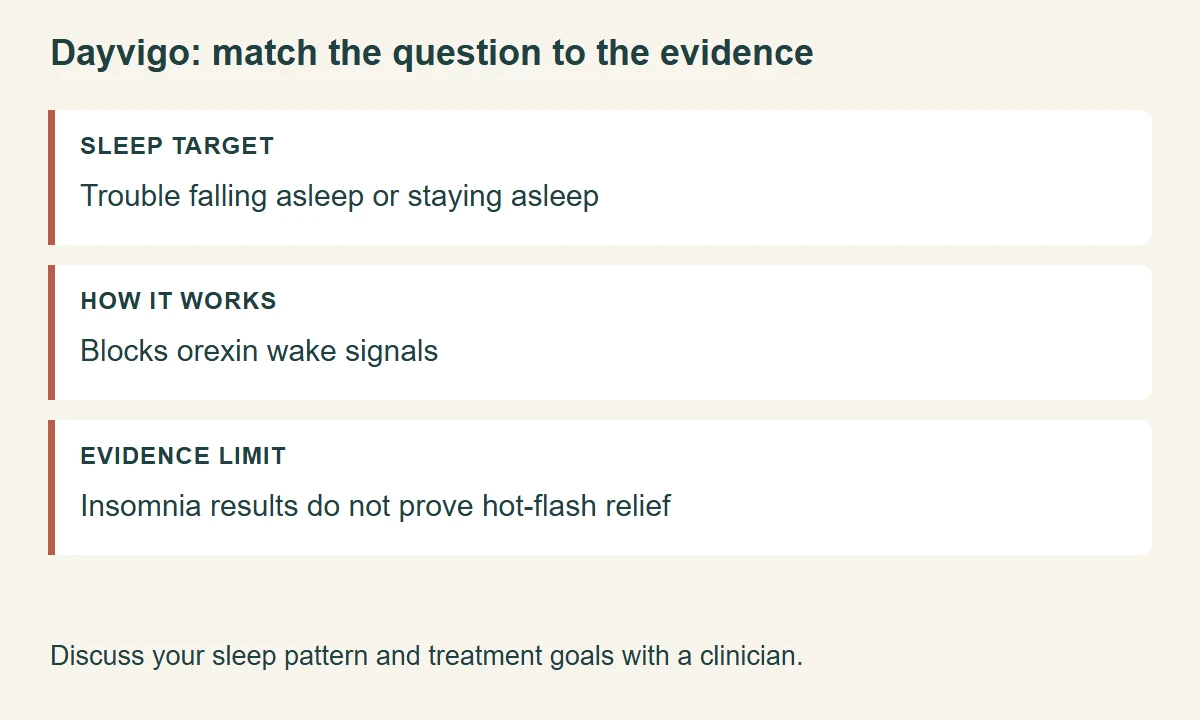
Dayvigo is a prescription medicine containing lemborexant, an orexin receptor antagonist for adult insomnia. Its US indication includes difficulty falling asleep, staying asleep, or both. It is not estrogen, progesterone or a melatonin supplement. The first question is whether that insomnia target matches the nights you want help with.
The Dayvigo prescribing information describes blocking orexin receptors involved in wakefulness. This mechanism differs from that of a medicine such as zolpidem. A different mechanism is not a promise of fewer side effects for a particular person, and it does not replace a medication review.
Try describing the problem without naming a product first. Do you lie awake before sleep, wake for long stretches, or wake earlier than planned? Do symptoms change with sweating or an irregular schedule? The answers help organize a consultation without assuming that a brand name explains the cause.
Our menopause insomnia guide covers that broader assessment. Bring the main pattern and its daytime effects to the appointment. The point is to decide what needs attention, rather than to work backward from a prescription mentioned online.
What did the study in midlife women actually find?
A published SUNRISE-2 subgroup analysis included 280 women aged 40 to 58 with insomnia. Some sleep measures improved, but not every comparison with placebo was statistically significant. The analysis is relevant to midlife insomnia; it should not be presented as proof that Dayvigo treats menopause itself or works equally well for everyone.
At six months, the 10 mg group had a statistically significant improvement versus placebo in reported time to fall asleep; the 5 mg comparison was not significant. Reported time awake after sleep onset improved from baseline, but neither dose differed significantly from placebo for that outcome in this subgroup.
I read the abstract, not the full study report. The subgroup was defined by age and sex, so this summary does not classify every participant by menopausal stage. Several authors were manufacturer employees. These details matter when interpreting encouraging findings without turning them into a personal prediction or a claim about hormonal symptoms.
Does Dayvigo treat hot flashes or replace menopause treatment?
Dayvigo is an insomnia treatment, not hormone therapy or an approved treatment for menopausal hot flashes. A sleep study involving midlife women does not establish that sweating or vasomotor symptoms improved. Discuss insomnia and accompanying symptoms separately so a sleep prescription does not become a substitute for assessing the reason you wake.
For example, the questions “Am I staying awake less?” and “Are my hot flashes less frequent?” describe different outcomes. It is reasonable to ask which one the proposed treatment is intended to change. An improvement in the first would not automatically answer the second.
Keep a short description of what accompanies waking: sweating, discomfort, bathroom trips, worry, or a partner's report of snoring. You do not have to decide the diagnosis yourself. The list gives the clinician a clearer starting point than describing every difficult night as the same problem.
The site's articles on hormone therapy and sleep and menopausal hot flashes address those separate conversations. If your question is about treating hormonal symptoms, say that directly at the appointment rather than assuming the sleep prescription covers them.
What do the dose, bedtime and meal instructions mean?
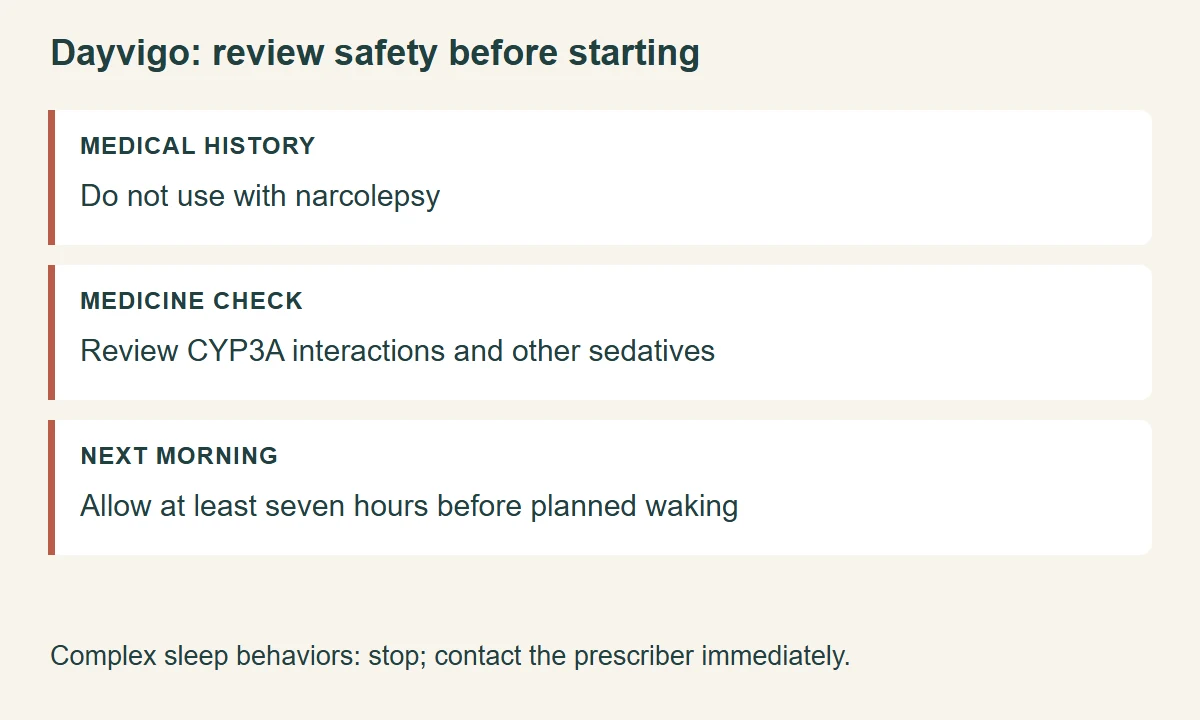
The US label recommends Dayvigo 5 mg immediately before bed, no more than once nightly, with at least seven hours before planned waking. Any increase belongs to the prescriber. Taking it with or soon after food may delay its effect. These instructions describe the label; they do not determine your individual prescription.
The maximum labeled dose is 10 mg, but certain interactions or liver conditions change what is appropriate. A higher number in a study is not an instruction to increase a prescription. If the pharmacy directions differ from what you expected, ask the pharmacist to clarify before taking it.
MedlinePlus reinforces the need to go to bed immediately and allow at least seven hours afterward. Ask how to handle a missed bedtime dose. An early alarm, nighttime caregiving responsibility or late meal is worth mentioning before the first night.
A useful plan is one you can follow on the nights you actually have, including workdays. Ask what to do if you are still awake after taking it, rather than adding another dose or another sleep product. Keep those instructions with the medication guide so you are not trying to reconstruct them while tired.
Who needs a careful conditions and interactions check?
Dayvigo must not be used in people with narcolepsy. A clinician also needs to review breathing disorders, liver disease, mental-health history, pregnancy or breastfeeding and the complete medication list. CYP3A interactions can change the plan. Having insomnia during menopause does not remove any of these safety questions or establish personal suitability.
The label says to avoid combinations with strong or moderate CYP3A inhibitors or inducers. With weak inhibitors, the maximum recommended dose is lower. This is a pharmacist's review, not a problem to solve by spacing tablets apart. Include occasional prescriptions, nonprescription products and supplements, not only medicines taken every morning.
It is not recommended in severe liver impairment. Sleep apnea and other respiratory conditions need individual consideration; the fact that short-term respiratory studies exist does not mean someone can skip assessment. Mention witnessed breathing pauses or heavy snoring. Our menopause and sleep apnea guide explains the surrounding questions.
Bring a written list or photographs of the labels, including products used only on difficult nights. Ask who should check a newly prescribed antibiotic or another new medicine later. The initial interaction check is useful only if everyone responsible for prescribing knows what else you use.
Can Dayvigo affect driving or combine badly with alcohol?
Dayvigo can impair next-day alertness and coordination, and other sedating medicines can add to its effects. Do not drink alcohol during treatment. The label specifically cautions about next-day driving at 10 mg. Feeling awake is not a reliable personal test that a prescription has left driving or hazardous work unaffected.
MedlinePlus warns that next-day impairment can occur even when someone feels fully awake. It also highlights falls, especially when getting out of bed at night. Ask how these warnings fit your commute, stairs, bathroom route or responsibilities at work. Do not drive or operate machinery until you know how the medicine affects you, and follow the prescriber's restrictions.
The prescribing information advises against using Dayvigo with other insomnia medicines. Tell the clinician if you have been alternating an antihistamine sleep aid, a prescription tablet or another sedating product. Do not keep a second product as an unreviewed backup because the first night was disappointing.
Our Unisom article explains why the active ingredient in an over-the-counter box matters. The practical question for your pharmacist is the complete combination, not whether each item can be bought separately. Ask which symptoms require a call and what to do before the next planned dose.
Which side effects need a prompt response?
Dayvigo warnings include complex sleep behaviors, sleep paralysis, hallucinations around sleep and temporary muscle weakness. If activities occur while you are not fully awake, stop Dayvigo and contact the prescriber immediately. New concerning behavior or worsening depression also needs prompt assessment. Seek emergency help for immediate danger, serious injury or trouble breathing.
Sleepwalking or sleep-driving is different from simply remembering a vivid dream. The person may not remember the activity. Ask anyone sharing your home to read the medication guide too, so they know which observations to report. These events can occur without alcohol or another sedative being involved.
For sleep paralysis, sudden weakness or other unusual symptoms, MedlinePlus advises stopping the medicine and calling the doctor immediately. Do not use a description online to dismiss a new symptom as harmless. If you are uncertain what happened, describe the event and timing to the prescribing team rather than taking another dose to see whether it repeats.
Routine side effects deserve a plan as well. Ask whether nightmares or morning sleepiness should prompt a call before the next scheduled review. Keep the medication name and strength available when contacting the team. Clear information about what happened is more useful than trying to decide on your own whether the treatment is “strong enough.”
How should Dayvigo fit with CBT-I and a review plan?
Dayvigo should sit within a plan that reviews benefit, adverse effects and other causes of insomnia. Cognitive behavioral therapy for insomnia, or CBT-I, remains a central treatment option. Discuss it even when medication is considered. An average result from a drug trial does not replace a plan for assessing your own sleep and daytime function.
NHLBI guidance describes CBT-I as a usual first treatment for long-term insomnia. It is more than being told to avoid screens. Ask about access, the treatment format and how it fits with the concerns that brought you to the appointment.
The 2026 AASM combination-treatment guideline conditionally favors CBT-I plus medication over medication alone, but generally favors CBT-I alone over starting both together. Evidence certainty was low. It is not a recommendation that every woman should add Dayvigo, nor a Dayvigo-specific menopause comparison.
Before leaving, agree on what improvement would look like and when to review it. Include how you function the next day, not only whether you fall asleep faster. MedlinePlus says to call if sleep has not improved within seven to ten days, or worsens. Do not wait for a routine review to report concerning symptoms.
| Question for the review | Detail to bring |
|---|---|
| Is the intended sleep problem changing? | Describe falling asleep and time spent awake separately, without trying to reproduce a research measurement. |
| Is the following day better or harder? | Mention concentration, unwanted sleepiness and any concern about driving or a fall. |
| Has the treatment plan changed? | Bring the current medicine list, including anything prescribed since the first appointment. |
| What happens next? | Confirm the review date, contact details and instructions for any proposed continuation or change. |
Where to go from here
Start with the menopause insomnia guide and the sleeping-pills comparison. For another orexin medicine, read about Belsomra. The articles on low-dose doxepin and ramelteon explain different mechanisms, while our CBT-I guide covers the main non-drug treatment for chronic insomnia.
Key takeaways
- Dayvigo treats adult insomnia involving falling asleep, staying asleep or both; it is not hormone therapy.
- The midlife-women subgroup is relevant, but not every comparison with placebo was statistically significant.
- Allow at least seven hours before planned waking and follow the exact prescription rather than a study dose.
- Narcolepsy, interactions, other sedatives, alcohol and next-day impairment need careful review.
- Stop Dayvigo and contact the prescriber immediately after complex sleep behaviors; discuss CBT-I and a benefit review too.
Frequently asked questions
What is Dayvigo used for during menopause?
Dayvigo is approved for adult insomnia involving difficulty falling asleep, staying asleep or both. A woman in menopause may have that condition, but the prescription is not hormone therapy. Describe the sleep pattern and accompanying symptoms so the clinician can consider insomnia treatment alongside any separate assessment of menopausal symptoms.
Did Dayvigo work in the study of midlife women?
A subgroup of 280 women aged 40 to 58 showed improvements in several reported outcomes, but not every comparison with placebo was statistically significant. For example, reported time awake after sleep onset did not differ significantly versus placebo at six months. The analysis supports discussion, not a guarantee of individual benefit.
Does Dayvigo help hot flashes or night sweats?
The evidence discussed here does not establish that Dayvigo treats hot flashes or night sweats. Its labeled use is insomnia, and the cited analysis focused on reported sleep outcomes in midlife women. Ask about sweating and other symptoms separately rather than assuming better sleep means the underlying menopausal symptoms were treated.
Can I take Dayvigo when I wake up at 3 a.m.?
Do not add a dose after waking overnight unless the prescribing clinician has specifically instructed you. Dayvigo is labeled for use immediately before bed, no more than once nightly, with at least seven hours before planned waking. Ask in advance how to handle missed doses or a night with an early alarm.
Can I drink alcohol or use another sleep aid with Dayvigo?
Do not drink alcohol during Dayvigo treatment. Alcohol and other sedating products can worsen impairment, and its label advises against combining it with other insomnia medicines. Have the pharmacist review prescriptions, nonprescription sleep aids and supplements together. Do not create an alternating or backup schedule without discussing it with your prescriber.
Who should not take Dayvigo?
Dayvigo is contraindicated in narcolepsy. Interacting medicines, liver disease, breathing conditions, mental-health history, pregnancy and breastfeeding also need individual review before treatment. This list is not a personal clearance checklist. Give the prescriber and pharmacist your complete history and medication list, then follow the specific advice provided for your circumstances.
Sources cited
- Dayvigo US prescribing information, revised February 2025; indication, directions, warnings and interactions read — Read source
- MedlinePlus: Lemborexant, patient directions and precautions read — Read source
- Terauchi et al., Efficacy and safety of lemborexant in midlife women with insomnia disorder, Menopause 2023; abstract and disclosures read — Read source
- NHLBI: Insomnia treatment, CBT-I section read — Read source
- Buysse et al., AASM combination-treatment guideline, 2026; recommendations and discussion read — Read source

Ellen Hayes
Health & Wellness Writer and Researcher
I compare prescribing information and research so the differences are easier to discuss with a clinician. This article is a research summary, not a medical review or a personal treatment recommendation. About Ellen and the site.