Doxepin for Sleep: Why the Low Dose Matters in Menopause
The prescription says doxepin for sleep, but an online search calls doxepin an antidepressant. Both can be true. The dose and formulation are the details that make the conversation useful, especially when your main problem is waking and staying awake.
I read the Silenor prescribing information alongside the sleep-medicine guideline and a trial in older adults. This guide explains what those sources establish, what they do not establish about menopause, and what to ask before taking a prescription home.
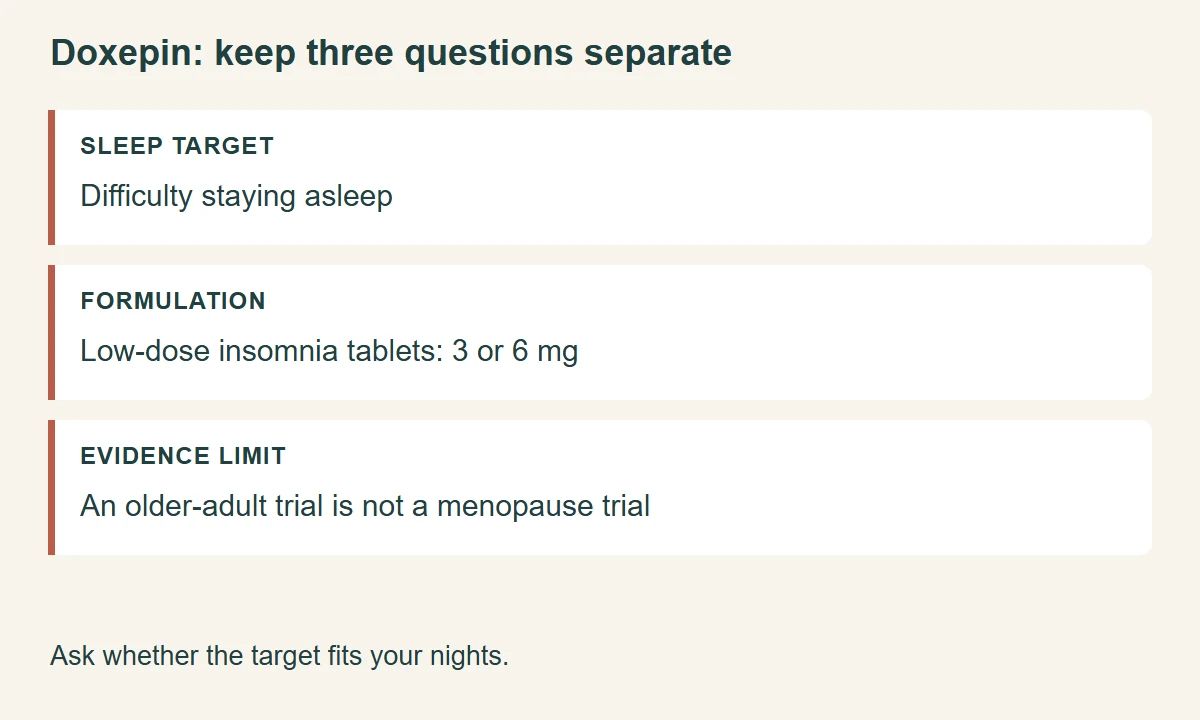
Doxepin for sleep is a prescription option used at low doses, usually 3 or 6 mg as Silenor, for difficulty staying asleep. Those doses differ from antidepressant treatment. It is not hormone therapy or a proven hot-flash treatment. Drowsiness, interactions and certain eye or urinary conditions still matter, so the prescription should be individualized.
What kind of sleep problem is low-dose doxepin meant to treat?
Doxepin for sleep is aimed at sleep-maintenance insomnia, which means difficulty staying asleep. That differs from lying awake at the beginning of the night. The Silenor label and the sleep-medicine guideline emphasize maintenance. Describing when you are awake helps your clinician decide whether that target fits your problem.
MedlinePlus distinguishes the insomnia tablets from doxepin capsules and liquid used for depression or anxiety. Seeing the same ingredient in two contexts does not mean that every formulation has the same purpose or instructions.
For the appointment, describe a typical night rather than only saying you sleep badly. Do you take a long time to fall asleep, wake repeatedly, or wake early and remain awake? Include how those nights affect the following day. This site's menopause insomnia guide puts those patterns in context.
Why is the sleep dose different from the antidepressant dose?
The low-dose doxepin tablets studied and labeled for insomnia contain 3 or 6 mg. The same ingredient is also used at substantially higher doses in antidepressant treatment. That difference matters when reading about benefits, side effects or another person's prescription. Do not substitute formulations or change the dose on your own.
The Silenor prescribing information says its sleep effect is thought to involve blocking histamine H1 receptors. That description explains the proposed mechanism; it does not turn doxepin into an over-the-counter allergy remedy or make it interchangeable with an antihistamine sleep aid.
The prescription is worth checking in full: medicine name, strength, formulation and directions. If a pharmacy label or a previous prescription seems different from what the clinician described, ask the pharmacist to reconcile it before taking a dose. Do not split or combine tablets to reproduce a number from an article.
| Detail | Low-dose insomnia treatment | What to ask |
|---|---|---|
| Formulation | Silenor tablets are 3 or 6 mg | Which exact product was prescribed? |
| Purpose | Difficulty maintaining sleep | Does this fit my waking pattern? |
| Other doxepin use | Different formulations and higher doses exist | Are these instructions specific to my prescription? |
For the wider comparison, see sleeping pills for menopause insomnia. A useful comparison starts with the symptom each treatment is meant to address, then considers the person's other conditions and medicines. Comparing brand names alone leaves out most of that decision.
What did the doxepin trials actually study?
The doxepin evidence reviewed here includes a placebo-controlled trial in older adults with chronic primary insomnia, not a trial selected for menopausal hot flashes. It found improvements in sleep maintenance. That supports a sleep-related use in the studied population; it does not establish treatment of hormonal symptoms or every cause of waking.
I read the abstract for this study, rather than the full report. It describes sustained improvements and no evidence of next-day residual sedation in that trial. That finding belongs to the studied doses, participants and testing conditions. It does not cancel the prescribing information's warning about possible next-day impairment.
The 2017 American Academy of Sleep Medicine guideline gives doxepin a weak recommendation for sleep maintenance, based on trials of 3 and 6 mg. Its assessment rated the overall evidence low quality. A weak recommendation leaves room for different choices based on benefits, harms and individual circumstances.
Two questions can keep that evidence in proportion: does the outcome being measured match the difficulty you want treated, and how will you judge whether it helps you? A sleep diary and a planned review can make the answer more useful than expecting a study's average result to become a personal guarantee.
Does doxepin treat menopause or the reason you wake up?
Low-dose doxepin treats a type of insomnia; it is not hormone therapy and should not be presented as a proven treatment for menopausal hot flashes. Waking can have more than one contributor. The consultation should consider the sleep pattern, other symptoms and possible sleep disorders rather than assuming every awakening has one hormonal cause.
Keep those questions separate when describing your nights. You might want help staying asleep and also need an assessment of sweating, snoring, pain or urinary symptoms. A medicine's sleep indication does not tell you that those accompanying problems have been addressed.
Our hot-flash guide and hormone therapy and sleep article cover different treatment decisions. If snoring or breathing pauses are part of the picture, bring that up before starting a sedating medicine; see menopause and sleep apnea for the surrounding questions.
For an appointment, a short list is enough: when the waking happens, what accompanies it, how often it occurs and which medicines or supplements you use. You do not need to arrive with a diagnosis. The point is to help the clinician decide what needs assessing alongside the insomnia.
What do the labeled timing and meal instructions mean?
The Silenor label says to take it within 30 minutes of bedtime and not within three hours of a meal, to reduce potential next-day effects. The prescribed dose depends on the person. These are instructions to review with the prescriber, not a reason to take an extra dose after waking overnight.
For adults, the label recommends 6 mg once daily, with 3 mg appropriate for some patients. For adults 65 and older, the starting dose is 3 mg. The maximum labeled daily dose is 6 mg. These numbers describe the product's prescribing information; your own prescription and pharmacist's advice govern your use.
MedlinePlus says to plan to remain in bed for seven to eight hours after a dose. If your real schedule makes the instructions difficult, discuss that before the first night. A late meal, early shift or irregular bedtime is worth mentioning rather than solving it by changing the directions yourself.
Ask how to handle a missed dose and what to do if you are still awake later. Do not add another sleep product because the first night was disappointing. A workable plan includes a clear dose, timing, interactions check and review date, not just a number written on the bottle.
Who should check carefully before taking doxepin for sleep?
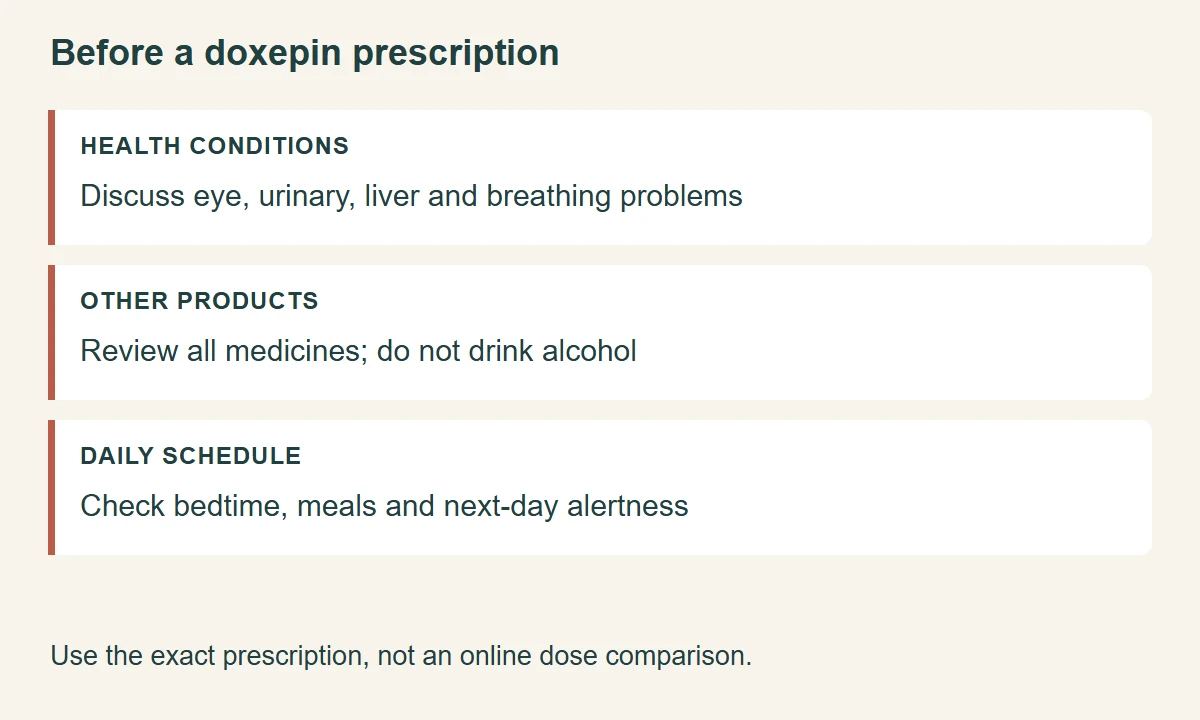
Doxepin for sleep needs a review of your medical history and medications. The Silenor label lists untreated narrow-angle glaucoma, severe urinary retention, relevant allergy and recent MAOI use as contraindications. It is ordinarily not recommended in severe sleep apnea. Liver problems, pregnancy or breastfeeding also need discussion before a prescription is started.
The label excludes use with an MAOI or within the preceding two weeks. This is not an interaction to manage by spacing two tablets a few hours apart. Ask the pharmacist to check the full list of prescriptions, occasional medicines and supplements, including anything you take only when a night is especially difficult.
For liver impairment or a tendency toward urinary retention, the label recommends beginning with 3 mg. Do not interpret a lower number as automatic suitability. The reason for the caution still needs evaluating. The same applies if you have had an unusual reaction to another sleep medicine.
Perimenopause does not automatically mean pregnancy is impossible. Mention a possible pregnancy, plans for pregnancy or breastfeeding when discussing any sleep prescription. The label advises against breastfeeding while taking Silenor. This is a medication conversation to have directly with the prescribing clinician, rather than something an online dose comparison can resolve.
Can a low dose still affect the next day or interact with other medicines?
Low-dose doxepin can still impair alertness or coordination, including the next day. Alcohol, other sedatives and sedating antihistamines can add to its effects. The Silenor label also identifies interactions that can raise doxepin exposure. A small dose is not permission to combine it with other sleep aids or drive while impaired.
One specific example is cimetidine, which increases exposure; the label limits Silenor to 3 mg when the two are used together. That is a pharmacist's review point, not a direction to alter your prescription after reading this page. Tell the team about nonprescription stomach medicines as well as sleep products.
Do not drink alcohol while taking Silenor. Alcohol can increase sedation and the risk of unusual sleep behaviors.
Our Unisom article explains why the active ingredient matters in an over-the-counter box. If you have been alternating products, bring that information to the appointment. Include alcohol and any medicine that makes you sleepy, even if sleep is not the reason you take it.
The label also warns about unusual behavior, hallucinations and complex sleep behaviors such as sleep-driving. Call your prescriber right away if you discover that you drove or performed other activities while not fully awake. New behavioral changes or worsening depression need prompt assessment. Seek emergency help for immediate danger.
What should a review of the prescription include?
A review of doxepin for sleep should consider whether waking and daytime function have improved, whether side effects have appeared, and whether the original explanation still fits. The label calls for reevaluation when insomnia has not improved after seven to ten days. Do not keep increasing the dose or adding products without advice.
Ask what you should record between appointments. Useful details may include time awake after waking, how the following morning feels and anything unusual another person notices. There is no need to monitor every minute of the night. The record should help the conversation, not become another reason to stay awake watching a screen.
The AASM guideline places cognitive behavioral therapy for insomnia, or CBT-I, as a primary intervention for chronic insomnia. Medication may have a role when CBT-I is unavailable, insufficient on its own, or used alongside it in selected cases. Our CBT-I guide explains what that treatment involves.
Before leaving, make sure you know whom to contact about side effects, when the first review will happen and how the medicine fits with other treatment. Those practical answers matter even when a medicine has good trial evidence. A prescription should come with a plan for checking its benefit, not an assumption that it is the final answer.
Where to go from here
Start with the menopause insomnia guide for the broader assessment. Our sleeping-pills comparison places different medicines side by side. For other mechanisms, read Belsomra and Lunesta; the CBT-I guide covers the main non-drug treatment for chronic insomnia.
Key takeaways
- Doxepin for sleep refers here to the low-dose insomnia formulation, not interchangeable antidepressant treatment.
- The labeled sleep target is difficulty staying asleep; it is not hormone therapy or an established hot-flash treatment.
- The guideline recommendation is weak, and the older-adult trial discussed here was not selected for menopause symptoms.
- Timing, meals, morning alertness, contraindications and interactions remain important at low doses.
- Ask about CBT-I and a review plan instead of adding or changing medicines yourself.
Frequently asked questions
What is doxepin for sleep used for?
Doxepin for sleep, in its low-dose Silenor formulation, is used for difficulty staying asleep. It is different from higher-dose antidepressant treatment. Describe whether you struggle to fall asleep, wake repeatedly or wake early, so a clinician can decide whether the labeled target matches your problem and what else needs assessment.
Is low-dose doxepin the same as an antidepressant prescription?
It contains the same active ingredient, but the low-dose insomnia tablets and antidepressant treatment should not be treated as interchangeable. Silenor tablets contain 3 or 6 mg. Other formulations and doses exist for different purposes. Check the exact prescription with the pharmacist, and do not substitute, split or combine medicines yourself.
Does doxepin help menopausal hot flashes?
Low-dose doxepin is not hormone therapy or an established treatment for menopausal hot flashes. Its labeled use is sleep-maintenance insomnia. The older-adult trial discussed in this article was not selected for hot flashes. Tell the clinician about both sleep difficulty and vasomotor symptoms so the treatment plan addresses the right questions.
Can I take doxepin after waking at 3 a.m.?
Do not add a dose of doxepin after waking overnight unless your prescriber has specifically instructed you. Silenor is labeled for dosing near bedtime, and MedlinePlus says to allow seven to eight hours in bed afterward. Ask what to do about missed doses or late waking rather than improvising a schedule.
Can low-dose doxepin cause morning drowsiness?
Yes. Low-dose doxepin can affect alertness or coordination the following day, despite reassuring findings in some trials. Alcohol, other sedatives and some interacting medicines can increase risk. Follow the prescription's timing and meal instructions, discuss side effects with your clinician, and do not drive or perform hazardous tasks while impaired.
Who should not take Silenor?
Silenor is contraindicated with untreated narrow-angle glaucoma, severe urinary retention, relevant allergy, or MAOI use within the preceding two weeks. Severe sleep apnea, liver problems, pregnancy and breastfeeding require discussion too. This is not a complete personal suitability check; ask the prescriber and pharmacist to review your conditions and all medicines.
Sources cited
- Silenor prescribing information, effective April 21, 2026, read through openFDA — Read source
- MedlinePlus: Doxepin (Insomnia) — Read source
- Sateia et al., AASM pharmacologic guideline, 2017, sections on doxepin and CBT-I — Read source
- Krystal et al., 12-week doxepin trial in older adults, 2010; abstract read — Read source

Ellen Hayes
Health & Wellness Writer and Researcher
I compare prescribing information and research so the differences are easier to discuss with a clinician. This article is a research summary, not a medical review or a personal treatment recommendation. About Ellen and the site.