Brown Noise for Sleep in Menopause: Hype or Help?

If white noise sounds too much like static to you, you've probably seen brown noise recommended instead: a deeper, rumbling sound that people describe as calmer. In menopause, when waking at 3 a.m. can turn into an hour of staring at the ceiling, a sound that promises to smooth the night is tempting.
I wanted to know what is actually behind the trend. So I read the research on brown noise and sleep, including what it is, what has been tested, how loud is too loud, and who should check with a doctor first. The honest answer is smaller than the videos suggest.
Brown noise is a deep, rumbling steady sound with more energy in the low pitches than white or pink noise. I found no trial of brown noise for sleep in menopausal women, and reviews of steady noise call the evidence weak. It may help some people relax or mask sounds, but it's a low-risk experiment, not a treatment.
What is brown noise, and how is it different from white and pink noise?
Brown noise is a steady sound whose energy is concentrated in the low pitches, so it sounds deeper than white or pink noise. A 2022 review describes it as a "low roar" that drops in intensity by about 6 decibels per octave. White noise is a flat hiss, and pink noise sits in between.
Here is the simple version. Imagine the sound as a piano keyboard. White noise plays every key with the same strength, which is why it sounds hissy and bright. Pink noise turns the high keys down a bit. Brown noise turns them down a lot, so what you mostly hear is the bass end.
| Type | How it is described | Often compared to |
|---|---|---|
| White noise | Equal strength across pitches; bright, hissy | Static, a running air conditioner |
| Pink noise | More low-pitched energy than white; softer | Steady rain, wind |
| Brown noise (also called red noise) | Even more low-pitched energy; deeper, "low roar" | Strong wind, a waterfall, distant thunder |
The comparisons in the last column are common ways people describe the sounds, not measurements. The technical description comes from a 2022 review in Sensors, which says brown noise has power inversely proportional to the square of the frequency.
If you want the full picture on the steady-sound family as a whole, our guide to white noise for menopause sleep covers the review of 38 studies, machines versus fans versus apps, and safety. This article is about brown noise itself.
Does brown noise actually help you sleep?
There is no good evidence yet that brown noise itself improves sleep. A 2022 review of sleep aids, covering sounds sold for sleep, says scientific evidence for brown, purple and blue noise is insufficient because there are few academic reports. The better-studied sounds are white and pink noise.
That matches what I saw in the bigger reviews. A 2025 perspective in the journal Sleep says findings on ambient sounds such as white and pink noise are "inconclusive," and notes that two systematic reviews of colored noise, which mainly examined white and pink noise, found no consistent evidence that they improve sleep. Brown noise was not what those reviews tested.
A 2021 systematic review of 38 studies in Sleep Medicine Reviews, rated the evidence that continuous noise improves sleep as very low quality. Its authors said that contradicts how widely it is used. Their findings ranged from noise improving sleep to noise disrupting it, so brown noise could land on either side of that range.
I did not find a trial of brown noise in perimenopausal or menopausal women either. That is a statement about my search, not proof that none exists. It does mean that anything you read promising brown noise for hot flashes, night sweats or menopause insomnia is going beyond the evidence.

Why do so many people say brown noise helps?
Brown noise is popular mostly because many people find its deeper sound less harsh than white noise, and masking background sound is a believable idea. That is a matter of taste, not proof. A 2022 review notes that brown noise is widely shared online as a sleep sound, while the scientific evidence behind it is still insufficient.
Preference is a fair reason to pick brown noise over white, as long as you don't mistake it for a sleep treatment.
A 2025 lab study looked at the "calming" claim. In 31 analyzed listeners, white, pink and brown noise did not change pupil size differently, which the authors read as no difference in a marker of arousal. Ten-second clips in a lab are far from a night of sleep, but it is a reason for caution about big claims.
There is one more thing to know. Some of the best-known lab results about sound and sleep involve pink noise delivered in a precise, brain-timed way, which is a different technique from leaving a recording on all night. The white noise article explains that difference, so I won't repeat it here.
When can brown noise help, and when won't it?
Brown noise can help when outside sounds are what wake you, because masking is its main plausible job. A 2025 review of sound machines in hospitalized adults found small trials, mostly of white noise, that suggested improved sleep efficiency. It won't help when the cause of waking is inside your body.
That hospital review included 7 randomized trials with 496 participants, and six of the seven used white noise. The authors concluded masking noises "seem to improve sleep efficiency in hospitalized adults, with good tolerability," while noting the studies were few and varied. These were patients in noisy wards, not women in a quiet bedroom, so I would not stretch the result.
In menopause, many awakenings come from inside: a night sweat, a pounding heart, a full bladder or a mind that starts racing at 3 a.m. A deep rumble does nothing for a hot flash. If that sounds like you, these pages cover more likely fixes:
- How to fall back asleep at 3 a.m. for the middle-of-the-night wake-up.
- Can't stay asleep in menopause for the reasons you keep waking.
- Insomnia and anxiety at night if worry is what keeps you up.
- A snoring partner and sleeping apart if the noise is next to you.
For a partner's snoring, a deeper sound may take the edge off for some people, though I did not find a study comparing brown noise with white noise for that purpose. If the snoring is loud, the better question is why it is happening, as the apnea section below explains.
How loud should brown noise be?
Keep brown noise as quiet as still covers the sound you want to mask. The National Institute on Deafness and Other Communication Disorders (NIDCD) says sounds at or below 70 A-weighted decibels (dBA), even after long exposure, are unlikely to cause hearing loss, while long or repeated exposure at or above 85 dBA can cause it.
For context, the NIDCD lists normal conversation at 60 to 70 dBA. The CDC's NIOSH sets its recommended limit for noise at work at 85 dBA averaged over an eight-hour day, and notes that a sound 10 decibels louder is ten times more intense. So a sound that feels only a little louder can carry a lot more energy.
Brown noise has one extra twist. Because it is heavy on low pitches, it can feel quieter than it is. Low rumbles are easy to underestimate, and a phone microphone may not measure them well. That is my own caution, not a finding from a study, so the safest habit is to keep the level low, whatever your ears tell you.
The NIDCD's rule of thumb is to avoid noises that are too loud, too close or last too long. For a bedroom, that suggests placing the speaker across the room instead of next to your pillow, using a timer if you can, and turning it down until it just blurs the outside sounds.
What is the easiest way to play brown noise?
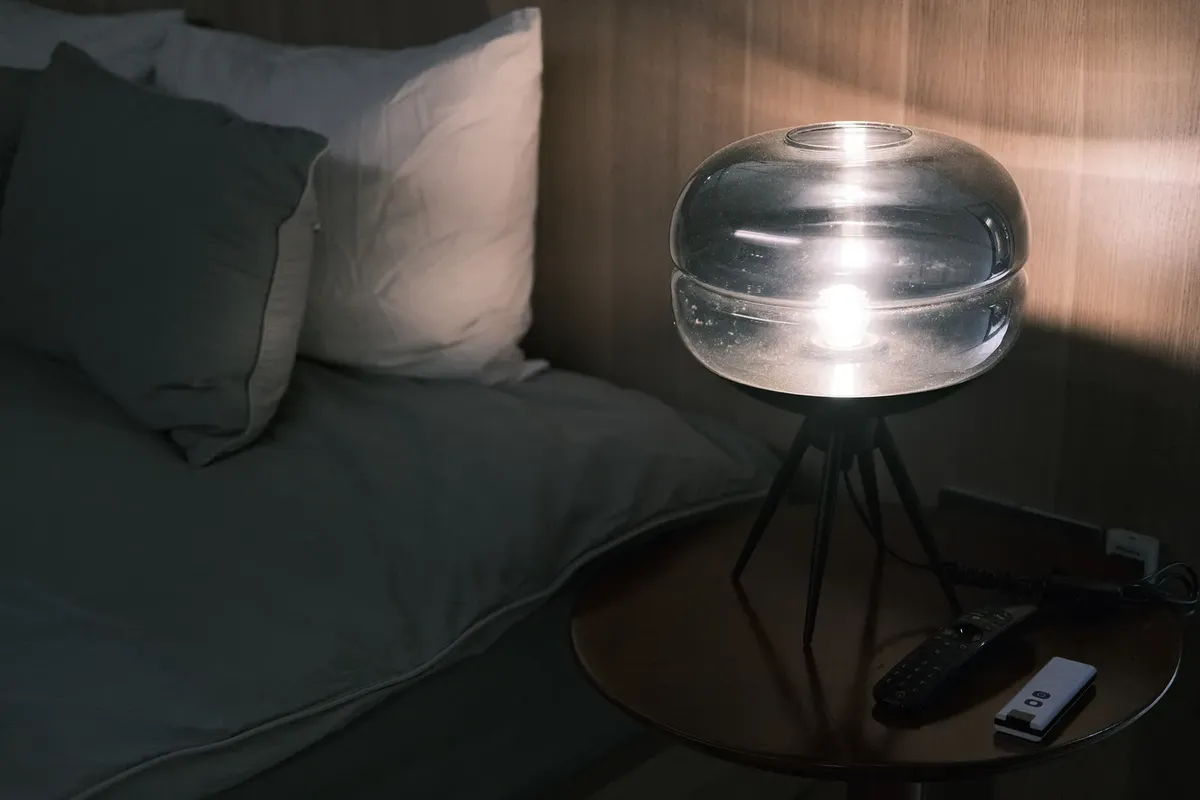
You can play brown noise from a phone app, a smart speaker, a video or audio track, or a sound machine with a brown setting. Which is best depends on practical things: screen light, volume control and sound quality. I found no evidence that one source is better for sleep than another.
| Source | Upside | Watch out for |
|---|---|---|
| Sound machine with a brown setting | No screen; can sit across the room | Check how loud it gets at the top setting |
| Smart speaker | Easy to start by voice; timer | Small speakers may not reproduce deep bass well, so the sound may come out thin |
| Phone app or video | Free or cheap; many options | Screen light, ads, notifications; battery running out |
| Headphones or earbuds | Doesn't disturb a partner | Sound sits close to your ears; hard to sleep on; keep the volume low |
The 2025 Sleep perspective raises a point about apps: app-based sleep sounds raise questions about fitting sleep hygiene advice, which usually discourages screen use in bed. If you use your phone, start the sound before you lie down, turn on Do Not Disturb and place it face down, away from the pillow.
About that last row: the NIDCD lists listening at high volume through earbuds or headphones as a recreational hearing risk. If you try headphones for brown noise, keep the volume low and consider a sleep-friendly headband instead of earbuds. That part is my own suggestion, not from a trial.
Who should not use brown noise, or should check first?
Check with a doctor before using brown noise if you have tinnitus, hearing loss, ear pain or dizziness. The NIDCD says that if you have tinnitus, you should first see your primary care doctor. It notes the sound rarely pulses with the heartbeat, and a specialist may order imaging tests, especially if it pulses.
The same NIDCD page says tabletop or smartphone sound generators are typically used as an aid for relaxation or sleep with tinnitus, and that if your tinnitus is mild, this might be all you need to help you fall asleep. It also lists a radio or household fan. I did not find research on brown noise for tinnitus specifically, so I would not promise it.
- Tinnitus or new ringing: see your primary care doctor first. A sound that pulses with your heartbeat needs a medical check.
- Hearing loss or ear symptoms: ask a clinician before playing sound for hours every night.
- Loud snoring, gasping or pauses in breathing (yours or a partner's): this can be sleep apnea, and masking the sound is not the answer.
- Anyone who needs to hear a smoke alarm, a baby or a call for help: this is my own safety suggestion, not from a study. Keep the sound low and test that you can still hear alarms.
Sleep apnea is the one I would not want you to miss. MedlinePlus says that with obstructive sleep apnea you usually begin snoring heavily soon after falling asleep, snoring may be interrupted by a long silent period while breathing stops, and sometimes people wake up gasping for air. Our article on menopause and sleep apnea explains why it can be missed.
What are the possible side effects and downsides?
Brown noise has no label or dose, so "side effects" here means possible downsides. The main ones are hearing harm if it is too loud, possible worse sleep for some people, and relying on a device to fall asleep. The 2021 review's authors said continuous noise may also negatively affect sleep and hearing.
The 2025 Sleep perspective adds a concern about the "risk of increased dependency on technology." That concern is about sleep apps in general, not to brown noise specifically, and I read it as a prompt to notice whether you now feel you can't sleep without the sound. If so, that is useful information about your habits, not a failure.
Because no study has followed people using brown noise night after night, I would treat it as a tool you can drop. Keep the volume low, and stop if your sleep gets worse or you notice ringing or muffled hearing in the morning.
How can you try brown noise sensibly?
Run it as a short, honest experiment. There is no proven recipe, so the aim is to learn whether brown noise helps you. These steps are my own practical suggestions based on the volume guidance above, not a protocol from a trial, so adjust them to what works for you.
- Name what wakes you. For a week, write down what you think woke you: heat, a full bladder, worry or an outside noise. Noise masking only fits the last one.
- Start quiet. Play brown noise just loud enough to blur outside sounds. Put the speaker across the room, not on the pillow.
- Compare for two weeks. Alternate a few nights with and without it if you can, and note how long it takes to fall asleep and how many times you wake.
- Try pink or white noise if it feels too heavy. If the rumble bothers you, a lighter sound is fine. Taste is a legitimate guide here.
- Check your ears. Muffled hearing or ringing in the morning means turning it down or stopping, and mentioning it to a doctor.
If you've tried this for a couple of weeks and still wake every night, that is a pattern to discuss with your doctor, not something to solve by turning up the volume. For long-term insomnia, the approach with the strongest backing is cognitive behavioral therapy for insomnia; our CBT-I guide explains what it involves.

Talk to your doctor if you have new ringing or a pulsing sound in your ears, sudden changes in hearing, loud snoring with gasping or pauses in breathing, daytime sleepiness that interferes with driving or work, or sleep problems that last for weeks. Those call for a medical check, not a sound machine.
Where to go from here
If you want the bigger picture on steady sound, start with white noise for menopause sleep. If the problem is waking in the middle of the night, read how to fall back asleep at 3 a.m. and can't stay asleep. For a snoring partner, see sleeping apart.
Key takeaways
- What it is: brown noise has more low-pitched energy than white or pink noise, so it sounds like a deep roar.
- Evidence is thin: a 2022 review calls the evidence on brown noise for sleep insufficient, and I found no trial in menopausal women.
- Why people like it: many find the deeper sound less harsh than white noise, but a 2025 lab study found no difference in a pupil marker of arousal between white, pink and brown noise.
- Keep it quiet: the NIDCD says sounds at or below 70 dBA are unlikely to cause hearing loss, while long exposure at or above 85 dBA can.
- See a doctor for red flags: tinnitus, a pulsing sound, or loud snoring with gasping and daytime sleepiness.
Frequently asked questions
Does brown noise help you sleep during menopause?
It might help some people, but it is not proven. I found no trial of brown noise in menopausal women, and the broader research on steady noise is mixed. A 2021 systematic review rated the evidence that continuous noise improves sleep as very low quality. Treat brown noise as a low-risk experiment.
What is the difference between brown noise, pink noise and white noise?
They differ in how the sound energy is spread across pitches. White noise is a flat hiss. Pink noise has more energy in the lower pitches. Brown noise has even more, so it sounds deeper, like a low roar. A 2022 review describes brown noise as dropping about 6 decibels per octave.
Is brown noise better than white noise for sleep?
Nobody knows yet. A 2025 perspective in the journal Sleep calls findings on colored noises such as white and pink noise inconclusive, and the sleep studies I found mostly tested white or pink noise, not brown. Some people simply find the deeper sound less harsh, which is a matter of taste, not proof.
How loud should brown noise be for sleep?
Keep it as quiet as still covers the sound you want to mask. The NIDCD says sounds at or below 70 A-weighted decibels (dBA) are unlikely to cause hearing loss, even after long exposure, while long or repeated exposure at or above 85 dBA can. Keep it across the room.
Can brown noise help with tinnitus at night?
Steady sound is a common tool for tinnitus, but see a doctor first. The NIDCD says tabletop or smartphone sound generators are typically used as an aid for relaxation or sleep with tinnitus, and that you should first see your primary care doctor. I did not find research testing brown noise specifically for tinnitus.
Is it safe to play brown noise all night?
No long-term study has tested it, so I can't call it proven safe or unsafe. The main known risk is volume, since the NIDCD says long or repeated exposure at or above 85 dBA can cause hearing loss. Keep it low and across the room, and stop if you notice ringing or muffled hearing in the morning.
Sources cited
- Yoon H, Baek HJ. External auditory stimulation as a non-pharmacological sleep aid. Sensors (Basel). 2022;22(3):1264. pmc.ncbi.nlm.nih.gov
- Erfanian M, Chait M, Kang J. Pupil-linked arousal does not differ between 'white', 'pink' and 'brown' noises. Int J Psychophysiol. 2025;218:113271. pubmed.ncbi.nlm.nih.gov
- Riedy SM, Smith MG, Rocha S, Basner M. Noise as a sleep aid: a systematic review. Sleep Med Rev. 2021;55:101385. pubmed.ncbi.nlm.nih.gov
- Vazzaz J, Matcham F, Economides M, Cavanagh K. Between sound and sleep: a perspective on Sonic Sleep Aids. Sleep. 2025;48(11):zsaf275. pmc.ncbi.nlm.nih.gov
- Khandelwal K, Anyim A, Shu S, et al. Impact and efficacy of sound machine on sleep in hospitalized adults: a systematic review. Sleep Med X. 2025;10:100154. pmc.ncbi.nlm.nih.gov
- National Institute on Deafness and Other Communication Disorders (NIH). Noise-Induced Hearing Loss. nidcd.nih.gov
- National Institute on Deafness and Other Communication Disorders (NIH). Tinnitus. nidcd.nih.gov
- CDC / NIOSH. About Noise and Hearing Loss Prevention. cdc.gov
- MedlinePlus (NIH). Obstructive sleep apnea. medlineplus.gov
How this article was checked
The NIDCD noise-induced hearing loss and tinnitus pages, the CDC/NIOSH noise page, the MedlinePlus obstructive sleep apnea page, the 2022 Sensors review and the 2025 Sleep perspective were opened and read in text. The 2021 Riedy review, the 2025 pupil study and the 2025 hospital sound machine review were read as abstracts only. I searched Europe PMC for brown noise and sleep in menopausal women and found no trial; that is a statement about my search, not proof none exists.
It has not been reviewed by a clinician. Ellen Hayes is a researcher and writer, not a doctor, and nothing here is a diagnosis or a substitute for being seen by one.

Ellen Hayes
Health & Wellness Writer and Researcher
Hi — I'm Ellen. Brown noise is often pitched as the "better" white noise, so I went looking for the research behind it. It turned out to be thin, which is why I'd treat it as a low-risk experiment rather than a fix.
I'm not a doctor. I'm not an expert — and I'm never going to talk down to you like one. I'm a woman in the middle of perimenopause who got tired of vague answers, started reading the actual research, and writes it down here in plain English, the way I'd explain it to a friend over coffee. More about Ellen →