Can't Stay Asleep in Menopause? Why You Keep Waking
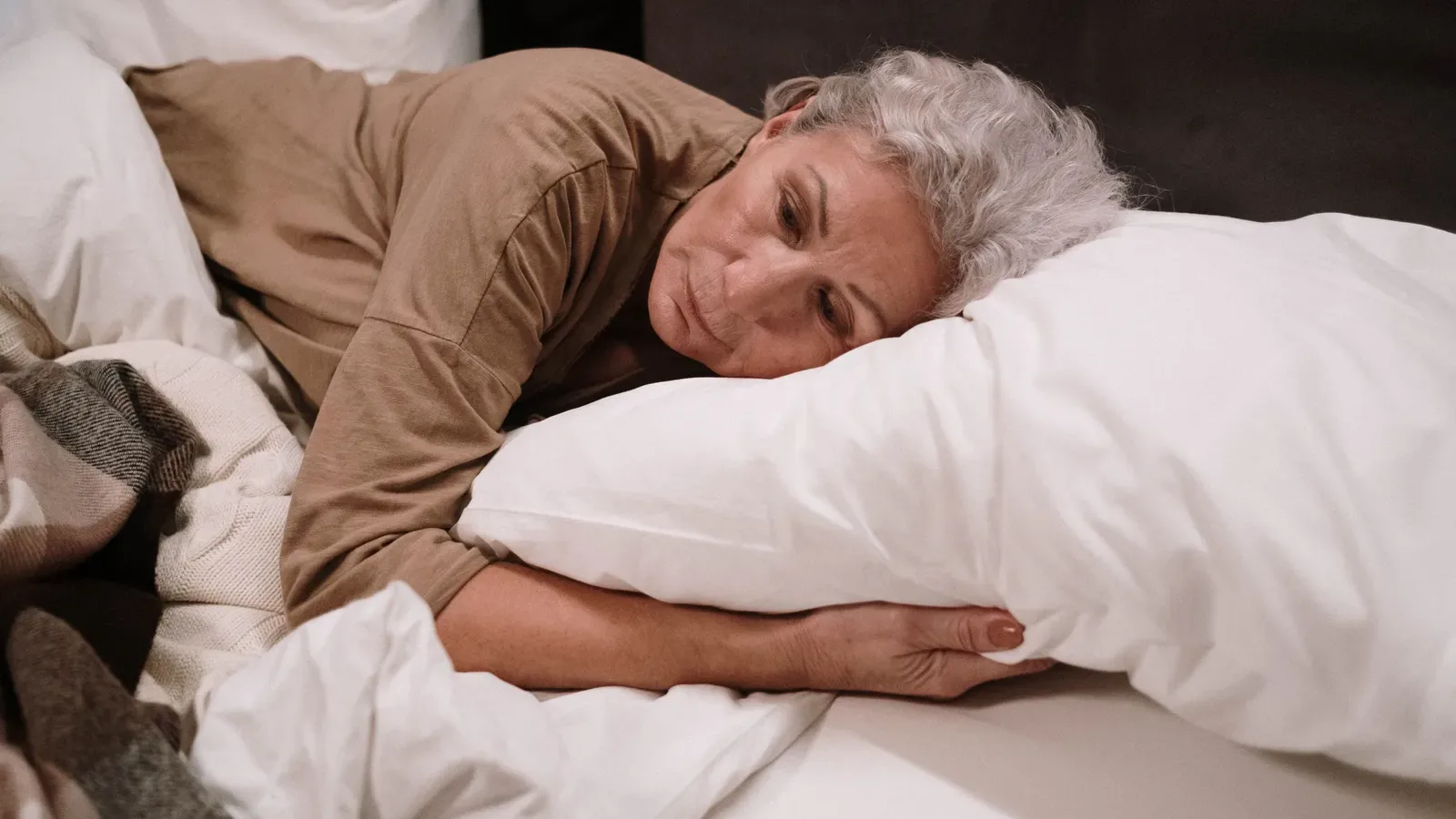
If you can't stay asleep, you know the routine: you drop off fine, then your eyes open at 1:30, then again at 3:00, then again before the alarm. By morning you feel as if you never really slept.
This guide is about that pattern of waking again and again: why it tends to show up in perimenopause and menopause, how to tell your own causes apart, and what the research says can change it. If you want help on a single bad night, I linked that article below.
Can't stay asleep in menopause? It is often called sleep maintenance insomnia, and it usually has several causes: hot flashes and night sweats, hormone changes, sleep apnea, alcohol, a full bladder, anxiety or pain. Cognitive behavioral therapy for insomnia and treating the underlying cause have the best research behind them. A doctor can sort out which applies.
What does it mean when you can't stay asleep in menopause?
Not being able to stay asleep means you fall asleep, but then wake in the night or too early and struggle to fall back to sleep. MedlinePlus lists trouble staying asleep as one of the main kinds of insomnia, alongside trouble falling asleep. Clinicians often call it sleep maintenance insomnia.
It is a different problem from lying awake at bedtime. If your trouble is getting to sleep, the fix is not always the same. If you want to know what to do in the middle of one particular wake-up, that is covered in how to fall back asleep at 3 a.m., and I will not repeat those steps here.
This article is about the pattern: the several-times-a-night, most-nights version, and what may be driving it.
How common is waking up again and again in menopause?
Very common. A 2023 review by Baker says the most common sleep complaint in the menopausal transition is nighttime awakenings. Drawing on SWAN and other longitudinal research, the review reports that women moving through the transition were more likely to report repeated waking than women who had not yet transitioned.
The same review notes that between 40 and 60 percent of women report sleep disturbances during the transition and after menopause. A 2026 narrative review in Obstetrics & Gynecology adds that how common sleep disruption is depends on menopausal stage, on whether you have hot flashes, and on whether it is measured by questionnaire or in a sleep lab.
So you are in large company. But common does not mean you have to put up with it, and the numbers also show it is not all in your head.
What keeps waking you up? A cause-by-cause table
Waking up repeatedly in menopause rarely has one cause. The table below sets out the usual suspects, the clue that points to each, and a sensible first step. It is a map for a conversation with your doctor, not a diagnosis, and you can have more than one row at once.
| Possible cause | Clue you may notice | A sensible first step |
|---|---|---|
| Hot flashes and night sweats | You wake hot, damp or kicking off covers | Note how often it happens and ask about treatment. See night sweats |
| Sleep apnea | Snoring, gasping, a partner sees you stop breathing, tired by day | Ask your doctor about a sleep study |
| Bladder | You wake needing the bathroom, often more than once | Limit fluids close to bedtime and read waking up to pee |
| Alcohol | You wake in the second half of the night after an evening drink | Try ending drinks at least three hours before bed. See alcohol and sleep |
| Anxiety or a racing heart | You wake with dread or a pounding heart, mind already busy | Read waking up with anxiety |
| Pain or restless legs | Aches, or an urge to move your legs, wake you | Tell your clinician; treating the cause can help sleep |
The rows are not ranked. Baker's review discusses both hot flashes and sleep apnea as contributors to disrupted sleep in midlife, so each gets a section below.
Are hot flashes the main reason you can't stay asleep?
Hot flashes are one of the most studied contributors. Baker's review concludes that vasomotor symptoms (hot flashes and night sweats) are a key factor disturbing sleep in peri- and postmenopausal women, and that they contribute specifically to sleep-maintenance difficulties. Hot flashes also add to time spent awake during the night.
There is a catch worth knowing. The same review says the link between hot flashes and sleep measured in a lab is less consistent than the link with how women say they sleep. In one study, hot flashes tended to come before awakenings in the first half of the night, while in the second half the awakening tended to come first.
A 2026 diary study of 99 women found that nights with more hot flashes were linked to worse sleep quality that night. Hot flashes are not the whole story, but if you wake hot or damp, they are worth treating as a real suspect. Separately, Baker's 2023 review reports that lower estradiol and higher FSH were linked to awakenings even after accounting for hot flashes and low mood, which suggests the hormone change itself may play a part.
Could sleep apnea be waking you?
It could. The NHLBI says women's risk of sleep apnea increases during and after menopause, partly because of hormone changes. It also notes that waking often, insomnia and tiredness can be symptoms in women. Because these overlap with menopause symptoms, discuss them with your clinician rather than assume they have one cause.
In women the signs are often different from the classic loud snoring. The NHLBI lists anxiety, daytime sleepiness, depression, morning headaches, insomnia, tiredness and waking up often as symptoms more common in women. It adds that menopause itself can cause insomnia and fatigue, which can make sleep apnea harder to recognize.
Baker's review reports that postmenopausal women had more than a threefold higher risk of severe obstructive sleep apnea than premenopausal women, after adjusting for age, BMI and smoking. It says continuous positive airway pressure (CPAP) is the treatment of choice, and that people with both apnea and insomnia may benefit from CBT-I as well.
I cannot tell you whether you have it. A doctor can, usually with a sleep study. If you snore, gasp, or have been told you stop breathing, do not wait.
How do bladder trips, alcohol, anxiety and pain fit in?
Each can break up sleep on its own or pile onto hot flashes. MedlinePlus lists alcohol, caffeine, anxiety, depression, physical pain, sleep apnea and waking at night to use the bathroom among the common causes of insomnia. Often it is two or three of them at once.
- Bladder: The NHLBI suggests limiting how much you drink close to bedtime so you can sleep longer without using the bathroom. Our guide to waking up to pee at night covers when it is a bladder issue and when it is the insomnia.
- Alcohol: The Sleep Foundation says alcohol can bring on lighter, more fragmented sleep and frequent awakenings, especially in the second half of the night as blood alcohol falls. It says experts recommend avoiding alcohol for at least three hours before bed. More in alcohol and menopause sleep.
- Anxiety: If you wake with dread or a racing heart, read waking up with anxiety. Worry about not sleeping can also keep the cycle going.
- Pain and restless legs: MedlinePlus says treating a medical problem behind insomnia, such as pain from arthritis, is part of treatment. The 2026 review also includes restless legs syndrome and periodic limb movements among the main sleep disorders of this stage of life.

How can you work out your own pattern?
A sleep diary can help organize the clues behind repeated waking. The NHLBI says a provider may ask you to keep one when diagnosing insomnia. My suggestion is to bring two weeks of notes to your appointment, so you and your doctor can discuss the pattern rather than rely on memory.
Each morning, jot down these points. It takes a couple of minutes:
- What time you went to bed, roughly when you woke, and when you got up.
- Whether you were hot, damp or kicking off covers when you woke.
- Whether you needed the bathroom, and how many times.
- What you drank in the evening, including any alcohol, and when your last caffeine was.
- Whether you woke anxious, in pain, or with a pounding heart.
- Snoring, gasping or tiredness the next day, ideally from someone who shares your room.
Two weeks is my suggestion, not a rule from a study. Record what happened without assuming that one drink, one symptom or one bad night proves the cause.
What does the research say actually changes it?
The strongest evidence I found is for cognitive behavioral therapy for insomnia (CBT-I), plus treating whatever is driving the waking. The NHLBI describes CBT-I as a 6- to 8-week plan, usually recommended first for long-term insomnia, that helps you fall asleep faster and stay asleep longer.
CBT-I
CBT-I is a set of skills, not a pill. Per the NHLBI, it combines cognitive therapy, relaxation, sleep education, sleep restriction and stimulus control, and it can be done with a doctor, nurse or therapist in person, by phone or online. Our CBT-I guide explains each part.
Baker's review describes an earlier trial in the MsFLASH network in which 8 weeks of CBT-I by telephone cut insomnia symptoms more than menopause education did, with gains kept at 6 months. A 2024 scoping review of randomized trials also found CBT-I improved sleep quality and insomnia severity in menopausal women, though most studies involved mainly white, well-educated women.

Treating the hot flashes
If hot flashes are waking you, treating them may help your sleep. Baker's review says effective treatment of vasomotor symptoms with hormone therapy reduces sleep disturbance, and that most of the good-quality randomized trials found hormone therapy reduced sleep disturbances. It may be particularly useful when nocturnal hot flashes are the trigger.
For women who cannot or prefer not to use hormones, the same review says non-hormonal options exist, including low-dose SSRIs and SNRIs, though their side effects need weighing. Whether any of this suits you is a decision for you and your clinician, based on your age, history and risks.
Habits that support the rest
For the practical sleep habits that support treatment, see our complete perimenopause and menopause sleep guide.
What are the possible side effects and cautions with these options?
Each route has trade-offs, and none is risk-free. Treating menopause symptoms, trying sleep medicines, and even CBT-I all come with things to ask your clinician about. This section sets out what the sources I read say, so you can go into the appointment with questions rather than guesses.
- CBT-I: No drug side effects, but sleep restriction deliberately limits your time in bed and can leave you sleepy at first, so it is best done with a trained professional. I did not find a source I could cite for how long that lasts.
- Hormone therapy: Baker's review says its risk profile differs between women and that treatment should be individualized to maximize benefits and minimize risks. Ask about your own history.
- Prescription sleep medicines: The NHLBI says zolpidem-type drugs can cause anxiety and, rarely, activities while asleep such as walking, eating or driving. Benzodiazepines can cause dizziness, confusion and muscle weakness, interact dangerously with other medicines, and can be habit-forming. The NHLBI says benzodiazepines should be taken for only a few weeks.
- Over-the-counter sleep aids: The NHLBI says antihistamine sleep aids can be unsafe for some people. It also says research has not proven that melatonin is an effective treatment for insomnia, and lists daytime sleepiness, headache, stomach upset and worsening depression as possible effects. It can also interfere with blood-pressure control, causing high or low blood pressure.
- Off-label medicines: The NHLBI notes that antidepressants, antipsychotics and anticonvulsants are sometimes prescribed for insomnia but are not FDA-approved for it.
Who should not manage this on their own?
Do not rely on home experiments if your waking comes with warning signs. Women who snore loudly or have been seen to stop breathing, who feel dangerously sleepy during the day, who have low mood or heart symptoms, or who drink heavily should talk to a clinician before changing anything on their own.
- Possible sleep apnea: sleep habits alone do not replace assessment. Ask your clinician whether you need a sleep study.
- Heavy daily drinking: do not stop suddenly without medical advice. MedlinePlus explains that alcohol withdrawal can include seizures and severe confusion. Do not mix alcohol with sleeping pills or sedatives.
- Depression or thoughts of self-harm: this needs help now, not a bedtime routine. In the U.S., call or text 988.
- Already taking sleep or mood medicines: do not stop or add anything without asking your prescriber.
Talk to your doctor if you snore loudly, gasp, or have been told you stop breathing; you feel sleepy or nod off while driving (MedlinePlus warns insomnia can raise the risk of a car accident); you wake three or more nights a week for three months or longer; you feel depressed, hopeless or very anxious; you wake with chest pain, a racing heart or drenching sweats; or you take any medicine and wonder if it affects your sleep. If you are thinking about hurting yourself, call or text 988. In an emergency, call 911.
Where to go from here
For the big picture, start with the complete perimenopause and menopause sleep guide. For a hot, damp wake-up, read night sweats in women. For lasting change, try CBT-I for menopause insomnia. These guides help you prepare questions about repeated waking for your next appointment.
If the wake-up is a bathroom trip, see waking up to pee at night. If wine is in the picture, read alcohol and menopause sleep. If you wake anxious, try waking up with anxiety. And for tonight, how to fall back asleep at 3 a.m.
Key takeaways
- It is common: about 40% of women in the late transition report waking several times, and that stays stable after menopause.
- There is usually more than one cause: hot flashes, hormone changes, sleep apnea, alcohol, bladder, anxiety and pain all count.
- Do not skip sleep apnea: women's risk rises after menopause and the signs may not look like snoring.
- Track the pattern: a sleep diary gives your doctor clues; it does not diagnose the cause.
- What has evidence: CBT-I, and treating hot flashes (including hormone therapy for some women, a decision for you and your doctor).
Frequently asked questions
What is sleep maintenance insomnia?
Sleep maintenance insomnia means you fall asleep but can't stay asleep: you wake during the night, or wake too early, and struggle to drift off again. MedlinePlus lists staying asleep as one of the core insomnia problems. It is a pattern, not a diagnosis by itself, so a clinician looks for causes behind it.
Why can't I stay asleep in menopause?
Usually more than one thing is at work. Hot flashes and night sweats, falling estradiol, a bladder that wakes you, sleep apnea, alcohol, anxiety and pain can each break up sleep. A 2023 review concluded that hot flashes contribute specifically to sleep-maintenance difficulties, and that hormone changes seem to affect awakenings directly.
Is waking up several times a night normal in menopause?
It is common, which is not the same as harmless. A 2023 review says about 40 percent of women in the late menopausal transition report waking several times, and that share stays stable after menopause. Three or more nights a week for over three months fits the NHLBI definition of chronic insomnia.
What helps most when you can't stay asleep?
For long-term insomnia, cognitive behavioral therapy for insomnia (CBT-I) is the usual first treatment, and trials in menopausal women found it works. If hot flashes are waking you, treating them may help too, and hormone therapy is one option to discuss with your doctor. Which fits you depends on your health history.
Could sleep apnea be why I wake so often?
It could. The NHLBI says a woman's risk of sleep apnea rises during and after menopause, and that women often have waking up often, insomnia or tiredness rather than loud snoring. Because the signs can look like menopause, ask your doctor about a sleep study if you snore, gasp or feel sleepy by day.
When should I see a doctor about waking at night?
See a doctor if you wake three or more nights a week for a few months, if a partner sees you stop breathing, or if you feel sleepy while driving. Also go if you have low mood or chest symptoms. These are reasons for a medical check, not something to white-knuckle through alone.
Sources cited
- Baker FC. Optimizing sleep across the menopausal transition. Climacteric. 2023;26(3):198-205. pmc.ncbi.nlm.nih.gov
- Lyu AC, Kravitz HM. Sleep disruption in the menopausal transition and postmenopause: a narrative review. Obstet Gynecol. 2026;148(5):616-625. pmc.ncbi.nlm.nih.gov
- Law C, Gunthert K, Sokolovsky AW, Behar E. Subjective menopausal hot flashes in sleep disturbance: does the timing of hot flashes matter? Menopause. 2026;33(6):692-701. pmc.ncbi.nlm.nih.gov
- Arentson-Lantz EJ, Muench A, Kokonda M, et al. Cognitive behavioral therapy for menopausal insomnia in perimenopausal and postmenopausal women with insomnia and nocturnal hot flashes: a randomized-controlled pilot trial. Menopause. 2026. pmc.ncbi.nlm.nih.gov
- Ntikoudi A, Owens DA, Spyrou A, Evangelou E, Vlachou E. The effectiveness of cognitive behavioral therapy on insomnia severity among menopausal women: a scoping review. Life (Basel). 2024;14(11):1405. pmc.ncbi.nlm.nih.gov
- NHLBI (NIH). Sleep apnea and women. nhlbi.nih.gov
- NHLBI (NIH). Insomnia: what is insomnia? nhlbi.nih.gov
- NHLBI (NIH). Insomnia: treatment. nhlbi.nih.gov
- MedlinePlus (NIH). Insomnia (health topic and medical encyclopedia). medlineplus.gov
- Sleep Foundation. Alcohol and sleep. sleepfoundation.org
- MedlinePlus. Alcohol withdrawal. medlineplus.gov
How this article was checked
The Baker review (full text), the NHLBI sleep apnea, insomnia and insomnia treatment pages, the MedlinePlus insomnia pages and the Sleep Foundation alcohol page were read in full. The Lyu and Kravitz review, the Law diary study, the Arentson-Lantz pilot trial and the Ntikoudi scoping review were read as abstracts only. I did not find a source for how long the sleepiness from sleep restriction lasts, so the article does not say.
It has not been reviewed by a clinician. Ellen Hayes is a researcher and writer, not a doctor, and nothing here is a diagnosis or a substitute for being seen by one.
Ellen Hayes
Health & Wellness Writer and Researcher
Hi — I'm Ellen. This one is about the pattern of waking again and again, not a single bad night. Here is what I found about causes and what the research says can change it, including what it cannot tell us.
I'm not a doctor. I'm not an expert — and I'm never going to talk down to you like one. I'm a woman in the middle of perimenopause who got tired of vague answers, started reading the actual research, and writes it down here in plain English, the way I'd explain it to a friend over coffee. More about Ellen →