Quviviq for Menopause Insomnia: Research and Safety

Quviviq often enters a menopause sleep conversation with a hopeful question: could a medicine that quiets wake signals help when bedtime has become unpredictable? There is research worth discussing, including an analysis in women of menopausal transition age. There are also limits that a reassuring headline can miss.
I checked the published study abstract against the US prescribing information and patient guidance. The aim here is to help you ask better questions about the evidence, your sleep pattern and the practical demands of taking a prescription safely. It is not a recommendation to choose one sleeping pill.
Quviviq, the brand name for daridorexant, treats adult insomnia involving trouble falling asleep or staying asleep. Research includes a small subgroup of women of menopausal transition age, but it does not establish hot-flash treatment. Discuss the evidence, seven-hour sleep window, interactions, next-day impairment and unusual sleep behaviors with a clinician before use.
What is Quviviq, and which sleep problem does it target?
Quviviq is a prescription orexin receptor antagonist containing daridorexant. Its US indication covers adult insomnia with difficulty falling asleep, staying asleep, or both. It acts on wake-promoting signaling rather than replacing reproductive hormones. That distinction helps frame a consultation, but it cannot determine whether this medicine fits your particular sleep difficulties.
The US prescribing information is the starting point for understanding the approved use. An insomnia diagnosis and a menopause concern can coexist without being the same treatment target. Ask the prescriber to name the problem the proposed prescription is intended to change.
For instance, “I cannot get to sleep even when I have enough time” gives a different starting point from “I wake soaked and spend an hour changing clothes.” You do not need to choose a diagnosis before the visit. Describe what happens, how long it has been happening, and what the following day feels like.
What did the Quviviq study in midlife women find?
A 2026 analysis examined 117 women aged 47 to 55 from an adult insomnia trial. Results with daridorexant 50 mg were numerically favorable, but the reported confidence intervals crossed zero. The findings support a discussion about midlife insomnia; they do not provide a precise personal benefit estimate or prove treatment of menopausal symptoms.
The reported difference in time awake after falling asleep was 13.8 minutes less than placebo, with a 95% confidence interval ranging from 29.0 minutes less to 1.4 minutes more. That interval includes no difference. Similar uncertainty appeared for falling asleep, reported sleep duration and daytime impairment. Several authors were manufacturer employees or disclosed financial relationships.
I read the abstract and disclosures, not the full report. Its conclusion is encouraging, but the uncertainty deserves equal space. An average result is also not a promise about the nights of one person. A useful question is what part of the evidence the clinician finds relevant to your own treatment goal.
When you read “studied in women,” ask how the group was selected and what the researchers measured. Age, confirmed menopausal stage, hot-flash frequency and insomnia are different descriptions. Keep those distinctions in mind when comparing a research summary with the symptoms you want help managing.
Does Quviviq treat hot flashes or replace hormone therapy?
Quviviq is not hormone therapy, and the research discussed here does not establish a treatment effect on hot flashes or night sweats. Ask separate questions about insomnia and menopausal symptoms. A prescription aimed at sleep may belong in a broader plan, but its purpose should be explained rather than assumed from your age.
Try writing two headings before an appointment: “sleep” and “other symptoms.” Under the first, note trouble falling asleep, time spent awake, and daytime impact. Under the second, describe sweating, changes in bleeding, discomfort or other concerns you want assessed. Do not force everything into one explanation for the sake of a tidy list.
Then ask which concern the clinician is addressing first, and why. If the plan includes more than one treatment, ask how each will be reviewed. This does not mean every symptom needs a separate medicine. It means you should understand the intended purpose of each part of the plan you agree on.
Our articles on hormone therapy and insomnia and nonhormonal hot-flash medicines explain different discussions. They are background reading, not instructions to combine treatments. Bring questions about overlap, alternatives and what remains unexplained to the person responsible for prescribing.
What do the bedtime instructions mean for real nights?
The US label places Quviviq within 30 minutes of bedtime, no more than once nightly, with at least seven hours before planned waking. A meal may delay its effect. Follow your own prescription and ask about missed doses; these instructions are not permission to add another tablet when a night remains difficult.
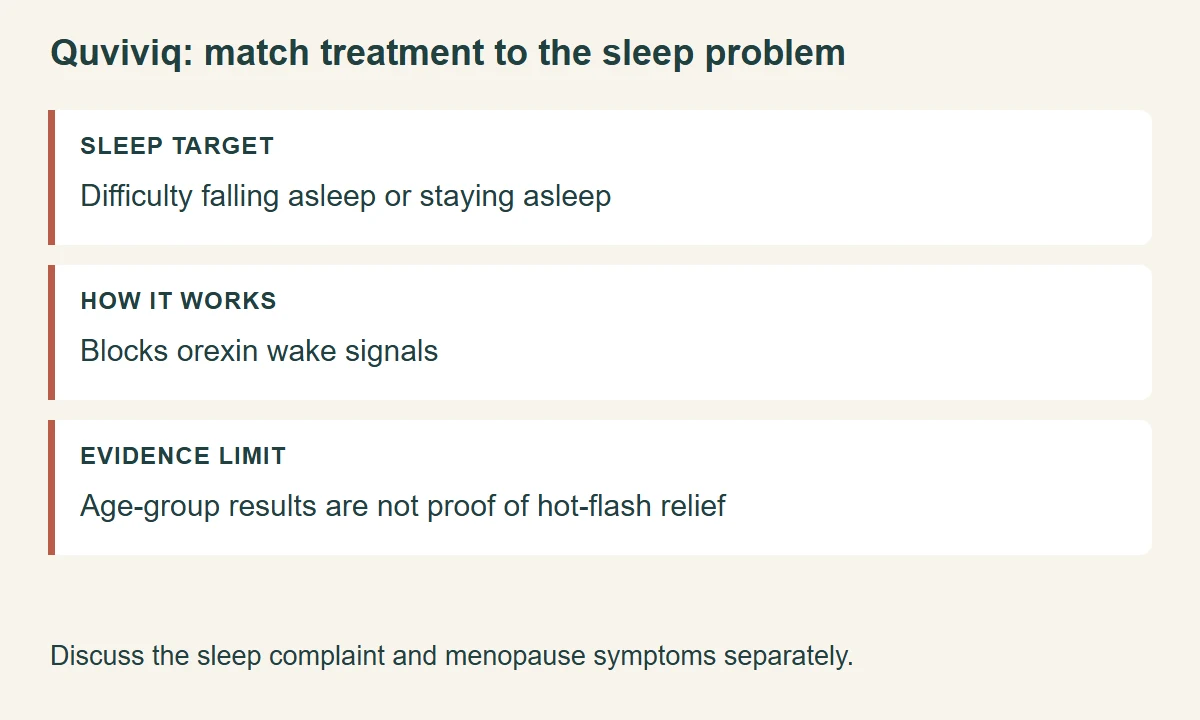
Seven hours is a minimum opportunity for sleep, not a promise of seven hours asleep. Look at the time you must be active the next morning, not only when you hope to get into bed. Ask how the instructions fit an early shift, unpredictable caregiving or a night when your usual bedtime has already passed.
The tablet strength should be confirmed with the prescriber and pharmacist. Study doses are descriptions of research groups, not a way to select your own dose. If the printed pharmacy directions and your recollection of the appointment seem different, resolve the difference before taking the medicine rather than guessing which version to follow.
MedlinePlus patient guidance advises against taking more than one dose in a day. Keep a written answer to “What if I am still awake?” with the medication guide. A plan made while alert is easier to follow than an improvised decision made during a frustrating night.
Do not turn meal timing into a reason to skip food or redesign your evening around a prescription without advice. Ask how to use the medicine within the routine you can realistically maintain. If the instructions cannot fit that routine, that is information the prescriber needs when considering the plan.
Which conditions and interactions need a review first?
Quviviq must not be used with narcolepsy or a known allergy to its components. Liver disease, breathing conditions, mental-health history and the complete medication list also need review. CYP3A4 interactions may require avoiding a combination or changing the prescription. Menopause does not remove these safety questions or establish that a treatment is suitable.
Strong CYP3A4 inhibitors and moderate or strong inducers are combinations the US label says to avoid. Moderate inhibitors have a lower labeled dose limit. The distinction matters because the rule is not “avoid every inhibitor.” Have a pharmacist check the actual medicine names rather than trying to identify categories from a short online list.
Bring prescription medicines, nonprescription sleep aids, vitamins and herbal products together. A photograph of each label can make the discussion easier, especially when two brands contain the same ingredient. Include products you take only occasionally. “Sometimes” still belongs on the list when the question is what could be taken on the same evening.
Mention loud snoring or breathing pauses, liver problems, previous medication reactions and pregnancy or breastfeeding where relevant. Ask whether any part of your history needs assessment before a prescription decision. The purpose is to give the clinician information, not to clear yourself using a list of conditions on a website.
Finally, ask who will review medicines added later by another clinician. A first consultation cannot account for a future prescription that nobody knows about yet. Keep the list current and show it when a new treatment is proposed. Do not stop an established medicine to make room for a sleep prescription on your own.
Can Quviviq affect driving or interact with alcohol?
Quviviq can reduce next-day alertness and coordination even when taken as directed. Do not drink alcohol during treatment, and have other sedating products reviewed. Feeling awake does not guarantee unimpaired driving. Discuss the following morning, including work and caregiving, before the first dose rather than judging safety from the first night alone.
MedlinePlus warns that driving can be affected even when a person feels fully awake. Its guidance also highlights falls and effects that can persist after stopping. Ask what restrictions apply to you, and how to respond if you feel sleepy, unsteady or unable to concentrate when you expected to be functioning normally.
Think beyond a commute. Does your morning involve driving someone else, climbing steps repeatedly, using equipment or supervising a dependent person? Describe those tasks at the appointment. “I can sleep in” may not capture what you actually need to do if something unexpected happens during the night or early the next day.
Other insomnia medicines are not an unreviewed backup plan. Tell the pharmacist if an antihistamine, an old prescription or a supplement remains beside the bed. Ask which products should not be used and what to do with leftover prescriptions. Our Unisom guide explains why checking the active ingredient is more useful than comparing packaging.
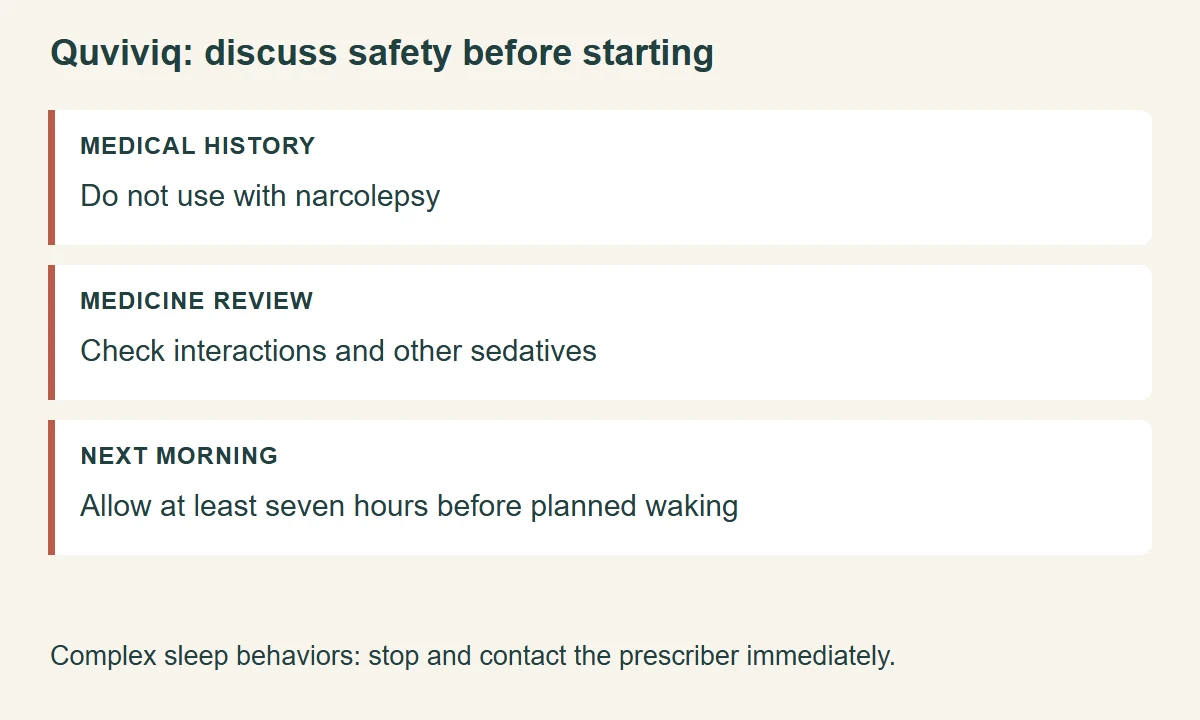
Ask for contact instructions that you can use if morning impairment becomes a problem. Be ready to name the prescription, when you took it and what you noticed. Do not make a second-night experiment with a different combination to see if the result improves; return the question to the prescribing team.
Which symptoms need prompt medical attention?
Stop Quviviq and contact the prescriber immediately after activities performed while not fully awake, such as sleepwalking or sleep-driving. New behavior changes or worsening depression need prompt attention too. Seek emergency care for breathing difficulty, serious swelling, severe injury or immediate danger. Ask about other concerning symptoms before treatment begins.
Unusual sleep activities are different from simply remembering a strange dream. You may learn about an event from someone else. If that happens, record the description without trying to decide whether it was “serious enough” to count. Take the report to the prescriber and follow the medication guide's instruction about stopping after complex sleep behavior.
Sleep paralysis, hallucinations near sleep and temporary weakness also appear in patient guidance. Call the clinician promptly about these events rather than assuming they are an ordinary part of menopause. If a symptom makes it difficult to seek help yourself, someone sharing your home should know where to find the medicine name and contact details.
Before the first night, ask which concerns need an immediate call, which need emergency help and which can wait for a planned review. “Contact us if there is a problem” is less usable than a clear set of instructions. Request the written medication guide and keep it somewhere you can find without searching your phone at night.
For less urgent concerns, describe the impact in concrete terms: a headache that changes your morning, unexpected tiredness, or a new difficulty managing routine tasks. You do not need to decide whether the medicine caused the symptom before reporting it. Tell the team what changed and when it happened.
How does Quviviq fit with CBT-I and follow-up?
Quviviq should be considered within an insomnia plan that includes assessment, access to CBT-I and a review of benefit and adverse effects. CBT-I is a usual first treatment for long-term insomnia. Ask how medication fits your goals and circumstances, rather than treating a prescription as the end of the conversation about sleep.
The NHLBI treatment guide describes cognitive behavioral therapy for insomnia as a structured treatment, available through different formats. It is more than advice to avoid screens. Ask who provides it locally, whether remote care is available and what the practical barriers would be for you.
There is also direct research in this population: a randomized trial of telephone CBT-I involved perimenopausal and postmenopausal women with insomnia and hot flashes. Sleep outcomes improved more than with menopause education. That study was not a comparison against Quviviq, so it cannot rank the two treatments or dictate your individual plan.
Agree on what you will bring to follow-up. Use the same simple observations before and after treatment: what happens around bedtime, how much time you notice yourself awake and how you function the next day. Ask the clinician whether a diary would help. An elaborate tracking routine is not a requirement for having a useful conversation.
| Question to settle | What to bring or request |
|---|---|
| What are we trying to improve? | Your main sleep difficulty and the daytime activity it affects. |
| What happens if the plan is hard to follow? | Questions about bedtime, meals, early alarms and caregiving. |
| How will safety be reviewed? | The complete medicine list, new symptoms and morning responsibilities. |
| When should I call rather than wait? | Written instructions for urgent concerns, lack of improvement and the next appointment. |
Patient guidance says to call if insomnia has not improved within seven to ten days or worsens. Ask for a review date, but do not wait for that date to report a serious concern. A workable plan includes a way to ask for help and reconsider the explanation, not just a refill schedule.
Where to go from here
Start with the menopause insomnia guide and our CBT-I guide. The sleeping-pills comparison explains different targets. For related reading, see Dayvigo, Belsomra and ramelteon. These articles are preparation for a clinician conversation, not a schedule for combining or switching medicines yourself.
Key takeaways
- Quviviq contains daridorexant and treats adult sleep-onset or sleep-maintenance insomnia; it is not hormone therapy.
- The midlife subgroup is relevant, but small and uncertain; its results do not establish hot-flash treatment.
- Follow the prescription and allow at least seven hours before planned waking; do not add an overnight dose.
- Narcolepsy, allergy, CYP3A4 interactions, other sedatives, alcohol and morning responsibilities need review.
- Stop and contact the prescriber immediately after complex sleep behaviors, and discuss CBT-I and follow-up too.
Frequently asked questions
What is Quviviq used for during menopause?
Quviviq is used for adult insomnia with difficulty falling asleep, staying asleep or both. Menopause may be part of the surrounding clinical picture, but the medicine is not hormone therapy. Ask which sleep problem the clinician intends to address and how other symptoms will be assessed alongside that treatment decision.
Has Quviviq been studied in midlife women?
Yes. A published analysis examined women of menopausal transition age within a larger insomnia trial. It offers relevant but uncertain subgroup evidence. It does not establish benefit for every menopausal stage or symptom. Ask how the findings fit your situation rather than treating the study headline as a personal prediction.
Does Quviviq stop hot flashes or night sweats?
The evidence discussed here does not establish that Quviviq stops hot flashes or night sweats. Ask about those symptoms separately from difficulty falling asleep or staying asleep. Make sure you understand the intended purpose of each part of your treatment plan, and report which concerns remain at the next review.
Can I take another Quviviq dose if I wake overnight?
Do not add another dose during the same night. Follow the prescription and clarify missed-dose instructions with your pharmacist before the situation occurs. The labeled bedtime schedule requires at least seven hours before planned waking. An early alarm or caregiving responsibility is a reason to discuss the plan in advance.
Is Quviviq safe to combine with alcohol or other sleeping pills?
Do not drink alcohol during Quviviq treatment. Have the pharmacist review other prescriptions, nonprescription sleep products and supplements together; its label does not recommend combining it with other insomnia medicines. Do not build your own backup combination. Ask for an agreed response if sleep remains difficult after taking the prescription.
What should I do after sleepwalking or another unusual sleep activity?
Stop Quviviq and contact the prescriber immediately if you discover activities performed while not fully awake, such as sleepwalking or sleep-driving. Explain what happened, including observations from someone else. Seek emergency care for serious injury, breathing difficulty or immediate danger. Do not take another dose to test whether the event repeats.
Sources cited
- Quviviq US prescribing information and Medication Guide; DailyMed updated February 26, 2026, prescribing text revised September 2024 — Read source
- MedlinePlus: Daridorexant; revised March 15, 2025 — Read source
- Schaedel et al., Maturitas 2026: daridorexant in women of menopausal transition age — Read source
- NHLBI: Insomnia treatment — Read source
- McCurry et al., JAMA Internal Medicine 2016: telephone CBT-I in perimenopausal and postmenopausal women — Read source

Ellen Hayes
Health & Wellness Writer and Researcher
I compare prescribing information and research so the differences are easier to discuss with a clinician. This article is a research summary, not a medical review or a personal treatment recommendation. About Ellen and the site.