Progesterone Cream for Menopause: What the Trials Show
Progesterone cream has mixed and mostly weak evidence for menopause. One small 1999 trial found fewer hot flashes, but three later placebo-controlled trials found no benefit for symptoms, mood, bones or arteries. Most importantly, in testing it did not change the uterine lining, so it can't be relied on to protect the uterus alongside estrogen.
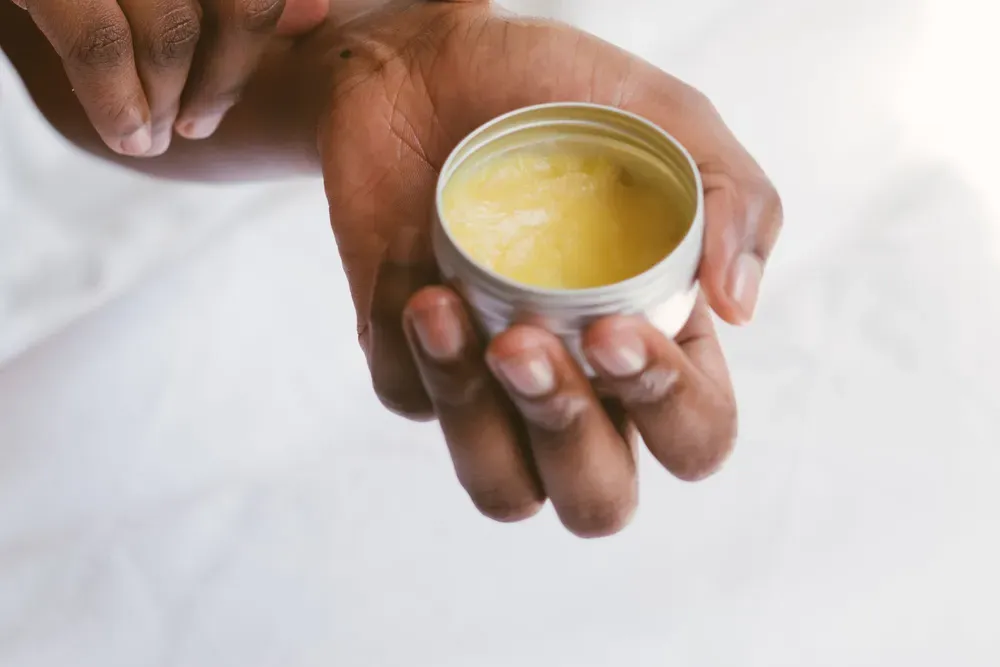
Progesterone cream has a gentle reputation. It's sold in small jars and tins, often next to vitamins, with promises about hot flashes, sleep, mood and bones, and it's frequently described as the "natural" alternative to prescription hormones. I wanted to know what actually happens when it's tested against a placebo cream.
The short version is that the trials disagree with each other on hot flashes, mostly don't find the other benefits, and raise one real safety issue for women who also use estrogen. That last point matters more than all the rest, so if you only read one section, make it the one on protecting the uterus.
What is progesterone cream, and what is it sold for?
It's a skin cream containing progesterone, the hormone the ovaries make after ovulation, which falls during the menopause transition. It's marketed for hot flashes, sleep, mood and bone health, on the idea that it tops up progesterone through the skin. Some creams sold under similar names contain wild yam extract instead of progesterone.
Those are three quite different products, and it helps to keep them apart:
- Over-the-counter progesterone creams, sold without a prescription, with the strength set by the manufacturer.
- Compounded progesterone creams, mixed by a compounding pharmacy on a prescription, often as part of "bioidentical" hormone therapy.
- Wild yam creams, which contain plant compounds rather than progesterone itself. They're covered further down.
None of these is the same as the FDA-approved progesterone used in hormone therapy, which is a capsule taken by mouth. The North American Menopause Society lists government-approved bioidentical hormones as "estradiol, estrone, and MP," meaning micronized progesterone, and notes these "are regulated and monitored for purity and efficacy." The difference between approved and compounded hormones is covered in our bioidentical hormones guide.
Does progesterone cream help hot flashes?
The trials point in different directions. One randomized trial from 1999 found that a daily 20 mg cream improved hot flashes in 83% of women who had them, against 19% on placebo. But two later trials, including one that tested four different doses in 223 women, found the cream no better than placebo for menopausal symptoms.
| Trial | Who and what | What it found |
|---|---|---|
| Leonetti, 1999 | 102 women within 5 years of menopause; 20 mg cream daily vs placebo for 1 year | Hot flashes improved or resolved in 25 of 30 (83%) vs 5 of 26 (19%) with symptoms at the start; no effect on bone density |
| Wren, 2003 | 80 postmenopausal women; 32 mg daily vs placebo for 12 weeks | No detectable change in hot flashes, mood, sexual feelings, cholesterol or bone markers |
| Benster, 2009 | 223 women aged 40–60 with severe symptoms; 5, 20, 40 or 60 mg daily vs placebo for 24 weeks | No significant difference from placebo on menopausal symptom scores at any dose |
| Benster, 2009 | 131 women aged 50–75; 20 mg twice daily vs placebo for 3 years | No difference in artery plaque progression or bone density |
That result is real, but it rests on a small group. Of the 90 women in the final analysis, only 56 had hot flashes at the start, so the 83% figure comes from 30 women. The later trial with four doses was larger, with 223 women, though shorter at 24 weeks, and it came to the opposite conclusion.
So the fair summary is "unproven," not "proven not to work." If hot flashes are your main problem, several treatments have much stronger evidence, both hormonal and non-hormonal; our hot flashes guide ranks them by the quality of the research behind each.
Does the progesterone actually get into your body?
Some does, but apparently not much. In a 2003 trial, a daily 32 mg cream raised blood progesterone only slightly and had no detectable effect on hot flashes, mood, cholesterol or bone markers. That was one trial at one dose, but it lines up with the other studies below.
You may see saliva tests offered as a way to check whether a cream is "working." The evidence doesn't support that. In a 2000 study of progesterone cream, salivary progesterone levels "were so variable as to be considered completely unreliable." The North American Menopause Society's 2022 statement goes further: "Salivary and urine hormone testing to determine dosing are unreliable and not recommended."
Can progesterone cream protect your uterus if you take estrogen?
It can't be relied on to, and this is the most important point in the article. If you have a uterus and use estrogen that reaches your whole body, you need enough progestogen to stop the lining from overgrowing. In a direct test, progesterone cream at three doses produced no detectable change in a lining stimulated by estrogen.
In plain terms, a "secretory change" is the shift progesterone is supposed to cause in the uterine lining, the change that protects it from estrogen's growth signal. The cream didn't produce it at any of the three doses. This was a small study, but it measured exactly the thing that matters.
Why it matters: "Chronic unopposed endometrial exposure to estrogen increases the risk for endometrial hyperplasia or cancer," according to The North American Menopause Society, and "women with an intact uterus using systemic ET should receive adequate progestogen." For the approved oral form, the statement gives an example of an adequate regimen: "200 mg/d for 12-14 d/mo."
If you use estrogen and still have a uterus, don't swap your prescribed progestogen for a cream, and don't add estrogen of any kind on the assumption that a cream will cover you. Talk to your prescriber first. Any unexpected bleeding should be checked.
One exception keeps this from being confusing. Low-dose vaginal estrogen, used for dryness and painful sex, generally doesn't need a progestogen at all for low-risk women, because so little reaches the blood. Our vaginal estrogen guide explains the difference.
Does progesterone cream help your bones or heart?
The trials that measured these found no benefit. The 1999 hot flash trial found no protective effect on bone density after a year, and a three-year trial of 20 mg twice daily found no difference from placebo in either bone density or the progression of fatty plaque in the arteries. Cholesterol didn't change in the 2003 trial either.
If bone health is your concern, there are options with real evidence behind them, from strength training and calcium and vitamin D to prescription treatments. Our osteoporosis guide covers what actually protects bone in midlife.
What about wild yam cream?
Wild yam cream is often sold as a natural source of progesterone, but it doesn't raise progesterone in your body. In a placebo-controlled trial, three months of wild yam cream produced no change in blood or saliva progesterone, and no statistical difference from placebo on hot flashes or other menopausal symptoms.
The same trial found no significant side effects over three months, so the main risk isn't the cream itself. It's relying on it for something it doesn't do, especially uterine protection.
What are the proven options instead?
It depends on what you were hoping the cream would fix. For uterine protection during estrogen therapy, there's FDA-approved oral micronized progesterone and other prescription progestogens. For hot flashes, both hormone therapy and several non-hormonal medicines have strong trial evidence. For sleep, oral progesterone has its own, separate research.
- If you want "natural" progesterone: oral micronized progesterone is structurally identical to the progesterone your body makes, and it's FDA-approved. The North American Menopause Society describes MP as "structurally identical to the progesterone produced by the corpus luteum."
- If sleep is the goal: the research on progesterone and sleep is about the oral capsule, not cream. The North American Menopause Society notes that oral MP "has mildly sedating effects" and "should therefore be administered at night," and that a meta-analysis found it "improved sleep-onset latency but not sleep duration or sleep efficiency." Our progesterone and sleep guide explains why the route matters.
- If hot flashes are the goal: see our hot flashes guide for hormonal and non-hormonal options ranked by evidence, and our HRT guide for hormone therapy itself.
- If a clinic offers a compounded cream: the 2022 statement lists "minimal government regulation and monitoring, overdosing and underdosing" and "lack of scientific efficacy and safety data" among its concerns, and says "patient preference alone should not be used to justify use of compounded bioidentical hormone therapy."
Where to go from here
If you're weighing hormone therapy, start with our HRT guide, then our guide to FDA-approved versus compounded hormones. If you were drawn to a cream because pills worry you, our estrogen patch guide shows what changes with a skin route that is approved and well studied. For dryness specifically, see our vaginal estrogen guide.
For how hormones fit into the bigger picture of midlife sleep, start at the complete perimenopause and menopause sleep guide.
Key takeaways
- Hot flash evidence is mixed: one 1999 trial found 83% improved versus 19% on placebo, but a larger four-dose trial found no difference from placebo.
- Little gets through the skin: a 32 mg daily cream raised blood progesterone only slightly and had no detectable effect on symptoms, mood, lipids or bone markers.
- It didn't protect the uterine lining: at 16, 32 and 64 mg, cream produced no detectable change in an estrogen-stimulated lining.
- No bone or heart benefit was found in trials lasting one and three years.
- Wild yam cream didn't raise progesterone and worked no better than placebo.
- Saliva tests aren't reliable for checking hormone levels, and The North American Menopause Society doesn't recommend them.
Frequently asked questions
Does progesterone cream work for hot flashes?
The evidence is mixed. A 1999 trial found a daily 20 mg cream improved hot flashes in 83% of women who had them, versus 19% on placebo. But a larger 2009 trial of four doses in 223 women, and a 2003 trial of 32 mg daily, found no benefit over placebo.
Can progesterone cream protect the uterus when taking estrogen?
It can't be relied on to. In a study of women using estrogen through the skin, progesterone cream at 16, 32 or 64 mg daily produced no detectable change in the uterine lining. Women with a uterus using systemic estrogen need an adequate, prescribed progestogen to lower the risk of endometrial cancer.
Is progesterone cream the same as bioidentical progesterone?
Not exactly. Oral micronized progesterone is bioidentical and FDA-approved, and The North American Menopause Society describes it as structurally identical to the progesterone the body makes. Over-the-counter and compounded creams may contain the same molecule, but they aren't approved products, and trials show little gets through the skin.
Does progesterone cream help with sleep?
There's no good trial evidence that it does. The research linking progesterone to better sleep in menopause is about oral micronized progesterone, a prescription capsule taken by mouth at bedtime. Cream is a different route that raised blood progesterone only slightly in the 2003 trial, so those sleep findings shouldn't be assumed to apply.
Does wild yam cream contain progesterone?
Wild yam cream contains plant compounds, not progesterone your body can use. In a placebo-controlled trial, three months of wild yam cream produced no change in blood or saliva progesterone and no statistical difference from placebo on hot flashes or other menopausal symptoms, although it caused no significant side effects.
Can a saliva test show whether progesterone cream is working?
No. In a study of progesterone cream, salivary progesterone levels were so variable that researchers called them completely unreliable. The North American Menopause Society's 2022 statement says salivary and urine hormone testing to determine dosing are unreliable and not recommended.
Sources cited
- Leonetti HB, Longo S, Anasti JN. Transdermal progesterone cream for vasomotor symptoms and postmenopausal bone loss. Obstet Gynecol. 1999;94(2):225-228. pubmed.ncbi.nlm.nih.gov/10432132
- Wren BG, Champion SM, Willetts K, Manga RZ, Eden JA. Transdermal progesterone and its effect on vasomotor symptoms, blood lipid levels, bone metabolic markers, moods, and quality of life for postmenopausal women. Menopause. 2003;10(1):13-18. pubmed.ncbi.nlm.nih.gov/12544672
- Benster B, Carey A, Wadsworth F, et al. A double-blind placebo-controlled study to evaluate the effect of progestelle progesterone cream on postmenopausal women. Menopause Int. 2009;15(2):63-69. pubmed.ncbi.nlm.nih.gov/19465671
- Benster B, Carey A, Wadsworth F, et al. Double-blind placebo-controlled study to evaluate the effect of pro-juven progesterone cream on atherosclerosis and bone density. Menopause Int. 2009;15(3):100-106. pubmed.ncbi.nlm.nih.gov/19723679
- Wren BG, McFarland K, Edwards L, et al. Effect of sequential transdermal progesterone cream on endometrium, bleeding pattern, and plasma progesterone and salivary progesterone levels in postmenopausal women. Climacteric. 2000;3(3):155-160. pubmed.ncbi.nlm.nih.gov/11910616
- Komesaroff PA, Black CV, Cable V, Sudhir K. Effects of wild yam extract on menopausal symptoms, lipids and sex hormones in healthy menopausal women. Climacteric. 2001;4(2):144-150. pubmed.ncbi.nlm.nih.gov/11428178
- The 2022 Hormone Therapy Position Statement of The North American Menopause Society. Menopause. 2022;29(7):767-794. doi.org/10.1097/GME.0000000000002028
How this article was checked
The North American Menopause Society's 2022 statement was read in its full published text, and every quote from it appears as written. The trial results come from the published abstracts of each study, including the details that limit them: that the positive 1999 result comes from the 56 women who had hot flashes at the start, and that the uterine lining study was small. An independent fact-check found one real error in an earlier draft, which described the four-dose trial as longer than the 1999 trial when it was shorter (24 weeks versus one year), and suggested quoting one study's conclusion in full. No product brands are named or recommended here.
It has not been reviewed by a clinician. Ellen Hayes is a researcher and writer, not a doctor, and nothing here is a diagnosis or a substitute for being seen by one.

Ellen Hayes
Health & Wellness Writer and Researcher
Hi — I'm Ellen. I understand the appeal of a cream: it feels like the gentle option. But "gentle" and "proven" aren't the same thing, and with hormones, the gap between them can matter. I'd rather you hear that here than at a follow-up appointment.
I'm not a doctor. I'm not an expert — and I'm never going to talk down to you like one. I'm a woman in the middle of perimenopause who got tired of vague answers, started reading the actual research, and writes it down here in plain English, the way I'd explain it to a friend over coffee. More about Ellen →