Frozen Shoulder in Menopause: It's Not Just Hormones

Frozen shoulder typically affects women aged 40 to 60, and it's still formally classified as having no known cause. The hormone link is plausible but unproven. The link that is strong, and actionable, is metabolic: around 30% of people with frozen shoulder have diabetes. If you have one, ask for a blood sugar and thyroid test.
I went looking into this one because of a question I kept seeing in different words: my shoulder seized up in my fifties, my doctor said “probably the menopause, we don't really know” — is that a real answer or a brush-off?
It turns out to be both. The research genuinely does not know what causes this, and says so in print. But sitting inside that honest uncertainty there is something far more concrete than “probably hormones,” and it has nothing to do with estrogen.
Before the rest of this page. Shoulder pain that comes with chest tightness, breathlessness, sweating or nausea needs emergency assessment, not an orthopaedic appointment. So does shoulder pain after a fall, a shoulder you genuinely cannot move, or new numbness or weakness in the arm. And if you have or have had cancer, new night-time shoulder or arm pain is its own reason to be seen. The full list is in when to get help now.
What is frozen shoulder, and how is it different from ordinary shoulder pain?
It's a thickening and contracture of the capsule that surrounds the shoulder joint, which physically shrinks the space the joint has to move in. That matters because it isn't a muscle problem or a wear-and-tear problem — and it has one specific sign that separates it from almost everything else.
That sign is the loss of passive external rotation. In plain terms: someone else holds your elbow at your side and rotates your forearm outward, away from your body. With most shoulder problems, that movement is available even if it hurts. With frozen shoulder, it is physically blocked.
This is worth knowing before your appointment for one practical reason: it's a test someone has to do to you, not one you can do on yourself. If you lift your own arm, other muscles compensate and the restriction hides. So “I can still move it” isn't evidence either way, and it's not the thing to report.
The UK trial I'll come to later used “restriction of passive external rotation” of at least 50% as its entry criterion. That's how central this one movement is to the diagnosis.
Why does it land on women in their forties and fifties?
Nobody knows, and the honest position in the literature turns out to be more interesting than a confident guess would have been. The condition is still formally described as idiopathic — meaning of unknown cause — while at the same time showing a markedly narrow age-and-sex pattern that nobody has managed to explain.
A 2026 study in Climacteric opens by stating the puzzle in a single sentence: adhesive capsulitis “is considered idiopathic, yet typically affects women aged 40–60 years.” That's the whole mystery. A condition with no known cause that nonetheless picks out women at exactly the age the menopause transition happens.
It is reasonable to look at that and think: hormones. Researchers have thought the same thing, which is why somebody finally went and checked. What they found is the most useful part of this article, and it is not what you'd expect from how the internet discusses it.
Does hormone therapy protect against frozen shoulder?
The honest answer is that we don't yet know. The most direct attempt to test it that I could find did not show a significant effect, and I want to walk through its numbers carefully — because this is a study whose headline is very easy to misuse in either direction.
Look at what's tempting there. “Twice the odds” is a real number from a real dataset, and a headline writing itself around it would say hormone therapy halves your risk of frozen shoulder. The authors say the opposite of that, in their own plain-language summary: the difference “was not significant. A larger sample size is needed.”
And look at the study's own title. It describes itself as “a preliminary pilot study to address design issues” — its purpose was partly to work out how many women a proper study would need to recruit. It was built to size the next study, not to answer the question.
How I read a result like this, for what it's worth. A wide confidence interval that crosses 1, from a small subgroup, in a study that calls itself a pilot, means one thing: not yet known. It does not mean “no effect,” and it does not mean “probably an effect.” If hormone therapy is right for you for other reasons, that decision stands on those reasons — and if it isn't, this is not evidence you're missing out on shoulder protection.
So that's the hormone question: open, being investigated properly, and currently not a reason to do anything differently. Which would be a frustrating place to end an article — except that while researchers are unsure about estrogen, they are not remotely unsure about something else.
What's the link with diabetes, and why does it matter to you?
This is the part I'd want a friend to read. The association between frozen shoulder and diabetes turns up across different study designs — its size is disputed, its existence much less so — and it runs in a direction most people don't consider. Not just “diabetes raises your risk,” but the reverse.
Read that 30% slowly. It means that if you line up ten women who have just been told they have a frozen shoulder, around three of them have diabetes — and some of those three do not yet know it. The shoulder got there first.
I want to be careful about the size of the risk, though, because it varies a lot between study designs — and the biggest numbers come from the least reliable designs. A more recent and more rigorous review makes that visible.
Those two stat-cards disagree, and I'd rather show you that than pick the dramatic one. Case-control studies start with people who already have the condition and look backwards, which tends to inflate associations. Cohort studies follow people forward and are harder to fool.
So the truthful summary is: diabetes clearly raises the risk, probably by something between a third more and a few times more, and the researchers themselves say better studies are needed to pin it down.
But here's why the exact multiplier doesn't change what you should do. The 30% figure isn't about how much diabetes raises your risk — it's about how common diabetes turns out to be among people who already have a frozen shoulder. That number is what justifies the test, and it holds whichever risk estimate you prefer.
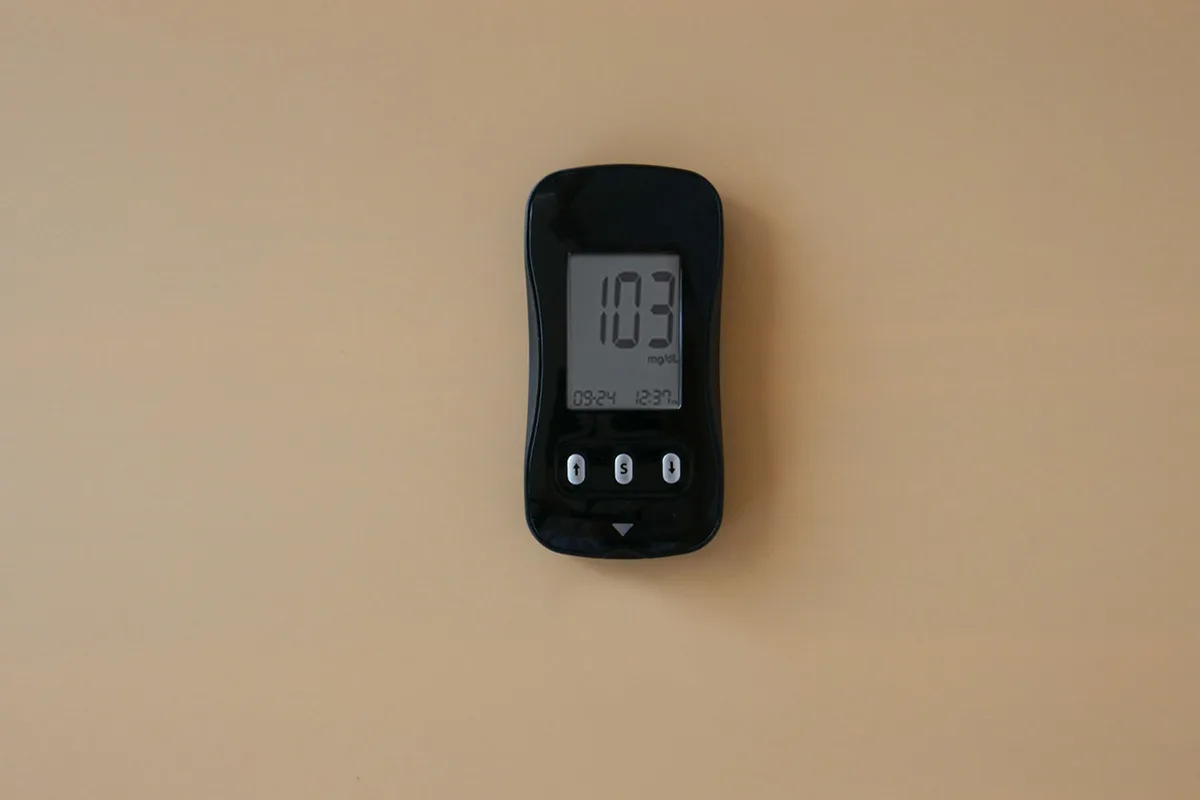
What else should be checked?
Your thyroid, and this one comes with a strongly worded instruction rather than a suggestion. The same endocrine thread that connects frozen shoulder to diabetes also connects it to thyroid dysfunction, and both are conditions that become more common in exactly this decade of life.
A 2021 review puts it plainly: frozen shoulder is “a condition often associated with diabetes and thyroid dysfunction, and which should always be investigated in patients with a primary stiff shoulder.” Not considered. Always investigated.
That phrasing matters because of what usually happens instead. A frozen shoulder is an orthopaedic-feeling problem, so it gets an orthopaedic-feeling response: rest it, move it, injection, physio. The two blood tests that the literature says should always be done can slip past the entire appointment, because nobody in the room is thinking about blood.
The sentence to say out loud. “I've read that frozen shoulder is strongly associated with diabetes and thyroid problems and that both should be checked — can we do an HbA1c and a TSH?” Those are the two tests by name. You're not diagnosing yourself or arguing with anyone; you're asking for two routine bloods that the research says belong with this diagnosis.
And if either comes back abnormal, you have gained something far more valuable than a shoulder explanation. Undiagnosed type 2 diabetes and an untreated thyroid are both worth finding on their own terms, years before they would otherwise have surfaced.
And if you already know you have diabetes?
Then this section doesn't drop out of your path — it changes shape. Two things are worth doing rather than one.
Ask for a current HbA1c anyway, because the shoulder is a reason to look at how the diabetes is actually running right now. And flag the diabetes before any steroid injection, because an injection into the shoulder joint measurably moves blood glucose.
That is not a reason to refuse the injection — it's the treatment that held its own against surgery in the trial further down this page. It's a reason to tell whoever manages your diabetes that it's happening, and to expect a higher reading the next day rather than be alarmed by one.
Why is it worst at night?
Because of what happens to the joint when you lie still and when you lie on it — and because night pain is not an incidental detail of this condition. It's so characteristic that the UK's National Health Service lists it among the two defining symptoms, with the sleep consequence named explicitly.
The NHS describes the symptoms as “pain in your shoulder which can be worse at night and disturb sleep,” alongside “stiffness in your shoulder which makes it difficult to move.” On a site about midlife sleep, that's the sentence that earns this article its place.
Two things drive it. Lying on the affected side compresses a joint whose capsule is already tight and inflamed, which is why so many women describe being woken the moment they roll over in their sleep. And during the day, movement keeps things loose in a way that stillness doesn't — so the shoulder stiffens overnight and the first movement of the morning is the worst one.
What actually helps the nights, practically. Most women work out some version of this for themselves, but it takes a while: sleep on the unaffected side with a pillow hugged in front of you, so the painful arm rests supported and slightly forward rather than hanging across your body or pinned underneath. Some find a second pillow wedged behind the back stops them rolling over in their sleep.
This is also where frozen shoulder quietly becomes a sleep problem rather than a shoulder problem. Months of being woken several times a night has its own consequences, and they compound the ones the menopause transition is already producing. Our guides to menopause fatigue and getting back to sleep at 3 a.m. are about that half of the problem.
How long does it actually last?
Longer than anyone wants to hear, and the honest sources decline to give a tidy figure. The NHS says frozen shoulder “can take months or years to get better,” adding that “the pain and stiffness will usually go away eventually.” Note the two hedges in that sentence: usually, and eventually.
The 2021 review is more specific, and more encouraging: “most patients respond very well to combination of conservative treatment resulting in gradual resolution of symptoms in 12–18 months.” It also notes that the traditional staging of frozen shoulder into phases has a duration that “is not constant and varies with the intervention.”
That last point is worth pulling out, because the three-phase story — freezing, frozen, thawing — gets presented online as a fixed timetable you can count down. The phases are a useful planning tool for clinicians, not a schedule. Yours won't necessarily take the length someone's chart says it should.
And it doesn't always simply resolve. The Journal of Bone and Joint Surgery review notes that frozen shoulder “may cause protracted disability.” That is a real caveat on the reassuring version of this condition, and it's a reason to treat it actively rather than waiting out a timetable. “It'll sort itself out” is mostly true and not always true — if you're a year in and no better, that's a reason to go back, not to keep waiting.

What actually works?
Here the evidence is unusually clear, and unusually reassuring if you've been told you might need an operation. A large UK trial compared the two surgical options against the non-surgical one, and the result was not what the people who run shoulder clinics expected.
Sit with that for a second. The least invasive option — twelve sessions of structured physiotherapy with a steroid injection — performed about as well at a year as having your shoulder capsule surgically divided under general anaesthetic. And the surgery that performed marginally best on the score was also the one that hurt the most people.
That doesn't make surgery pointless. The 2021 review describes the usual sequence: resistant cases that haven't responded to conservative treatment for six to nine months may be offered surgery. The trial's message isn't “never operate” — it's that starting with physiotherapy and an injection is not a lesser option you're being fobbed off with.
One caution on the manipulation route, from that same review: manipulation under anaesthesia “could result in unwarranted complications like fractures of humerus or rotator cuff tear.” The trial found it the most cost-effective of the three, but it is not risk-free, and that's a conversation to have rather than a box to tick.
The practical reading of all that. If you've been offered physiotherapy and a steroid injection, that is the least invasive of the three options the UK FROST trial found clinically equivalent — not a holding pattern.
If you've been offered surgery as a first move, the trial is a fair thing to ask about. And if you've had six to nine months of proper conservative treatment with no change, that's the point at which the surgical conversation genuinely opens up.
What if it isn't frozen shoulder?
Shoulder pain in your fifties has several causes and they get confused with each other constantly, partly because “frozen shoulder” has become the folk name for any stiff painful shoulder. The distinguishing question is the one from the top of this article: is passive external rotation genuinely blocked, or just painful?
Things that commonly get called frozen shoulder and aren't:
- Rotator cuff problems. Pain on lifting and weakness, but the joint can usually still be rotated outward by someone else. This is a common mix-up.
- Osteoarthritis of the shoulder. Stiffness too, but with a grinding quality and a different pattern on imaging.
- Neck problems referring pain down. If the pain travels past your elbow, or comes with tingling or numbness in the hand, the neck is a likelier source than the shoulder.
- Polymyalgia rheumatica. This one matters because it's a different kind of condition with a different treatment, and it looks superficially similar in exactly this age group. The NHS describes “pain and stiffness in the shoulders, neck and hips, which develops quickly over a few days or weeks,” adds that “both sides of the body are usually affected,” and that the stiffness is worst on waking and “usually starts to improve after about 45 minutes as you become more active.” Frozen shoulder is typically one shoulder, and it doesn't loosen off within the hour the way the polymyalgia stiffness does.
- Secondary frozen shoulder. The same capsular contracture, but following an injury, surgery or a period of immobility. For women in this age group, breast surgery, axillary node surgery and radiotherapy to that area all belong on that list — and if that's your history, say so unprompted, because it changes the diagnosis from “no known cause” to one with a known trigger.
What about the other shoulder?
It's one of the first questions people ask, and the one I can give the least satisfying answer to. Frozen shoulder can affect the second shoulder, either at the same time or later, and it's reported more often in people with diabetes — but I couldn't find a figure I'd trust enough to put a number on it here.
What I will say is that both shoulders going stiff together, at the same time, in your fifties, is the pattern that should make polymyalgia rheumatica part of the conversation rather than assuming it's two frozen shoulders at once.
When should you get help now?
Most stiff painful shoulders in midlife are not dangerous, and this list isn't here to make you anxious about an ordinary one. It's that a few specific patterns need seeing today or this week rather than going into a physiotherapy queue, and they're recognisable.
Emergency, today
- Shoulder pain with chest tightness or discomfort, breathlessness, sweating or nausea. The US National Heart, Lung, and Blood Institute lists “pain in the shoulder, back, or arm” among the symptoms women are more likely to have during a heart attack, and notes these “can happen together with chest pain or without any chest pain.” Pain spreading to the jaw or neck is a recognised heart attack symptom in anyone. This is an ambulance question, not an appointment question.
- A shoulder that looks deformed, or that you genuinely cannot move at all, or shoulder pain straight after a fall or injury.
- Pain with fever or feeling systemically unwell — an infected joint is rare but it is urgent.
- New weakness or numbness in the arm or hand, as opposed to pain limiting what you do.
This week, not in six weeks
- You have, or have had, cancer — and this is new night-time shoulder or arm pain. I've spent this article explaining that night pain is the hallmark of frozen shoulder, so I need to say the other half: in someone with a cancer history, new bone pain that is worse at night is also how secondary deposits present. It doesn't mean that's what this is. It means your history changes who should look at it and how soon.
- Pain that doesn't ease in any position, including lying still, or that is steadily worsening week on week rather than settling into a pattern.
- Unexplained weight loss, persistent fever or night sweats alongside the shoulder.
- Stiffness in both shoulders, neck and hips at once, worse in the morning — the polymyalgia pattern, which responds to a completely different treatment.
And one sight-threatening combination worth knowing by name. The NHS notes that up to 1 in 5 people with polymyalgia rheumatica develop temporal arteritis, and says to seek help immediately for “a new or frequent headache that usually develops suddenly,” “pain in the jaw muscles or tongue when eating or talking,” or “problems with sight, such as double vision or loss of vision.”
Untreated, temporal arteritis can cause blindness. So if you have widespread shoulder and hip stiffness plus any of those three symptoms, that's today rather than next week.
What should you do first?
Five things, in an order that deliberately puts the urgent and the cheap ahead of the slow. None of this replaces a diagnosis, and a shoulder that has been painful or stiff for months deserves a proper examination rather than a plan you manage on your own from a website.
- First, rule out the list above. If your shoulder pain comes with chest tightness, breathlessness, sweating or nausea, this list is not for you — that's an emergency assessment now. If it followed a fall, comes with fever, or there's new weakness in the arm, be seen the same week. And if you have a cancer history and this is new night pain, say that first, before anything else on this page.
- Get the external rotation checked by someone else. It's the sign that separates this from the conditions it's confused with, and it's a thirty-second examination. Say that's what you want looked at — and if your stiffness is in both shoulders, your neck and your hips, ask about polymyalgia rheumatica by name instead — and if you also have a new headache, jaw pain on chewing or any change in your sight, that is today, not an appointment.
- Ask for the HbA1c and the TSH. Thirty percent of people with this diagnosis have diabetes, and the review language is “should always be investigated.” This is the step most likely to be skipped and the one most likely to change something that matters. If you already have diabetes: still ask for a current HbA1c, and tell them before any steroid injection.
- If step 2 confirmed the blocked rotation, start the physiotherapy and treat it as the real treatment. On the best trial available it held its own against surgery at a year, and twelve sessions with a steroid injection was the comparator nothing beat clinically. If step 2 pointed somewhere else — neck, cuff, polymyalgia — this isn't your treatment, because that trial only enrolled people with genuine capsular restriction. And if your frozen shoulder followed surgery or an injury, say so, because that history belongs in the plan.
- Deal with the pain and the nights while you wait. Unaffected side, pillow hugged in front, pillow behind your back. Ask specifically what you should be taking for pain, and for how long — months of untreated night pain is its own injury, and a year-long condition deserves a proper answer on analgesia. That's a question for your doctor or pharmacist rather than something to work out from a website.
And if you're already six to nine months in with proper conservative treatment and nothing has changed, that's the point the surgical conversation genuinely opens up — not a reason to keep waiting out a timetable.
What I'd avoid. Forcing the movement through real pain in the belief that you're breaking up adhesions — the trial's physiotherapy arm was “mobilisation techniques and a graduated home exercise programme,” which is a different thing from wrenching it.
And don't accept “it's your hormones” as the end of the conversation. Even if that answer eventually turns out to be partly right, it has no test and no treatment attached to it. The metabolic answer has both.
Where to go from here
If the broader joint aches are the bigger problem, menopause joint pain at night covers the generalised version, and hip pain at night the other joint that commonly flares in midlife. If it's the sleep damage that's wearing you down, start with menopause fatigue. And our honest look at HRT covers the hormone decision on its actual merits, which is where it should be made.
For how all of this fits into the bigger picture of midlife sleep, start at the complete perimenopause and menopause sleep guide.
Key takeaways
- Frozen shoulder is formally classified as idiopathic — of unknown cause — and yet, in the words of a 2026 study, “typically affects women aged 40–60 years.” That mismatch is the honest state of the field.
- The defining sign is selective loss of passive external rotation: someone else rotating your forearm outward with your elbow at your side. You cannot test it on yourself, so “I can still move it” proves nothing.
- The most direct attempt to test whether hormone therapy protects against it found 7.65% of women not on HT affected versus 3.95% on it — roughly twice the odds, but not statistically significant (OR 1.99, 95% CI 0.86–4.58, p = 0.10), from only 152 women on HT, in a study that calls itself a pilot. Not yet known.
- Around 30% of people presenting with frozen shoulder have diabetes (95% CI 24–37%), and the meta-analysis authors conclude that screening for diabetes should be considered in anyone presenting with it.
- How much diabetes raises the risk is less settled: case-control studies say 3.69×, but forward-looking cohort studies say 1.32× and 1.67×, and the reviewers judged most studies at high risk of bias. The 30% figure is the one that justifies the test.
- A 2021 review says frozen shoulder is often associated with diabetes and thyroid dysfunction and “should always be investigated.” Ask for both blood tests by name.
- The NHS lists pain “worse at night” that disturbs sleep as one of the two defining symptoms. It is a sleep problem as much as a joint problem.
- Duration is months to years; one review puts gradual resolution at 12–18 months with conservative treatment, but the phases are not a fixed timetable and it “may cause protracted disability.”
- In a 503-patient trial across 35 UK hospitals, none of manipulation under anaesthesia, arthroscopic capsular release or physiotherapy plus steroid injection was clinically superior, and the capsular release carried higher risks. Physiotherapy and an injection is a real treatment, not a holding pattern.
- If you already have diabetes, the path changes rather than disappearing: ask for a current HbA1c, and mention the diabetes before a steroid injection — in one small study fasting glucose was significantly higher the day after a joint injection, and back to baseline within a week.
- New night-time shoulder or arm pain in someone with a cancer history needs seeing promptly. Night pain is the hallmark of frozen shoulder, which is exactly why this article says the other half out loud.
- Stiffness in both shoulders, neck and hips at once, worse on waking and easing after about 45 minutes, is the polymyalgia rheumatica pattern — a different condition with a different treatment, and one that can bring sight-threatening temporal arteritis with it.
- Shoulder pain with chest tightness, breathlessness, sweating or nausea needs emergency assessment. The NHLBI lists shoulder, back or arm pain among the symptoms women are more likely to have in a heart attack, and says it can happen with or without chest pain.
Frequently asked questions
Is frozen shoulder caused by menopause?
Nobody knows. It's still formally classified as idiopathic, meaning of unknown cause, while typically affecting women aged 40 to 60. That pattern makes hormones a reasonable suspicion, but suspicion isn't evidence, and the most direct attempt to test it did not find a significant effect.
Does hormone therapy prevent frozen shoulder?
Not proven. In 1,952 postmenopausal women, 7.65% of those not on hormone therapy had it versus 3.95% of those on it — about twice the odds, but not statistically significant (OR 1.99, 95% CI 0.86-4.58, p = 0.10), from only 152 women on therapy. The authors called it a pilot and asked for a bigger study.
Why should I get tested for diabetes if I have frozen shoulder?
Because around 30% of people presenting with frozen shoulder have diabetes, according to a meta-analysis of 18 studies, and some don't yet know it. The authors conclude that screening for diabetes should be considered in anyone presenting with frozen shoulder. A 2021 review adds thyroid to that list.
How do I know it's frozen shoulder and not a rotator cuff problem?
The distinguishing sign is selective loss of passive external rotation — someone else holding your elbow at your side and rotating your forearm outward. With a rotator cuff problem that movement usually still happens. You cannot test it yourself, because other muscles compensate and hide the restriction.
Why is frozen shoulder so much worse at night?
Lying on the affected side compresses a joint capsule that is already tight and inflamed, and stillness lets it stiffen. The NHS lists pain "worse at night" that disturbs sleep as one of the two main symptoms. Many women find that sleeping on the other side, with a pillow hugged in front, helps most.
How long does frozen shoulder last?
Months to years. The NHS says it "can take months or years to get better" and that pain and stiffness "will usually go away eventually." A 2021 review puts gradual resolution at 12 to 18 months with conservative treatment, but warns the phases are not a fixed timetable.
Do I need surgery for frozen shoulder?
Probably not as a first step. In a 503-patient trial across 35 UK hospitals, neither manipulation under anaesthesia nor arthroscopic capsular release was clinically superior to physiotherapy plus a steroid injection at 12 months, and the capsular release carried higher risks. Surgery is usually considered after 6 to 9 months without improvement.
When is shoulder pain an emergency?
Shoulder pain with chest tightness, breathlessness, sweating or nausea needs emergency assessment. The NHLBI lists shoulder, back or arm pain among the symptoms women are more likely to have in a heart attack, with or without chest pain. Also urgent: pain after a fall, a deformed shoulder, fever, or new weakness in the arm.
I already have diabetes. Does any of this change?
The path changes rather than disappearing. Ask for a current HbA1c anyway, because the shoulder is a reason to look at how things are running now. And mention the diabetes before any steroid injection: in one small study, fasting glucose was significantly higher the day after a joint injection and back to baseline within a week.
Should I worry if I have had cancer?
Tell whoever sees you, and say it early. Night-time shoulder or arm pain is the hallmark of frozen shoulder, but in someone with a cancer history new bone pain that is worse at night is also how secondary deposits present. It doesn't mean that's what this is — it means your history changes who should look at it, and how soon.
Sources cited
- Reinke EK, Ford AC, Wahl E, Kennedy J, Poehlein E, Green CL, Saltzman E, Wittstein JR. A preliminary pilot study to address design issues related to research on potential association of hormone therapy and adhesive capsulitis. Climacteric. 2026;29(3):478–483. doi:10.1080/13697137.2026.2615391. pubmed.ncbi.nlm.nih.gov
- Zreik NH, Malik RA, Charalambous CP. Adhesive capsulitis of the shoulder and diabetes: a meta-analysis of prevalence. Muscles Ligaments Tendons J. 2016;6(1):26–34. doi:10.11138/mltj/2016.6.1.026. pmc.ncbi.nlm.nih.gov
- Dyer BP, Rathod-Mistry T, Burton C, van der Windt D, Bucknall M. Diabetes as a risk factor for the onset of frozen shoulder: a systematic review and meta-analysis. BMJ Open. 2023;13(1):e062377. doi:10.1136/bmjopen-2022-062377. pubmed.ncbi.nlm.nih.gov
- Rangan A, Brealey SD, Keding A, et al. Management of adults with primary frozen shoulder in secondary care (UK FROST): a multicentre, pragmatic, three-arm, superiority randomised clinical trial. Lancet. 2020;396(10256):977–989. doi:10.1016/S0140-6736(20)31965-6. pubmed.ncbi.nlm.nih.gov
- Robinson CM, Seah KT, Chee YH, Hindle P, Murray IR. Frozen shoulder. J Bone Joint Surg Br. 2012;94(1):1–9. doi:10.1302/0301-620X.94B1.27093. pubmed.ncbi.nlm.nih.gov
- Pandey V, Madi S. Clinical guidelines in the management of frozen shoulder: an update! Indian J Orthop. 2021;55(2):299–309. doi:10.1007/s43465-021-00351-3. pubmed.ncbi.nlm.nih.gov
- Moon HJ, Choi KH, Lee SI, Lee OJ, Shin JW, Kim TW. Changes in blood glucose and cortisol levels after epidural or shoulder intra-articular glucocorticoid injections in diabetic or nondiabetic patients. Am J Phys Med Rehabil. 2014;93(5):372–378. doi:10.1097/PHM.0000000000000001. pubmed.ncbi.nlm.nih.gov
- National Health Service (UK). Frozen shoulder — symptoms, duration and treatment. nhs.uk
- National Health Service (UK). Polymyalgia rheumatica — symptoms, and temporal arteritis warning signs. nhs.uk
- National Heart, Lung, and Blood Institute (NIH). Heart attack symptoms, and heart attacks in women. nhlbi.nih.gov
How this article was checked
Every figure and quotation here was read at its primary source: seven peer-reviewed papers, including the Lancet trial and two systematic reviews, plus patient pages from the UK National Health Service and the US National Heart, Lung, and Blood Institute. All ten sources are listed and linked in full above.
Where the sources disagreed, both numbers are shown rather than the more striking one — the diabetes risk estimates in particular range from 1.32 to 5 times depending on study design, and that range is in the article.
It has not been reviewed by a clinician. Ellen Hayes is a researcher and writer, not a doctor, and nothing here is a diagnosis or a substitute for being seen by one.

Ellen Hayes
Health & Wellness Writer and Researcher
Hi — I'm Ellen. I started this one expecting to write about hormones and ended up writing about a blood test. That happens more often than I'd have guessed when I started reading research instead of articles.
I'm not a doctor. I'm not an expert — and I'm never going to talk down to you like one. I'm a woman in the middle of perimenopause who got tired of vague answers, started reading the actual research, and writes it down here in plain English, the way I'd explain it to a friend over coffee. More about Ellen →