Lunesta for Menopause Insomnia: Trial Results and Safety
Lunesta has something many sleep remedies do not: placebo-controlled trials in women going through menopause. That is useful evidence, but an important detail can get lost when the findings become a recommendation on a screen: those trials used 3 mg.
The current prescribing information recommends a starting dose of 1 mg for adults. I read the trial abstracts and prescribing information together to understand the gap, the possible benefit, and the warnings that need to be part of the same conversation.
Lunesta, the brand name for eszopiclone, is a prescription sleep medicine studied in women with menopause-related insomnia. Trials found sleep benefits, but they used 3 mg, while the current adult starting dose is 1 mg. Next-day impairment and potentially dangerous complex sleep behaviors remain important risks, even when the medicine is taken as directed.
What is Lunesta, and which sleep problems can it help?
Lunesta is eszopiclone, a prescription medicine for insomnia that can help with falling asleep and maintaining sleep. It belongs to the group often called Z-drugs. It is not hormone therapy, and its sleep indication does not establish that it treats every reason a woman wakes during perimenopause or after menopause.
The Lunesta prescribing information describes a controlled prescription medicine. The clinical question is whether its expected benefit fits your sleep problem and circumstances, not whether a branded medicine is stronger than something you can buy without a prescription.
Start with a description of your nights. Trouble falling asleep, repeated awakenings and waking early are different experiences, even when all leave you exhausted. Our menopause insomnia guide helps organize that broader assessment before the discussion narrows to a particular medicine.
What did the larger trial in menopausal women find?
A four-week trial studied eszopiclone 3 mg in 410 women aged 40 to 60 during perimenopause or early postmenopause. Compared with placebo, women reported improvements in several sleep outcomes and next-day functioning. This was evidence in a relevant group, but it was short-term and used a dose above today's recommended starting dose.
The 2006 Soares trial enrolled women whose insomnia included taking at least 45 minutes to fall asleep and sleeping six hours or less on at least three nights a week. Participants were assigned to nightly eszopiclone or placebo, with daily sleep reports and assessments of other symptoms.
The abstract reports improvements in sleep induction, maintenance, duration and quality, as well as fewer awakenings attributed to hot flashes. I read the abstract rather than the full report. It does not give the size of every benefit in minutes, so this article does not turn its positive result into an invented promise of extra sleep.
The selection criteria matter when applying the result. The women had specified insomnia symptoms and were studied during particular reproductive stages. A positive result does not establish that everyone with an occasional bad night should use the same medicine or the same dose.
At an appointment, ask whether the evidence resembles your situation. That includes the pattern of insomnia, other symptoms, medicines you already use and what you need to do the following morning. The trial is a starting point for that discussion, rather than a finished prescription.
Did another study find an effect on hot flashes?
A smaller crossover trial studied eszopiclone in women with insomnia, hot flashes and depressive or anxiety symptoms. It found improvements in insomnia and nighttime hot flashes, but not daytime hot flashes. That distinction matters: better sleep-related outcomes in a selected study do not make Lunesta an established general treatment for menopausal vasomotor symptoms.
That is a result on a symptom scale, not 8.7 extra hours of sleep or a guarantee of an individual response. The small sample, selected symptoms and limited duration constrain the conclusion. As with the larger study, the abstract is the source used here; I have not presented it as a full-text review.
If hot flashes are the main problem, our hot-flash guide and HRT and insomnia article cover the separate treatment discussion. The question is which symptoms need addressing, rather than assuming improvement on one measure means every part of menopause has been treated.
Why is the trial dose different from the starting dose today?
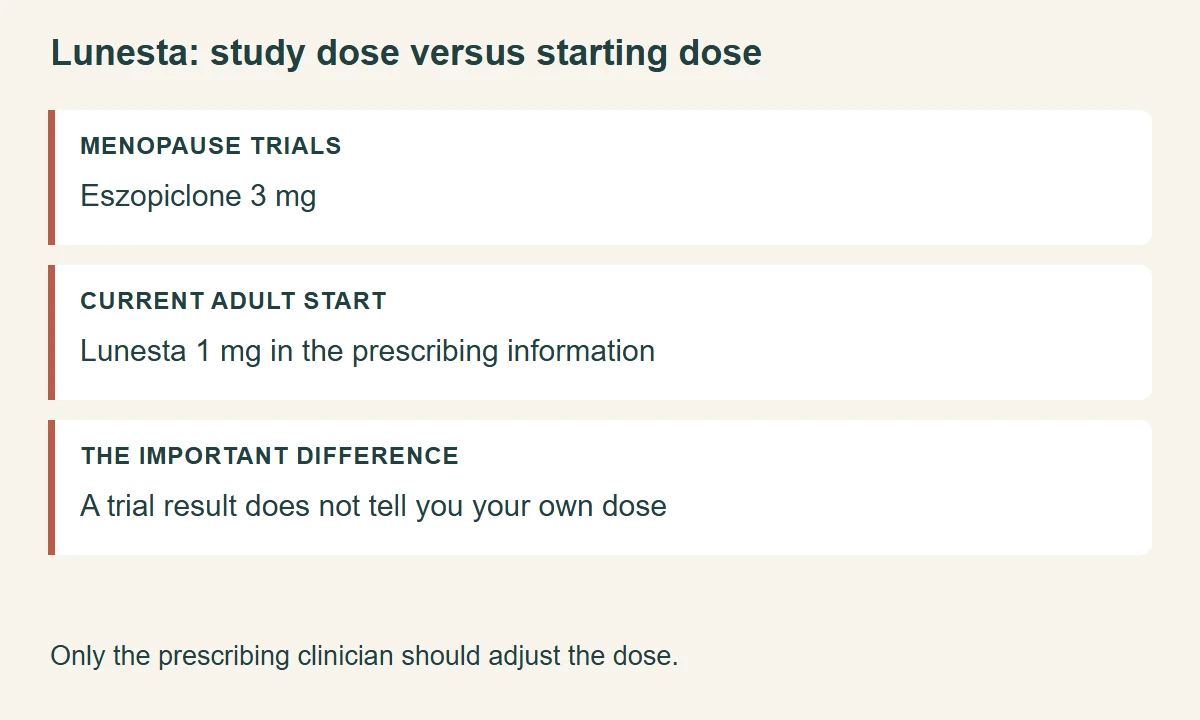
The menopause trials discussed here used eszopiclone 3 mg, but the current Lunesta label recommends starting adults at 1 mg. A clinician may adjust the prescription when appropriate. Higher doses can increase next-day impairment. A dose that produced a trial result is not a direction to start at that dose yourself.
The maximum labeled adult dose is 3 mg once nightly. For elderly or debilitated patients, people with severe liver impairment, or those taking potent CYP3A4 inhibitors, the label limits the dose to 2 mg. These are prescribing limits, not a personal dosing recommendation.
| Context | Dose described | What it means |
|---|---|---|
| The two menopause trials | 3 mg | A study detail, not the current starting instruction |
| Current adult starting dose | 1 mg | Use the exact prescription and pharmacist's instructions |
| Selected higher-risk groups | Maximum 2 mg in the label | The prescriber must review conditions and interactions |
The label says to take Lunesta immediately before bedtime with at least seven to eight hours remaining before the planned wake time. A heavy, high-fat meal can slow absorption and reduce its effect on getting to sleep. Ask how the directions fit your evening rather than adding another tablet because you do not feel sleepy quickly.
Bring practical constraints into that conversation: early driving, overnight caregiving or an irregular work schedule. A workable prescription needs instructions you can actually follow. It should also explain what to do after a missed dose or a night when the medicine does not seem to help.
Can you be impaired the next day without feeling very sleepy?
Lunesta can impair next-day alertness and coordination, sometimes without the person recognizing it. Risk rises with higher doses, insufficient time for sleep and interacting sedatives. The label specifically cautions people using 3 mg about driving and other hazardous activities the following day. Feeling subjectively better does not reliably establish your ability to drive safely.
This is why the morning belongs in a sleep-medicine consultation. Ask whether a planned early drive, physical work or other activity requiring full alertness changes the decision. Do not use this article or a good night's sleep as clearance to drive after a prescription that carries a warning.
The prescribing information also notes that drowsiness and decreased consciousness can increase fall risk, particularly in older people. Tell the clinician if you have fallen, feel unsteady, or already take medicines that affect alertness. Those details belong in the assessment before a dose is increased.
For comparison, our Ambien article explains a different Z-drug's dosing and warnings. Comparing medicines does not mean choosing whichever sounds least sedating online. It means asking which evidence, risks and instructions fit the person who will actually take it.
What does the boxed warning about sleep behaviors mean?
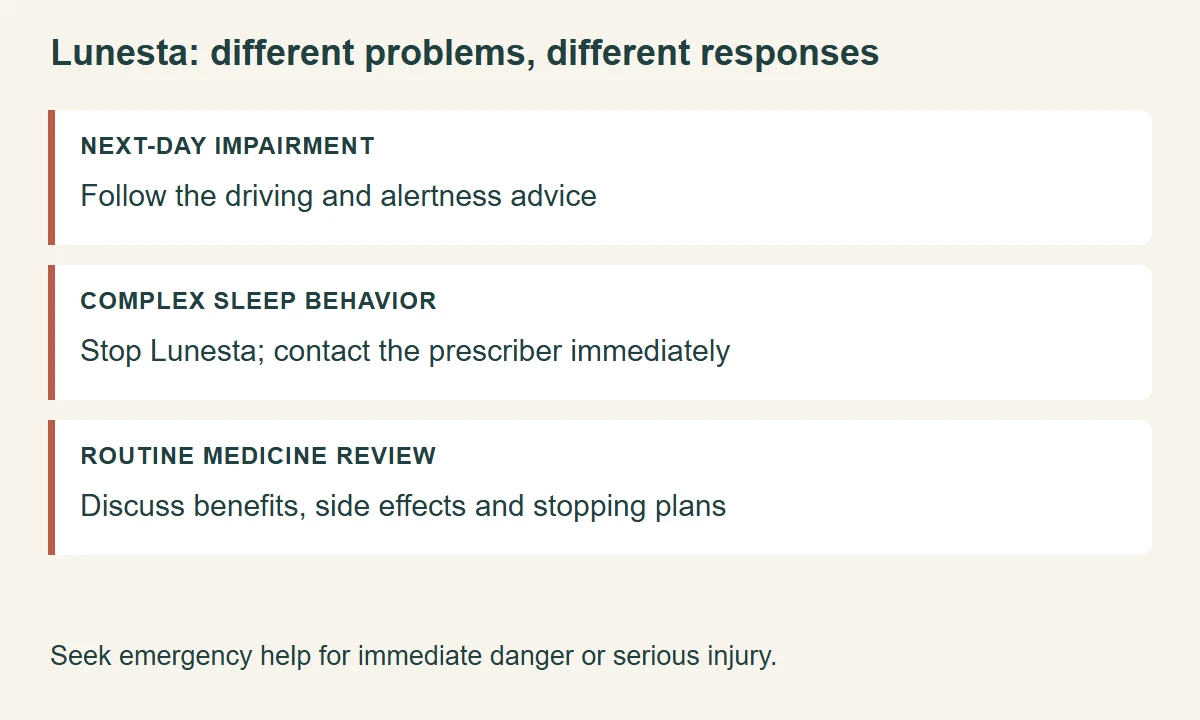
Lunesta carries a boxed warning about activities performed while not fully awake, including sleepwalking or sleep-driving, that can cause serious injury or death. They can happen after the first or a later dose, including at recommended doses. Stop Lunesta and contact the prescriber immediately if a complex sleep behavior occurs.
MedlinePlus tells patients to make family or caregivers aware of these behaviors because the person may not remember them. The issue is different from an unpleasant taste or an ordinary vivid dream; it requires a response rather than waiting for a routine review.
The label contraindicates Lunesta in people who have already experienced complex sleep behaviors after taking it. It also warns that such events can occur without alcohol or another sedative. Avoiding a combination that raises risk does not remove the medicine's own warning.
Stop Lunesta and call the prescriber right away after a complex sleep behavior. Seek emergency help for immediate danger, serious injury, breathing difficulty or swelling of the tongue or throat. Keep the medication information available so the treating team can see what was taken.
Which medicines and health conditions need checking first?
Lunesta requires a review of alcohol, other sedatives, interacting prescriptions and relevant health conditions. Medicines that inhibit CYP3A4 can raise exposure, while some inducers reduce it. Breathing problems, severe liver disease, depression, pregnancy and breastfeeding need discussion. Do not combine it with another sleep medicine or change the dose without guidance.
The label describes additive effects with alcohol, opioids, benzodiazepines and other central nervous system depressants. It does not recommend taking another sedative-hypnotic at bedtime or in the middle of the night. Bring the packages if you have been trying several products; the names on the front may hide overlapping ingredients.
Do not drink alcohol while taking Lunesta. Alcohol can add to impairment, and avoiding alcohol does not eliminate the medicine's complex-sleep-behavior risk.
Strong CYP3A4 inhibitors such as ketoconazole can increase eszopiclone exposure. This is one reason a newly prescribed antibiotic or another medicine should trigger a pharmacist's check rather than an assumption that an established sleep prescription stays unchanged. Do not adjust the dose from a list in an article.
The label also calls for care with respiratory impairment and depression, including worsening mood or suicidal thinking. Report new behavioral or mood changes promptly. If pregnancy is possible, planned, or breastfeeding is relevant, tell the prescriber; being in perimenopause does not remove those questions.
Where does Lunesta fit alongside CBT-I and other options?
Lunesta may be one option in an individualized insomnia plan, but cognitive behavioral therapy for insomnia remains a primary treatment for chronic insomnia. The AASM guideline gives eszopiclone a weak recommendation for sleep onset and maintenance. The decision should weigh benefit, harms, alternatives and follow-up rather than treat a positive trial as a universal answer.
The 2017 AASM guideline bases its eszopiclone recommendation on 2 and 3 mg studies. A weak recommendation reflects uncertainty and the need for individual choices, not a statement that a medicine never helps. It also does not supersede the current label's lower starting dose.
Ask what would count as enough benefit to continue and when the first review will happen. The label calls for reevaluation if insomnia has not improved after seven to ten days. A persisting problem deserves another look at the explanation, not simply another sleep product added to the nightstand.
Our CBT-I guide covers the structured non-drug treatment. If you are already taking Lunesta, ask the prescriber how to review or stop it when appropriate; rapid dose reduction or stopping can cause withdrawal effects. The boxed-warning instruction to stop after a complex sleep behavior is a separate urgent situation.
Before the visit ends, make the plan concrete: the exact prescription, what to avoid combining, what you may do the following morning, the review date and whom to call about a problem. That plan connects the evidence to everyday life, which is the part a study cannot decide for you.
Where to go from here
Our menopause insomnia guide is the starting point. Compare sleeping pills, Ambien and Belsomra without treating them as interchangeable. For maintenance-focused treatment, read low-dose doxepin for sleep; for the main non-drug approach, see CBT-I.
Key takeaways
- Lunesta has placebo-controlled evidence in perimenopausal and postmenopausal women with specified insomnia symptoms.
- The menopause studies used 3 mg; today's labeled adult starting dose is 1 mg.
- The smaller trial improved nighttime, not daytime, hot flashes; this does not make Lunesta a general hot-flash treatment.
- Next-day impairment may occur without obvious sleepiness, and complex sleep behaviors carry a boxed warning.
- Review interactions, CBT-I, benefits, stopping instructions and follow-up with the prescribing team.
Frequently asked questions
Has Lunesta been studied for menopause insomnia?
Yes. A four-week placebo-controlled trial studied eszopiclone 3 mg in 410 women aged 40 to 60 during perimenopause or early postmenopause and reported sleep improvements. A smaller crossover study also found benefit. These are relevant findings, but neither provides a reason to start at the trial dose without a prescription.
What is the starting dose of Lunesta for women?
The current Lunesta label recommends an adult starting dose of 1 mg immediately before bedtime, with at least seven to eight hours before the planned wake time. The menopause studies used 3 mg, which is a different question. Follow your prescription; dose increases and special limits require a clinician's assessment.
Does Lunesta stop hot flashes?
Lunesta is not hormone therapy or an established general hot-flash treatment. A small study in women with insomnia and other menopausal symptoms found improvement in nighttime, but not daytime, hot flashes. That result should be kept within the study's limits. Discuss sleep difficulty and vasomotor symptoms as related but distinct treatment questions.
Can Lunesta affect driving the next morning?
Yes. Lunesta can impair next-day alertness and coordination, including when you do not recognize the impairment. Higher doses and other sedatives can increase risk. The label specifically cautions people taking 3 mg about driving and hazardous activities the following day. Ask the prescriber how the warning affects your own schedule.
What should I do if sleepwalking happens on Lunesta?
Stop Lunesta and contact the prescriber immediately if you experience sleepwalking, sleep-driving or another activity performed while not fully awake. These complex sleep behaviors can cause serious injury and may happen at recommended doses. Seek emergency help for immediate danger or injury, and make sure family or caregivers know about the warning.
Can Lunesta be combined with another sleep aid?
Do not combine Lunesta with another sleep medicine without the prescriber's advice. The label does not recommend other sedative-hypnotics at bedtime or during the night, and alcohol or other central nervous system depressants can add impairment. Ask a pharmacist to check prescription medicines, occasional products and supplements before taking them together.
Sources cited
- Lunesta prescribing information, effective January 8, 2025, read through openFDA — Read source
- MedlinePlus: Eszopiclone — Read source
- Soares et al., eszopiclone in perimenopause and early postmenopause, 2006; abstract read — Read source
- Joffe et al., eszopiclone in women with insomnia and hot flashes, 2010; abstract read — Read source
- Sateia et al., AASM pharmacologic guideline, 2017, eszopiclone and CBT-I sections — Read source

Ellen Hayes
Health & Wellness Writer and Researcher
I compare prescribing information and research so the differences are easier to discuss with a clinician. This article is a research summary, not a medical review or a personal treatment recommendation. About Ellen and the site.