Cooling Comforters for Menopause Night Sweats: What Works
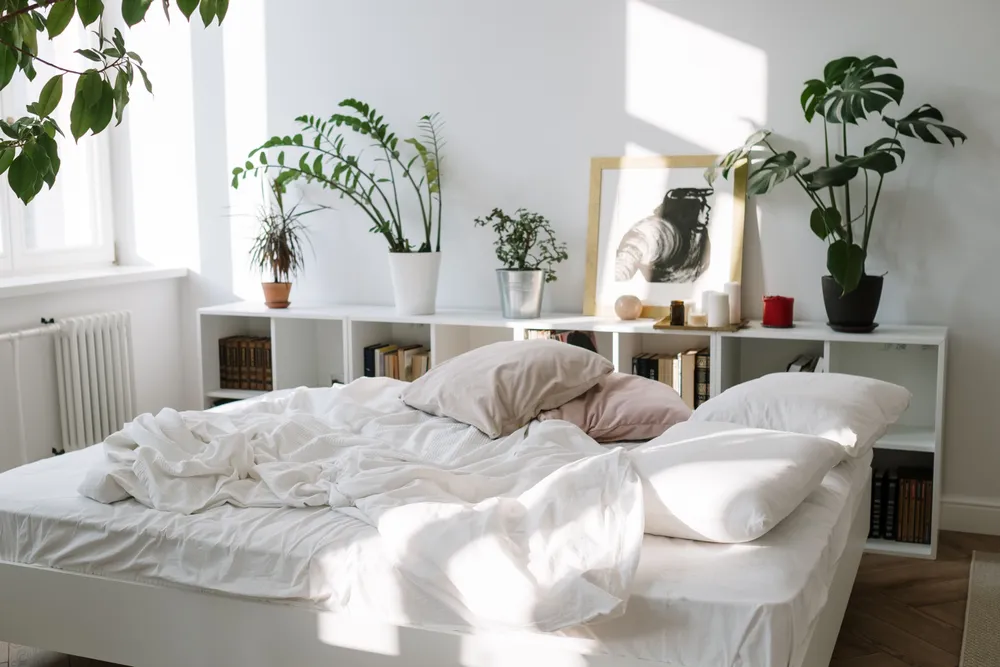
A cooling comforter swaps heavy fill and tightly woven synthetics for lighter fill and breathable, moisture-wicking fabric — real physics, similar to cooling sleepwear. No study has tested comforter fill specifically in a hot room; every duvet trial in the best available review used cool conditions. It's a reasonable upgrade, not a proven fix.
Every "cooling" product on this site's shelf eventually gets the same question from me: is this real physics, or is "cooling" just a word on a tag? The comforter is the one directly on top of you for eight hours, so it felt worth a proper look rather than an assumption.
What I found was honest, if a little deflating. The fabric science behind breathable, moisture-wicking bedding is real and reasonably well studied. But when I went looking for research that tested comforter fill in a genuinely hot room — the way a hot flash actually feels — it wasn't there. Here's what the evidence does and doesn't cover.
The honest framing up front: nobody has tested comforter fill material specifically in a hot room. What exists is real fabric-science research — just done in cool rooms, on a different product, or both. Treat this as an informed upgrade, not a proven treatment.
What actually makes a comforter "cooling"?
Two things, mainly: less fill, and a shell fabric that breathes. A cooling comforter uses a lower fill power or fill weight than a traditional winter duvet, so there's simply less insulating material trapping heat against you, wrapped in cotton percale, linen, or Tencel/lyocell instead of a tightly woven polyester blend.
Fill power is the number to check on the label: it measures how much loft, and so how much warmth, a given weight of fill produces. A lower number means a lighter, cooler comforter for the same size.
Regular heavy comforters are built to trap heat efficiently, which is exactly the wrong job for someone waking up drenched. A "cooling" version is doing the opposite on purpose — less insulation, more airflow, and fabric that pulls moisture away from your skin instead of holding it against you overnight.
Does comforter material actually change how hot you sleep?
In general, yes. A 2024 systematic review pulled together the available research on how sleepwear and bedding fiber types affect sleep, and confirmed that material meaningfully influences skin temperature, body temperature, and thermal comfort overnight — not a marketing claim, a real and measurable effect.
The review only found nine eligible studies in total, covering sleepwear, duvets, and bedsheets across cotton, wool, down, polyester, linen, and blends. That's a small, varied body of evidence for an entire product category, and the review's own authors describe comparing fiber types as "challenging due to the diverse nature of the studies."
Has anyone tested this in a hot room, the way a hot flash feels?
Not the comforter itself, and not directly. Of the nine studies in that review, only two tested duvet fill specifically, and both were run in cool rooms, not warm ones — the opposite of what someone dealing with night sweats actually needs answered.
That's the honest gap at the center of this article. The goose-down study did find a real effect — more slow-wave sleep with down than cotton — but at 52°F, warmth was likely welcome, not a problem. It tells us fill type changes sleep physiology. It does not tell us which fill helps when the room, and you, are already too hot.
Is there any research that does apply to a hot night?
One related finding, though it's about a different product. A small study of adults sleeping in an 86°F room found that wool sleepwear, not a comforter, helped participants over 65 fall asleep faster than cotton sleepwear did — a real, measured effect in a genuinely warm room.
Two honest caveats belong right next to that number. First, it's sleepwear, not a comforter — a genuinely different product, covered in our guide to cooling sleepwear, not this one.
Second, two of the review's three authors disclosed funding or a research scholarship from Australian Wool Innovation Ltd, the wool industry's own research body. That doesn't make the number wrong, but it's exactly the kind of detail worth knowing before you buy wool on the strength of it.
What should you actually look for when buying one?
Favor lower fill power or fill weight over "thick and luxurious" marketing language, and choose a breathable natural-fiber shell — cotton percale, linen, or Tencel/lyocell — over tightly woven synthetic blends that hold both heat and moisture against your skin all night.
| Fill type | How it sleeps |
|---|---|
| Lightweight down / down-alternative | Breathable and light for its warmth, but check fill power — a high-fill-power "cooling" down can still run warm |
| Wool | Genuinely good at wicking moisture, but heavier and pricier — and no study has tested wool as comforter fill specifically, only as sleepwear |
| Synthetic "cooling fiber" | Budget-friendly and machine-washable, but quality varies enormously by brand — check reviews, not just the label |
| Regular polyester/microfiber | What to avoid — tightly woven and heat-trapping by design, the opposite of what you want |
One more detail worth checking: baffle-box construction, which uses internal fabric walls to keep fill evenly distributed instead of clumping into a few hot, heavy pockets over time. It doesn't change how cool the fill sleeps, but it keeps a good comforter performing the way it did on night one.

Where does a cooling comforter fit next to a fan, pillow, or active pad?
It sits in the middle of the toolkit, both in price and in what it actually does. A bed fan moves air around you; a cooling comforter changes what's trapping heat against you in the first place, which is a different job, not a competing one.
It's also worth separating from a cooling weighted blanket, which some women use specifically for anxiety and racing thoughts at bedtime, covered in our weighted blanket guide — that's about pressure and calm, not primarily about heat. A cooling comforter is simply your everyday duvet replacement. From there, an active cooling mattress pad is the $400-plus option that cools the surface under you as well.
What if you and a partner need different warmth levels?
Two separate comforters on one bed, sometimes called a "Scandinavian" setup, solves this without separate beds or separate rooms. Each person gets their own duvet, sized and weighted for their own temperature, and there's no more nightly tug-of-war over one shared blanket.
If that mismatch is a bigger, ongoing issue than one blanket can fix, our piece on sleeping apart during menopause covers the fuller range of options, from separate duvets up to separate rooms.
How much do they cost, and is it worth it?
Budget cooling comforters start around $40 to $60, solid mid-range options run $70 to $130, and premium natural-fiber choices, like eucalyptus lyocell or high-fill-power down, can reach $150 to $250 or more. It's a real purchase, not an impulse buy the way a fan is.
It's worth it if your current comforter is heavy, synthetic, or simply old, and you've already tried cheaper fixes like a fan or a cooler room. It's a lower priority if your existing bedding is already lightweight and natural-fiber — in that case, the comforter probably isn't your actual problem.
- Good candidate: your current comforter is a heavy synthetic, or you're not sure what's actually inside it
- Good candidate: you've tried a fan and a cooler room and still overheat under the covers specifically
- Lower priority: your bedding is already lightweight, natural-fiber, and reasonably new
- Worth knowing: natural-fiber options cost more and often need special washing — check care instructions before you buy
Nobody has proven a cooling comforter shortens a hot flash. What the evidence does support is that less fill and better fabric trap less heat — a real, honest reason to expect a somewhat cooler night, not a cure.
Where to go from here
For the full toolkit and what to try in order, start with how to stay cool at night during menopause. The cheapest step is a bed fan, and a cooling pillow and cooling sleepwear sit alongside a comforter upgrade before an active cooling mattress pad.
For how cooling fits into the bigger sleep picture, start at the complete perimenopause and menopause sleep guide.
Key takeaways
- A cooling comforter uses lower fill power and breathable, moisture-wicking fabric instead of heavy fill and heat-trapping synthetics.
- Bedding fiber type genuinely affects sleep temperature and comfort, but no study has tested comforter fill specifically in a hot room.
- The two duvet-specific studies available were both run in cool rooms (roughly 52–72°F), not warm ones — the honest evidence gap at the center of this topic.
- Wool sleepwear (not a comforter) helped adults over 65 fall asleep faster in an 86°F room, in a small study whose researchers disclosed wool-industry funding.
- Look for lower fill power/weight and a natural-fiber shell (cotton percale, linen, Tencel); avoid tightly woven synthetics.
- Budget options run $40–$60, mid-range $70–$130, and premium natural-fiber comforters $150–$250 or more.
- It's a mid-toolkit upgrade — pricier than a fan, cheaper than an active cooling pad, and worth it once cheaper fixes aren't enough on their own.
Frequently asked questions
Do cooling comforters actually help with menopause night sweats?
No study has tested comforter fill material specifically in a hot room. What's real is the fabric science: lighter fill and breathable, moisture-wicking fabric trap less heat than a heavy duvet or tightly woven synthetic. It's a reasonable, low-risk upgrade, not a proven treatment.
What's actually different about a "cooling" comforter?
Lower fill power or fill weight, so there's simply less insulating material trapping heat against you, plus a breathable shell fabric like cotton percale, linen, or Tencel/lyocell instead of tightly woven polyester blends that hold heat and moisture in.
Has any research tested bedding materials in a hot room?
A 2024 systematic review found only nine eligible studies on sleepwear and bedding fiber types total, and the two duvet-specific studies were both done in cool rooms (roughly 52 to 72°F), not warm ones. No comforter fill study has tested a hot-room scenario, which is the honest gap here.
Is there any research that does apply to a hot night?
One related finding: wool sleepwear, not a comforter, helped adults over 65 fall asleep faster in an 86°F room in a small study of 13 older participants. It's promising for a different product, and two of the three authors of the review that reported it received funding from the wool industry, which is worth knowing.
How much does a cooling comforter cost?
Budget options start around $40 to $60, solid mid-range choices run $70 to $130, and premium natural-fiber comforters (like eucalyptus lyocell or high-fill-power down) can run $150 to $250 or more.
Should I get a cooling comforter or try a fan first?
A fan is the cheaper, lower-commitment first move, at $30 to $60. A cooling comforter is a bigger purchase that replaces something you already own, so many women try a fan and cooling pillow first and upgrade the comforter once they know it's worth the spend.
Sources cited
- Li X, Halaki M, Chow CM. How do sleepwear and bedding fibre types affect sleep quality: a systematic review. J Sleep Res. 2024;33(6):e14217. doi:10.1111/jsr.14217. pubmed.ncbi.nlm.nih.gov
- Sleep Foundation. Best Cooling Comforters. sleepfoundation.org
- Sleep Foundation. Best Temperature for Sleep. sleepfoundation.org
- The North American Menopause Society (NAMS). Hot flashes and vasomotor symptoms. menopause.org

Ellen Hayes
Health & Wellness Writer and Researcher
Hi — I'm Ellen. I expected to find a tidy answer about which fill "wins" for hot sleepers. Instead I found a small, honest research gap: nobody has tested comforter fill in a hot room. I'd rather tell you that plainly than pretend the evidence says more than it does.
I'm not a doctor. I'm not an expert — and I'm never going to talk down to you like one. I'm a woman in the middle of perimenopause who got tired of vague answers, started reading the actual research, and writes it down here in plain English, the way I'd explain it to a friend over coffee. More about Ellen →