Acupuncture for Menopause Sleep: Does It Really Work?
Acupuncture reliably beats doing nothing, and meta-analyses of menopausal insomnia show better sleep scores than medication. But in the best sham-controlled trial, real needles and fake needles produced almost identical hot flash scores. The benefit appears real; the specific placement of the needles is not what produces it.
Three women I know have tried acupuncture for menopause symptoms in the last two years. Two of them say it changed their sleep. One says it did nothing at all. That is a small and useless sample, but it is exactly the pattern the research shows — and the research can explain the split in a way that anecdotes cannot.
What I did not expect, going in, was to come out of the evidence with more respect for acupuncture rather than less. The findings are genuinely awkward for both camps. If you want to dismiss it, the data will not let you. If you want to sell it, the data will not let you do that either.
A note on tone before we start: I am not going to make fun of anyone who has found this helpful. Plenty of women feel considerably better after a course of acupuncture, and that is a fact in the data, not a delusion. The question this article answers is a narrower one: what part of the treatment is doing the work, and what that means for your decision.
What actually happens in an acupuncture session?
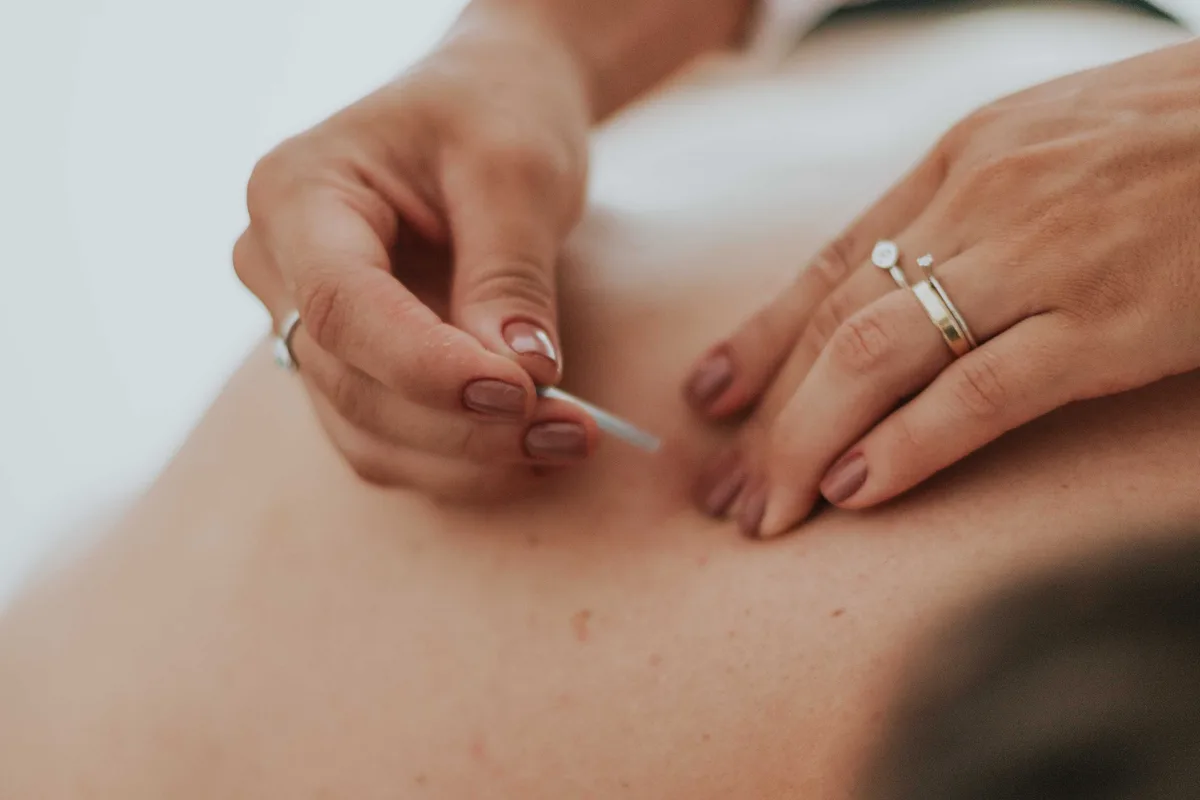
A practitioner inserts very fine needles at specific points, usually leaving them in for twenty to thirty minutes while you lie still. Most people feel a dull ache or nothing at all. A course is typically eight to ten sessions over several weeks, which is how it was delivered in the trials.
The needles are much thinner than the ones used for injections — closer to a thick hair than to a syringe. Some practitioners gently rotate them, some attach a small electrical current, some add heat. The traditional framework describes the points as sitting on channels of energy; the trials, sensibly, did not test that framework. They tested whether the treatment as delivered makes women feel better.
That distinction is worth holding onto for the rest of this article. You can be entirely unconvinced by the theory and still take the outcome data seriously, because the outcome data does not depend on the theory being right.
Does acupuncture improve sleep in menopause?
On the published evidence, yes. A pooled analysis of 32 randomized trials covering 2,673 women found acupuncture as an add-on treatment improved sleep quality scores substantially. Other reviews found it outperformed sleep medication. These are real results, and the next section explains why they need a caveat attached.
A separate review comparing acupuncture directly against sleep medication found acupuncture came out ahead on sleep quality scores. Acupressure — the same points, pressed rather than needled — also improved sleep quality across eight trials in nearly 500 women.
If I stopped writing here, you would close the tab and book a session, and I would have written the same article as everyone else. So here is the part almost nobody includes.
What happened when they used fake needles?
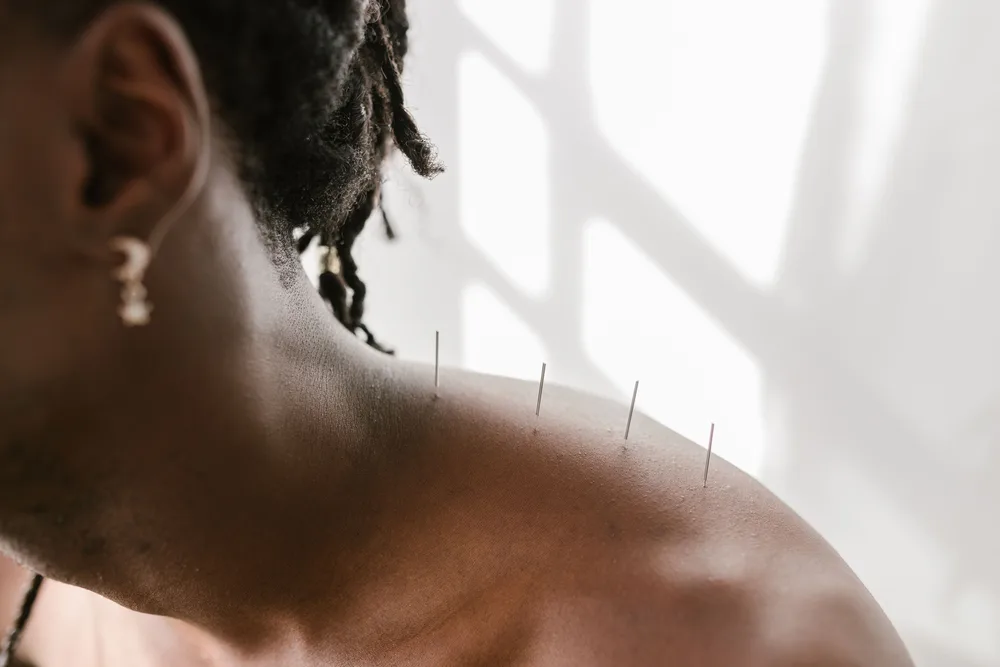
The difference vanished. In a rigorously designed trial in Annals of Internal Medicine, women received either real Chinese medicine acupuncture or non-inserting sham needles over eight weeks. Hot flash scores finished at 15.36 for real acupuncture and 15.04 for the sham. There was no meaningful difference between them.
A sham needle is a small piece of engineering. It has a blunt tip and a retractable shaft, so it presses against the skin and appears to shorten as if it were going in, without ever piercing anything. Done well, participants cannot tell which they received.
So in this trial, women who had needles inserted at carefully chosen traditional points and women who had blunt needles touched against their skin ended up in the same place. Both groups improved. Neither group improved more.
Does that mean it is just placebo?
Not quite, and the distinction matters. Women in both groups genuinely improved. What the sham comparison shows is that the improvement did not come from where the needles went, or from whether they broke the skin. Something about the encounter helped. The needling points were not the active part.
I want to be precise about what "placebo" means here, because the word gets used as an insult and it should not be. A placebo response is not imaginary and it is not a sign that you were gullible. It is a measurable change in symptoms produced by the context of treatment: the attention, the ritual, the expectation, the forty minutes lying still in a quiet room with someone whose entire job that afternoon is you.
For symptoms that are heavily modulated by attention and stress — and menopausal sleep is exactly that kind of symptom — that context is not a trivial ingredient. It may be most of the medicine.
The honest reframe: the sham trials did not show that acupuncture does nothing. They showed that what it does is not delivered through the needle tips. If forty minutes of enforced stillness and undivided attention, ten times over eight weeks, improves how you sleep, that is a real result about a real intervention. It just is not the result that is printed on the clinic's website.
Why do the meta-analyses look so positive, then?
Because most of the trials they pool compare acupuncture with medication or with nothing, not with sham needles. Against no treatment, acupuncture wins easily. The reviews also report very high statistical heterogeneity, meaning the studies disagree with each other more than pooled averages suggest.
Heterogeneity is a technical word for something quite simple. When reviewers combine studies, they check whether the studies are telling a consistent story. In one of these menopause reviews the inconsistency measure came in at 94 percent, which is about as high as that number goes. It means the individual trials found wildly different things and the average sitting on top of them is a summary of disagreement, not a summary of agreement.
There is a second issue. Trials of acupuncture where the control group knows it is getting nothing cannot separate the treatment from the expectation of treatment. That is not a flaw invented to discredit acupuncture — it is the same problem that applies to any therapy you cannot hide from the person receiving it, including exercise programs and talking therapies.
So both sets of findings are true at once. Compared with carrying on as you are, acupuncture is likely to leave you sleeping better. Compared with an elaborate imitation of acupuncture, it is not.
Is acupuncture safe?
Very, in trained hands. Serious complications are rare and the common side effects are minor: small bruises, brief soreness, occasional lightheadedness. Check the practitioner is licensed in your state and uses single-use sterile needles. If you take a blood thinner or have a bleeding disorder, say so before the first session.
This is genuinely the strongest thing acupuncture has going for it, and it deserves more weight than it usually gets. Compare the risk profile with the alternatives women are offered for menopausal sleep. Sleeping tablets carry dependence, next-day impairment and fall risk. Supplements carry interactions and, as we found when we looked at CBD for sleep in menopause, no guarantee that the bottle contains what the label says.
Acupuncture, done properly, carries the risk of a small bruise. When a treatment is that safe, the bar it needs to clear before being worth trying is lower than it would be for a drug.
A few specifics worth raising before your first appointment: tell the practitioner if you have a pacemaker, since some use electrical stimulation; if you are on anticoagulants; if you have lymphedema in an arm; or if you have a heart valve condition. None of these is necessarily a barrier, but they change how a careful practitioner works.
So should you try it?
That depends on what you want from it. If you want a treatment that works through a specific biological mechanism, the sham trials say this is not it. If you want a low-risk, structured, hands-on ritual that reliably makes women feel better and improved sleep scores in dozens of trials, it qualifies.
The thing that should drive the decision, honestly, is cost. An analysis of more than 700 US clinics found a median of about 112 dollars for a first visit and 80 dollars for follow-ups, with enormous variation between cities. The trials used eight to ten sessions. That is somewhere around 700 to 900 dollars for a fair test, and Medicare covers acupuncture only for chronic low back pain, so most women are paying out of pocket.
Community acupuncture clinics, where several people are treated in a shared room on a sliding scale, run considerably cheaper — often 15 to 50 dollars. Given what the sham trials suggest about where the benefit comes from, a cheaper course is not obviously a worse course.
If you decide to go, do it properly: book the full course rather than one session, because one session is not a test of anything. Set a checkpoint in advance — say, after session five — and decide now what would count as enough improvement to continue. Track your sleep through it, or you will be judging eight weeks from memory, and memory is generous to whatever we have paid for.
And if the budget only stretches to one thing this year, spend it on CBT-I rather than acupuncture. It has the strongest evidence of anything for insomnia, it holds up against proper control conditions, and several formats are free.
Where to go from here
If hot flashes are the specific thing waking you, natural remedies for night sweats and insomnia covers what else has been tested, and hormone therapy for menopause insomnia covers the option with the best evidence for that particular problem.
If it is anxiety keeping you awake, anxiety and insomnia at night is the more useful read. For the treatment that beats sleeping tablets head to head, start with CBT-I for menopause insomnia. And for how it all fits together, begin at the complete perimenopause and menopause sleep guide.
Key takeaways
- Pooled analyses of 32 trials in 2,673 women found acupuncture improved sleep quality scores in perimenopausal insomnia, with no serious adverse events.
- In the best sham-controlled trial, real acupuncture and fake needles produced almost identical hot flash scores (15.36 vs 15.04, P = 0.77).
- Both findings are true: acupuncture beats no treatment, and it does not beat a convincing imitation of itself.
- That means the benefit is real but is not produced by the point selection or by the needle entering the skin.
- The positive reviews mostly compare acupuncture with drugs or usual care, and report very high inconsistency between studies.
- Safety is its strongest argument: minor bruising and soreness, with serious complications rare in licensed hands.
- Budget for eight to ten sessions, roughly 700 to 900 dollars at median US prices, or far less at a community clinic.
Frequently asked questions
Does acupuncture help you sleep during menopause?
Pooled analyses of dozens of randomized trials report clearly better sleep quality scores with acupuncture. The important caveat is that most of those trials compared acupuncture with medication or with no treatment, not with fake needles. Against fake needles, the advantage largely disappears.
Is acupuncture just a placebo for menopause symptoms?
That is too blunt. Women improve genuinely, in both real and sham groups. What the sham trials show is that the improvement is not produced by the specific points chosen or by the needle piercing the skin. Something in the treatment encounter helps, but it is not the needling itself.
How many acupuncture sessions do you need for menopause symptoms?
The trials generally used eight to ten sessions over six to eight weeks, often two or three times weekly at the start. One session is not a fair test. If you are going to try it, plan and budget for the full course, and set a checkpoint in advance for deciding whether to continue.
How much does acupuncture cost in the United States?
An analysis of more than 700 clinics found a median of about 112 dollars for a first visit and 80 dollars for follow-ups, with wide variation by city. Community acupuncture clinics charge considerably less. Medicare covers acupuncture only for chronic low back pain, and private coverage is inconsistent.
Is acupuncture safe during menopause?
For most people, yes. Serious complications are rare when needles are single-use and the practitioner is properly licensed. Minor bruising, brief soreness and lightheadedness are the usual side effects. Tell the practitioner if you take blood thinners, have a bleeding disorder, or have a pacemaker before treatment begins.
Sources cited
- Ee C, Xue C, Chondros P, et al. Acupuncture for menopausal hot flashes: a randomized trial. Ann Intern Med. 2016;164(3):146–154. pubmed.ncbi.nlm.nih.gov
- Efficacy of acupuncture as an adjunctive therapy for perimenopausal insomnia: a systematic review and meta-analysis of randomized controlled trials. Clinics. 2025. sciencedirect.com
- Acupuncture as an independent or adjuvant therapy to standard management for menopausal insomnia: a systematic review and meta-analysis. PLOS One. 2025. journals.plos.org
- Effectiveness of acupuncture and acupressure for improving the sleep quality of menopausal women: a meta-analysis. 2025. pubmed.ncbi.nlm.nih.gov
- Acupuncture price in forty-one metropolitan regions in the United States: an out-of-pocket cost analysis. J Altern Complement Med. 2019. pubmed.ncbi.nlm.nih.gov
- National Center for Complementary and Integrative Health. Acupuncture: effectiveness and safety. nccih.nih.gov

Ellen Hayes
Health & Wellness Writer and Researcher
Hi — I'm Ellen. I went into this expecting to write a debunking piece and came out with something more complicated and a lot more interesting. The sham trials changed what I think the question even is.
I'm not a doctor. I'm not an expert — and I'm never going to talk down to you like one. I'm a woman in the middle of perimenopause who got tired of vague answers, started reading the actual research, and writes it down here in plain English, the way I'd explain it to a friend over coffee. More about Ellen →