Mirtazapine for Sleep in Menopause: Evidence and Risks

Mirtazapine for sleep often comes up when menopause insomnia has become exhausting, especially when mood symptoms are part of the picture. It is an antidepressant, and its sedating effects have prompted research in insomnia. But a promising short trial and a suitable long-term plan are different things.
I compared the US prescribing information with the published abstracts of two recent placebo-controlled trials. The aim is to explain what the evidence can support, where it stops and which practical questions belong in a prescribing appointment. This is not a recommendation to start mirtazapine or change an existing prescription.
Mirtazapine is an antidepressant approved for major depression in adults; its use for insomnia is off-label in the United States. Small trials show short-term sleep benefits, but do not establish menopause-specific or lasting benefit. Discuss daytime sedation, appetite and weight changes, interactions, mood monitoring and a prescriber-led stopping plan before treatment.
What is mirtazapine, and why is it prescribed for sleep?
Mirtazapine, sold as Remeron and generic products, is an antidepressant whose US indication is major depressive disorder in adults. It can cause sleepiness, and clinicians sometimes prescribe it off-label for insomnia. Ask whether the treatment is intended for depression, insomnia or both, because those goals require different evidence and follow-up discussions.
The US Remeron label is the reference for approved use and safety. A bedtime prescription does not by itself tell you which condition is being treated. If the explanation at the appointment was unclear, ask the prescriber before drawing conclusions from the name of the medicine.
Describe what you want help with in your own words. You might be spending a long time awake after waking, struggling with mornings, or noticing a persistent change in mood. These concerns can overlap, but you should not have to guess whether a prescription is aimed at one or all of them.
It is reasonable to ask why this medicine was selected over another approach. Bring the same question if you are already taking it and do not remember the original goal. An explanation can help you understand what counts as improvement and why a clinician may recommend continuing, adjusting or reconsidering the plan.
For background, our menopause sleep medicine comparison separates drug categories. It is a guide to the discussion, not a ranking of which medicine is strongest or an invitation to replace one prescription with another.
What did the DREAMING trial find about mirtazapine for insomnia?
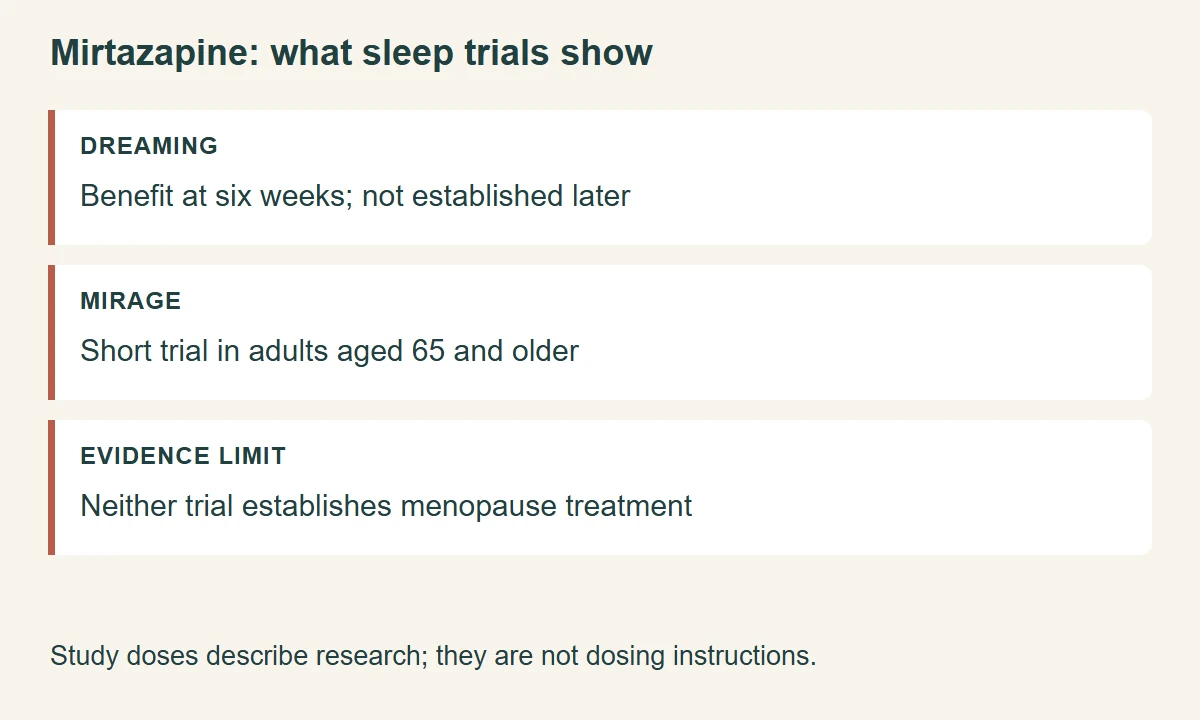
The DREAMING trial found that low-dose mirtazapine reduced insomnia severity compared with placebo at six weeks in adults with sleep maintenance problems. Differences were not statistically significant from twelve weeks onward. The study supports a short-term evidence discussion, but not an assumption that benefit continues indefinitely or specifically treats menopause insomnia.
The trial compared mirtazapine, amitriptyline and placebo in general practice. Participants had insomnia with sleep maintenance difficulties and insufficient benefit from non-drug treatment. The mirtazapine research regimen was 7.5 to 15 mg daily. Those figures describe the study; they are not instructions for selecting your own dose.
“No statistically significant difference” at later assessments does not prove that every participant stopped benefiting. It means the trial did not establish a continuing group difference. Equally, an encouraging early average cannot establish that you personally will benefit or that you should remain on the medicine for months.
Ask what time point the clinician intends to use for review and what they would consider a worthwhile improvement. A vague plan to “see how it goes” is harder to assess than one that names the symptom, the desired change and the next conversation.
If you bring a study to the appointment, highlight the question it raises for you. That might be whether your symptoms resemble those of the participants or whether a short trial fits your treatment goal. You do not need to interpret every statistical term yourself to ask how the findings apply to the proposed plan.
What does the MIRAGE study add, and what are its limits?
The MIRAGE trial found improved insomnia severity with mirtazapine over a short treatment period in adults aged sixty-five and older. More participants stopped because of adverse effects in the mirtazapine group than with placebo. The findings add short-term evidence, but cannot establish safety or benefit for all midlife women or long-term treatment.
This was a trial of older adults with chronic insomnia, rather than a trial designed to treat menopausal symptoms. The distinction should remain visible when someone describes the results as evidence “for women over fifty.” Age, sex, menopausal stage and treatment target are not interchangeable descriptions.
The early results are a reason to discuss the evidence, not a reason to ignore tolerability. A treatment that improves a questionnaire score but causes effects that disrupt your day may not meet your own goals. Ask the clinician how benefit and burden will be weighed together.
Read study summaries with two columns in mind: what was measured and what was not established. Here, a short course of treatment in a selected group does not tell us what will happen after many months, whether night sweats improve or how a different person's health conditions change risk.
It is also fine to ask about uncertainty without expecting the clinician to predict your outcome. A useful answer can describe why an option is being considered, the limits of the evidence and how a carefully reviewed plan would handle those limits.
Does mirtazapine treat menopause itself or replace hormone therapy?
Mirtazapine is not hormone therapy, and the insomnia trials discussed here do not establish treatment of menopause or hot flashes. If mood symptoms, sweating and disrupted sleep occur together, ask which concern each part of a proposed plan addresses. Improvement in sleep should not be assumed to mean that every menopause symptom is treated.
Write down the order in which symptoms occur on a typical night. You may notice sweating before a prolonged waking period, or you may be awake with thoughts and later become uncomfortable. There is no need to turn that observation into a diagnosis before the appointment; it is information for the assessment.
Our menopause insomnia guide brings the different conversations together. The guides to depression during menopause and hormone therapy and sleep cover related concerns without implying that all symptoms require the same treatment.
If a clinician is treating depression, do not interpret the insomnia trial timelines as a reason to stop antidepressant treatment after a few weeks. The diagnosis and overall plan matter. Ask how sleep changes fit into the assessment of mood and everyday functioning, rather than reviewing the nighttime effect in isolation.
You can ask for the explanation in writing, especially if several options are discussed at once. Knowing the purpose of each treatment helps you report changes accurately and avoid confusing a discussion of future possibilities with instructions to start several medicines together.
Can mirtazapine cause weight gain or next-day drowsiness?
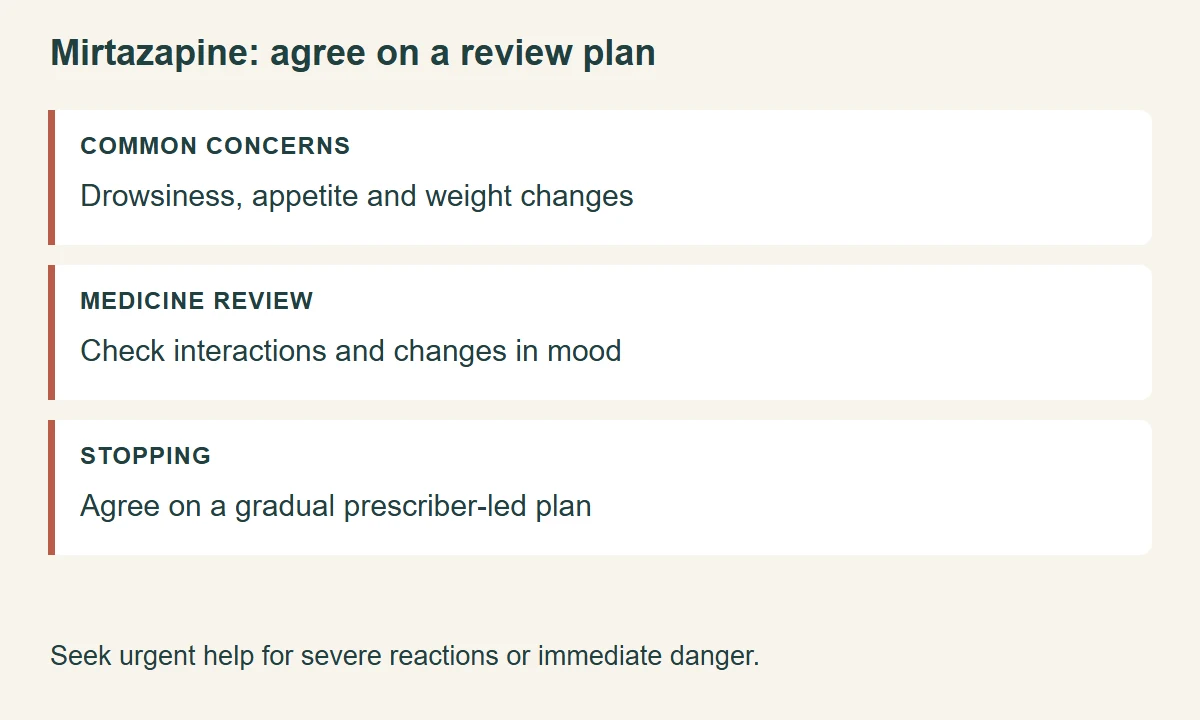
Increased appetite, weight gain, drowsiness and dizziness are recognized mirtazapine side effects. They do not occur in everyone, but should be discussed before treatment, particularly if morning alertness or weight changes concern you. A low dose does not guarantee freedom from these effects, and feeling sedated is not the same as functioning better.
NHS mirtazapine guidance describes these practical concerns. Tell the clinician what matters most to you rather than waiting for a side effect to become intolerable. It is possible to discuss weight respectfully, without treating every change as inevitable or making appearance the measure of treatment success.
Before treatment, consider the demands of an ordinary day. You may drive early, operate equipment or care for someone who needs quick attention. Ask how to handle drowsiness and what should prompt a call. Do not use a good night's sleep as proof that driving will be safe the next morning.
Statements that a lower dose is “always more sedating” are not a reliable personal dosing rule. Dose decisions should account for the reason for treatment and your response. If the effect is too strong, too weak or unpredictable, report it rather than changing the strength to test an online claim.
Discuss how you will monitor effects without turning the process into another nightly task. A few notes about morning alertness, appetite and daily function can be enough to start the review. Ask what changes are worth reporting sooner and whether any individual health concerns require additional monitoring.
Which interactions and mood warnings need attention?
Mirtazapine requires a full medicine review because interactions can affect sedation and other risks. Its label includes warnings about serotonin syndrome and mood changes, and contraindicates certain MAOI combinations. All antidepressant-treated patients should be monitored for worsening mood or suicidal thoughts, even though the boxed warning's increased-risk finding concerns younger people.
Tell the pharmacist about prescription medicines, nonprescription products and supplements, including products marketed for sleep or mood. The MedlinePlus patient information explains why starting, stopping or changing other medicines also needs advice. Avoid alcohol and do not add sedatives without a clinician's review.
Ask what mood changes should prompt contact and who you should call. If a trusted person is helping you monitor the treatment, ask whether they can join that part of the discussion. A clear action plan is useful even when the main reason you sought help was a sleep problem.
Severe reactions need urgent assessment. These include a serious rash with systemic symptoms, signs of a severe allergic reaction, or possible serotonin syndrome such as fever with marked confusion and muscle stiffness. Seek prompt medical advice for fever, sore throat or mouth sores, which the label identifies as possible signs of a blood-cell problem.
New suicidal thoughts require immediate professional help; if there is immediate danger, contact emergency services. Also report unusually elevated or agitated mood, major behavioral change or a reduced need for sleep. Do not assume a concerning change is simply a sign that an antidepressant is beginning to work.
How should you discuss timing, dose and stopping?
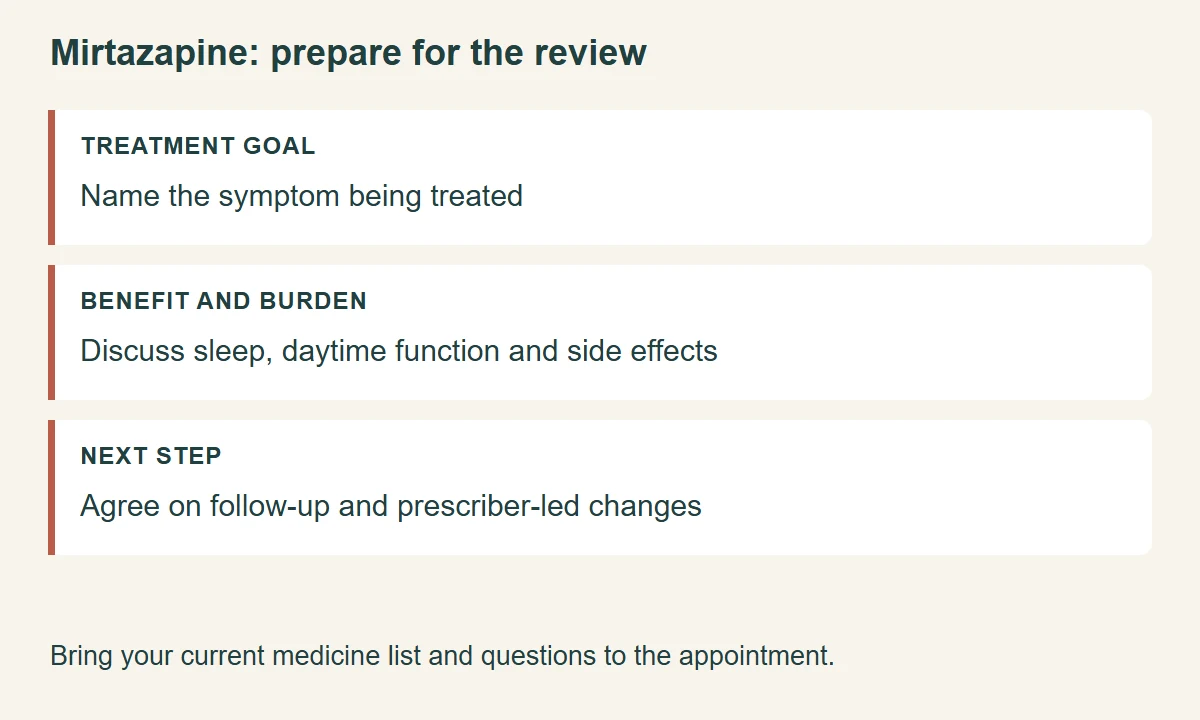
Follow the directions for your own mirtazapine prescription and clarify questions with the prescriber or pharmacist. Research doses are not personal dosing instructions. Do not add extra tablets after waking or stop suddenly because one night was disappointing. The label recommends gradual reduction when discontinuing, with the plan tailored by the prescriber.
Confirm which product you have, because ordinary tablets and orally disintegrating tablets have different handling instructions. Ask the pharmacist to demonstrate if necessary. The point is not to memorize every formulation; it is to leave with clear directions for the one actually dispensed to you.
Ask what to do if you miss a dose, are sick or cannot follow the usual schedule. Keep those instructions with the medication list. Avoid making a new rule from something you read about a different antidepressant or from a friend's prescription, even if the medicines sound similar.
A stopping discussion is part of planning, not a commitment to stop on a particular date. If treatment includes depression, the prescriber needs to consider that diagnosis as well as sleep. Tell them why you want to change the plan, whether the reason is side effects, limited benefit or feeling better.
For the next appointment, note when treatment started, any changes directed by the clinician and what you noticed afterward. You do not need to invent a taper schedule in advance. Ask for a written plan and a contact route if symptoms emerge during a prescribed reduction.
Make sure everyone involved in prescribing has the current medication list. If another clinician proposes a change, ask how the plans fit together and who will oversee follow-up. It is easier to clarify responsibility during the appointment than to discover afterward that you have two different sets of instructions.
What belongs in a broader menopause insomnia plan?
A broader plan should assess persistent sleep difficulties, address relevant menopause and mood symptoms, and discuss CBT-I as well as medicine options. AASM guidance strongly recommends multicomponent CBT-I for chronic insomnia. Agree on a review that considers daytime function and side effects, not only whether a tablet makes you feel sleepy at bedtime.
The AASM behavioral treatment guideline distinguishes a structured treatment from sleep hygiene alone. Our CBT-I article explains that discussion. Tell the clinician about access barriers, previous treatment and the parts of a program you found difficult to follow.
Prepare a short agenda rather than trying to describe every bad night. Start with the main sleep problem and its effect on the day. Then list symptoms you do not want overlooked, such as night sweats, persistent low mood or observed breathing pauses. Leave diagnosis to the assessment.
- Goal: What specific change would make daily life better?
- Evidence: Which research is relevant to the problem being treated?
- Safety: What would make the plan unsuitable or require earlier contact?
- Follow-up: When will benefit, tolerability and the next step be reviewed?
Keep the discussion open if the first approach does not help enough. That can mean revisiting the assessment, improving access to non-drug treatment or considering another clinician-led option. A decision about mirtazapine for sleep should fit your whole situation rather than depend on one promising result from a short trial.
Where to go from here
Return to the menopause insomnia guide for context, then explore CBT-I or the sleep medicine comparison. The separate article on hydroxyzine for sleep explains why different sedating medicines need different evidence and safety discussions.
Key takeaways
- Mirtazapine is approved for adult major depression; insomnia use is off-label in the United States.
- DREAMING and MIRAGE support a short-term evidence discussion, not a claim of lasting or menopause-specific benefit.
- Drowsiness, appetite and weight changes, interactions and mood monitoring belong in the plan.
- Discuss CBT-I and follow-up; dose changes and gradual discontinuation need prescriber guidance.
Frequently asked questions
Is mirtazapine approved to treat menopause insomnia?
Mirtazapine is approved for major depressive disorder in adults, not specifically for insomnia or menopause. Clinicians sometimes prescribe it off-label for sleep. Ask which condition is being treated, what evidence supports the choice and how the benefits and side effects will be reviewed in your particular situation.
Does mirtazapine work for sleep over the long term?
The trials discussed here do not establish reliable long-term insomnia benefit. DREAMING found improvement compared with placebo at six weeks, but not statistically significant differences from twelve weeks onward. MIRAGE lasted only twenty-eight days. Those findings should inform a planned review, rather than an assumption that early benefit continues indefinitely.
Is a lower mirtazapine dose always better for sleep?
A lower dose is not a dependable rule for better sleep or fewer side effects. Research doses describe study regimens, not instructions for self-adjustment. Ask the prescriber how the dose fits the condition being treated and report inadequate benefit or excessive sedation rather than changing the strength yourself.
Will mirtazapine make me gain weight?
Mirtazapine can increase appetite and weight, but this does not happen to everyone in the same way. Discuss concerns before treatment and ask how changes will be monitored. Do not assume that a low dose removes the risk, or stop a prescription abruptly because you notice a change.
Can I combine mirtazapine with another sleeping tablet?
Do not add another sleeping tablet without a prescriber or pharmacist checking the combination. Mirtazapine can cause drowsiness, and other medicines may increase impairment or introduce additional interactions. Include alcohol, supplements and over-the-counter products in the review. A clinician should explain whether any proposed combination is appropriate and how it will be monitored.
Can I stop mirtazapine when my sleep improves?
Discuss stopping with the prescriber rather than stopping abruptly when sleep improves. Mirtazapine may also be treating depression, and the label recommends gradual reduction when discontinuing. The plan depends on your prescription, response and treatment history. Ask for clear instructions and a way to report problems during the change.
Sources cited
- DailyMed: Remeron and RemeronSolTab US prescribing information — Read source
- Bakker et al., 2025: DREAMING randomized placebo-controlled trial; abstract — Read source
- Nguyen et al., 2025: MIRAGE randomized placebo-controlled trial; abstract — Read source
- NHS: mirtazapine information and practical precautions — Read source
- MedlinePlus: mirtazapine patient information — Read source
- Edinger et al., AASM 2021: behavioral and psychological treatments for chronic insomnia — Read source

Ellen Hayes
Health & Wellness Writer and Researcher
I compare prescribing information and research so the differences are easier to discuss with a clinician. This article is a research summary, not a medical review or a personal treatment recommendation. About Ellen and the site.