DHEA for Menopause: Why the Route You Take Matters
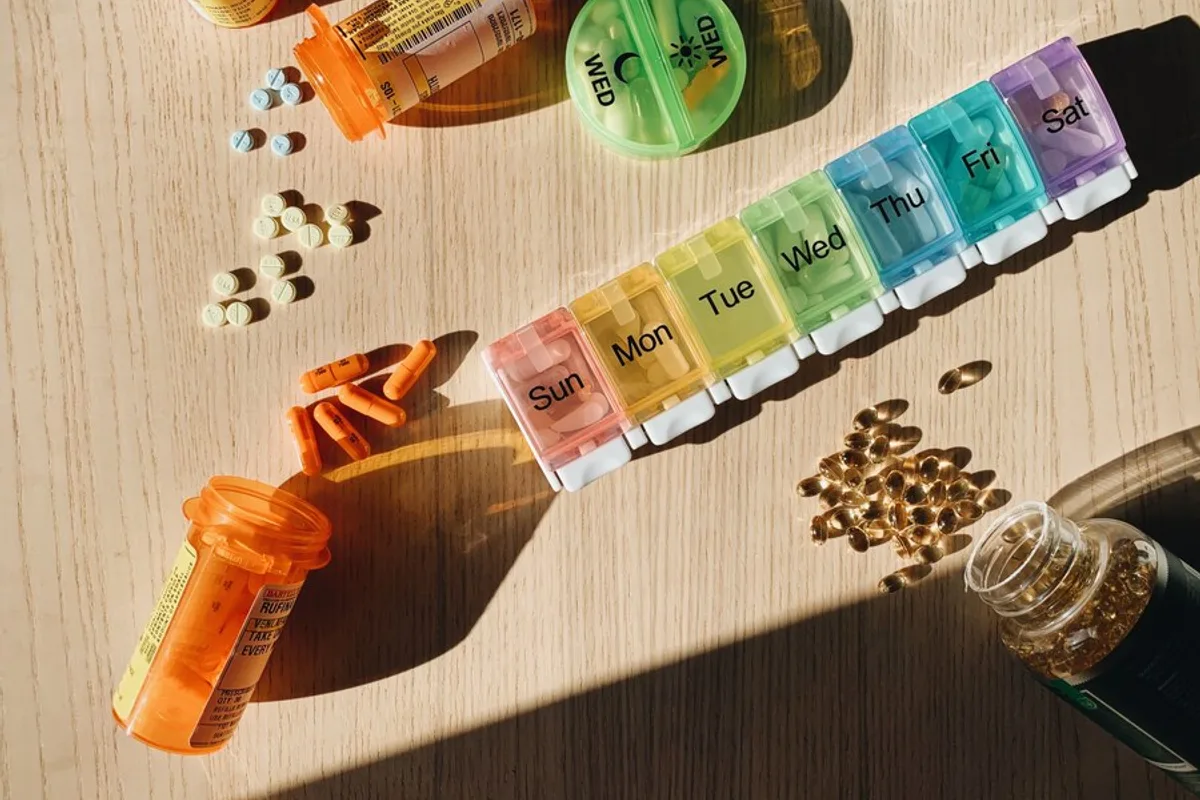
Oral DHEA supplements, taken on their own, have not been shown to reliably improve quality of life, sexual function or bone density in midlife women — and they come with a risk of androgenic side effects like acne. The one form of DHEA with solid evidence for symptom relief is a prescription vaginal product, not the pills sold as a supplement.
DHEA gets marketed as a kind of master hormone you can simply refill as you age. Reading the actual trial data complicates that story in a specific, useful way: the benefit that does show up in the research is concentrated almost entirely in one delivery method, and it isn't the one most people are buying.
What is DHEA and why would it affect menopause?
DHEA (dehydroepiandrosterone) is a hormone made mainly by your adrenal glands, and it's one of the body's main precursors of androgens — meaning your body converts it into testosterone and, from there, into estrogen. The theory behind supplementing it is straightforward: replenish a precursor hormone, and the body might convert more of it into the hormones menopause symptoms are tied to.
That theory is exactly what makes DHEA attractive to market broadly — it sits upstream of both testosterone and estrogen, so in principle it could touch almost anything hormone-related. Theory and trial results, though, have turned out to be two different things here.
Does DHEA actually improve quality of life or symptoms?
Not reliably, according to the most rigorous pooled evidence available. A Cochrane systematic review, the kind of analysis built specifically to resist cherry-picked positive trials rather than relying on any single promising study, found no measurable benefit for overall quality of life or general wellbeing compared with placebo.
The same review looked directly at menopausal symptoms — hot flashes, night sweats, vaginal dryness and more — and couldn't reach a clear verdict at all. Results were inconsistent across the 28 trials it covered, measured in incompatible ways (continuous scores in some, yes/no symptom counts in others), making a single pooled answer impossible rather than simply negative.
What about sexual function specifically?
This is where DHEA's evidence looks best at first glance — and where reading past the single headline number matters most, not just taking it at face value. Two major analyses, drawing on overlapping but not identical sets of trials, land in genuinely different places on this specific question.
Notice that the point estimates (0.31 and 0.35) are actually close to each other — it's statistical significance, not the size of the effect, that differs between the two. That's a real, unresolved disagreement between two careful teams of reviewers, not one of them being obviously wrong. The next section explains a detail buried inside the Cochrane data that helps make sense of it.
Why does the route you take matter so much?
Because the Cochrane review's own pooled sexual-function result splits apart cleanly once you separate trials by how the DHEA was actually delivered — and the split lands almost exactly where you'd want it to if you were trying to figure out which product to trust.
In plain terms: the overall "DHEA helps sexual function" headline is carried almost entirely by a single trial of a vaginal product, while the oral pills — the form actually sold as a general supplement on store shelves — don't clear statistical significance on their own. The review's own authors note the formal test comparing these two subgroups didn't itself reach significance (P = 0.18), so this isn't proof the route is the deciding factor. But it is the most direct, honest read of what the oral-only data shows by itself: nothing conclusive.
That vaginal product already has a name you may recognize. Prescription intravaginal DHEA (prasterona, brand name Intrarosa) is FDA-approved specifically for painful intercourse after menopause, and it's the same local treatment discussed in our vaginal dryness article. It is not the same product as an oral "DHEA" supplement capsule, and the trial evidence genuinely doesn't transfer from one to the other.
Does DHEA help bone density or metabolic health?
No clear benefit shows up here either, in the largest analysis built specifically to answer this question. This is the same body of evidence that found no significant effect on sexual symptoms overall — and its null results on metabolic markers are more consistent across the board.
The authors rated their own confidence in this evidence as low, mainly due to imprecision and inconsistency between the underlying trials — not because they found strong evidence of harm on these specific markers, but because the data simply isn't solid enough to support a confident claim of benefit either.
Is DHEA safe to take as a supplement?
The clearest, most statistically confident finding in the entire DHEA literature isn't a benefit at all — it's a side effect, and a fairly common one. It's worth knowing about before trying this supplement, not after you've already noticed it on your own skin.
This tracks with straightforward biology: DHEA is an androgen precursor, and more androgen activity can mean more acne and unwanted hair growth — the same free-androgen mechanism covered in our article on menopause facial hair. Worth knowing too: DHEA is sold over the counter as a dietary supplement in the United States, unlike in most countries, where it requires a prescription. That means US products aren't held to the same manufacturing, purity and dosing standards the FDA requires of actual medications — in the trials above, doses ranged all the way from 10 mg to 1,600 mg daily, a spread that should give anyone pause before assuming "more is simply better."
Where to go from here
For the local, prescription product this article keeps distinguishing DHEA pills from, see our full guide to vaginal dryness treatments, including where intravaginal DHEA fits among moisturizers, lubricants and vaginal estrogen. For the androgen side of the hormone story, our testosterone for menopause article covers the treatment with the strongest FDA-level evidence base for low libido specifically. And before combining DHEA with anything else, our guide to combining supplements safely is worth reading first.
For how all of this fits into the bigger picture of midlife sleep, start at the complete perimenopause and menopause sleep guide.
Key takeaways
- Oral DHEA has not been shown to reliably improve quality of life in peri- or postmenopausal women — a Cochrane review of 28 trials found no significant effect (SMD 0.16, not significant).
- The "DHEA helps sexual function" headline is mostly carried by one vaginal-product trial. Oral DHEA alone, isolated in the same data, did not reach statistical significance (SMD 0.11, P = 0.36).
- Two independent meta-analyses disagree on significance for sexual function, even though their effect-size estimates (0.31 and 0.35) are actually close to each other — a genuine, unresolved uncertainty, not a simple yes or no.
- No significant effect was found on bone density, cholesterol, blood sugar or weight across 23 trials and nearly 1,200 women.
- Androgenic side effects, mainly acne, are the most statistically confident finding in the DHEA literature (odds ratio 3.77 versus placebo).
- Oral DHEA supplements and prescription vaginal DHEA (prasterona) are different products for different purposes — the strongest evidence belongs to the local, prescription form.
Frequently asked questions
Does DHEA actually improve menopause symptoms?
A Cochrane review of 28 trials and 1,273 women found no evidence that DHEA improves quality of life (SMD 0.16, not significant), and the effect on menopausal symptoms themselves was too inconsistent across studies to pool into one answer.
Does DHEA help with sex drive or sexual function?
The overall pooled result from the Cochrane review was a small but statistically significant improvement (SMD 0.31, P = 0.01). But when split by route of administration, oral DHEA alone was not significant (SMD 0.11, P = 0.36) — the pooled benefit was driven mostly by a single trial using intravaginal DHEA.
Why does the form of DHEA (oral vs. vaginal) matter so much?
In the Cochrane meta-analysis, data from trials using oral DHEA pills did not show a statistically significant benefit for sexual function on their own, while the one trial using intravaginal DHEA did. These are different products used for different purposes, and the strongest evidence belongs to the local, prescription form, not the oral supplement sold over the counter.
Is DHEA safe to take as a daily supplement?
DHEA was associated with significantly more androgenic side effects, mainly acne, than placebo (odds ratio 3.77). A separate meta-analysis of 23 trials found no significant effect on bone density, cholesterol, blood sugar or weight. DHEA is sold over the counter as a supplement in the US, so it isn't held to the same manufacturing and purity standards as a prescription drug.
Is oral DHEA the same as the vaginal DHEA some doctors prescribe?
No. Prescription intravaginal DHEA (prasterona) is FDA-approved specifically for painful intercourse after menopause and works locally. The oral DHEA sold as a general wellness supplement is a different product, taken for different reasons, with a much weaker evidence base behind its own claims.
Sources cited
- Scheffers CS, Armstrong S, Cantineau AEP, Farquhar C, Jordan V. Dehydroepiandrosterone for women in the peri- or postmenopausal phase. Cochrane Database Syst Rev. 2015;(1):CD011066.
- Elraiyah T, Sonbol MB, Wang Z, et al. Clinical review: The benefits and harms of systemic dehydroepiandrosterone (DHEA) in postmenopausal women with normal adrenal function: a systematic review and meta-analysis. J Clin Endocrinol Metab. 2014;99(10):3536-3542.
How this article was checked
Both the Cochrane review and the Elraiyah meta-analysis were read in full rather than summarized from press coverage, including the subgroup-by-route-of-administration data (Analysis 2.4 in the Cochrane review's own tables) that the rest of this article's thesis rests on. The honest caveat that the subgroup-difference test itself did not reach significance (P = 0.18) is included deliberately, rather than overstating "route explains everything" as a proven fact. A separate, independent fact-check re-extracted every number in this article directly from the Cochrane review's raw results tables (not just its abstract) and confirmed every figure, including the Chi²/P-value pair above, down to the decimal.
It has not been reviewed by a clinician. Ellen Hayes is a researcher and writer, not a doctor, and nothing here is a diagnosis or a substitute for being seen by one.

Ellen Hayes
Health & Wellness Writer and Researcher
Hi — I'm Ellen. I went looking for a straightforward "does DHEA work" answer and found something more useful instead: the data itself quietly splits by the exact detail — oral versus vaginal — that most marketing never separates out. That's the kind of fine print I think is worth your time.
I'm not a doctor. I'm not an expert — and I'm never going to talk down to you like one. I'm a woman in the middle of perimenopause who got tired of vague answers, started reading the actual research, and writes it down here in plain English, the way I'd explain it to a friend over coffee. More about Ellen →