Creatine for Menopause: What 3 Trials Actually Found
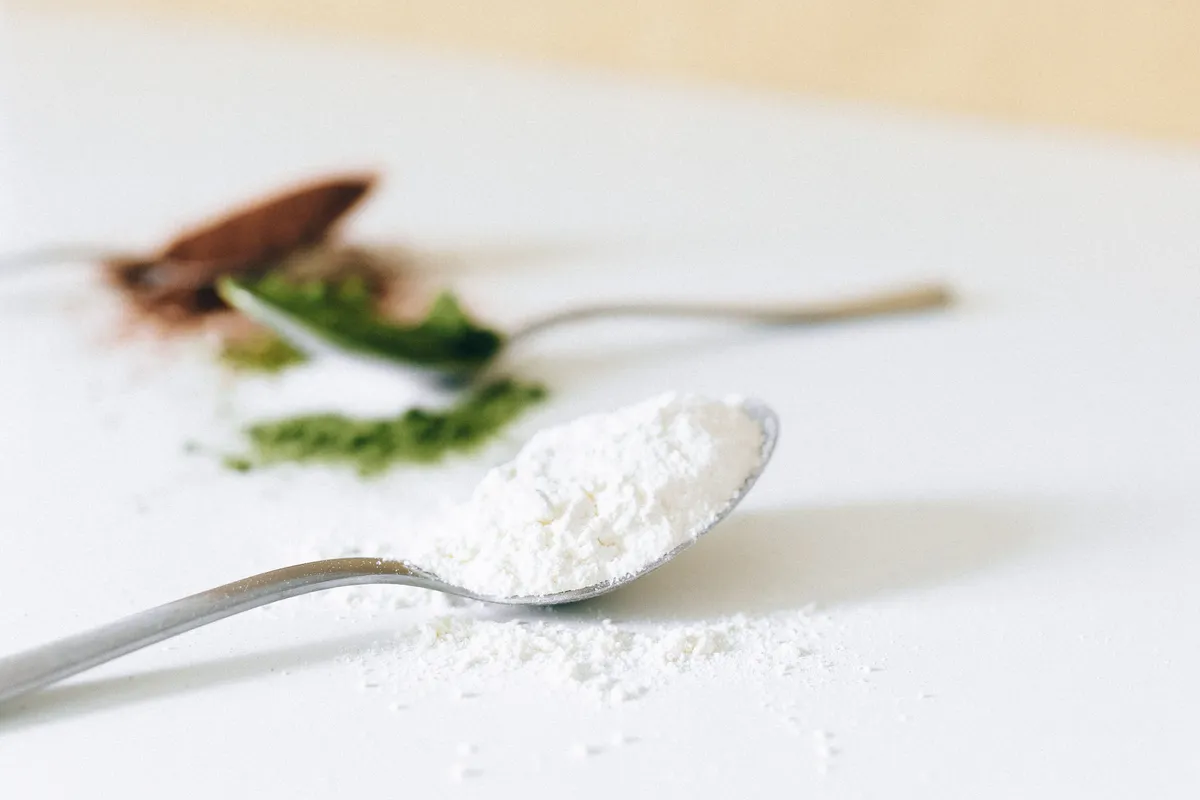
Creatine has real trial evidence in postmenopausal women for muscle strength (modest, duration-dependent) and bone geometry (mixed — no density benefit in the largest trial, but some fracture-relevant geometry changes). A single intriguing study also found it helped sleep-deprived brains, but that trial used young adults, not menopausal women, and a much higher dose than typical supplementation.
I expected to write either a clean "yes it works" or "it's overhyped" piece. Instead I found three separate, real trials asking three separate questions — muscle, bone, and brain — with three different answers, none of them as tidy as the supplement marketing suggests.
Why would creatine matter during menopause at all?
Because it's already doing essential work in your muscle and brain, and both of those tissues change measurably during the menopause transition. Creatine is a compound your body makes and stores in muscle and brain tissue, where it helps regenerate the fast-access energy (ATP) those tissues burn through during effort — supplementing it raises the stored reserve available to draw on.
Does it actually help you build or keep muscle?
Modestly, and with an important catch about time. A 2021 systematic review pooled 10 randomized trials testing creatine plus resistance training specifically in older women, rather than relying on mixed-sex data that might not apply the same way to a body with less estrogen and androgen circulating.
The catch is time, not the supplement. The duration split is the most useful finding here: short trials (under 24 weeks) showed essentially nothing, while longer ones showed real gains in both upper- and lower-body strength. The review's own authors call the overall evidence quality low and ask for more research — this is a real, modest signal, not a proven, large effect.
What about bone density — does creatine actually help?
Here the story gets genuinely mixed, across two trials from the same Canadian research group, run eight years apart at very different scales. The two results don't simply agree or disagree — they answer slightly different questions about the same bone.
That smaller trial is the one most creatine marketing points to. The same research group then ran a far larger, longer follow-up to see if it held up.
Read side by side, the honest summary is: the headline "creatine builds bone" claim comes from the smaller, earlier trial, and the larger, more rigorous one didn't replicate the density benefit — though it did find a different, more subtle geometric change that might matter for fracture risk specifically. Both can be true at once without contradicting each other; they're just answering slightly different questions about the same bone.
Can creatine help with the sleep loss that comes with menopause?
Possibly, based on one genuinely interesting study — but this is the claim that needs the heaviest caveat of the three, so I want to be direct about who was actually studied before you read the numbers below and assume they apply to you.
Who this study actually tested. The 15 participants were healthy adults averaging 23 years old — not perimenopausal or menopausal women, and not people with chronic, repeated sleep disruption. The dose was also a single large one-time amount, roughly 5 to 8 times a typical daily maintenance dose, given under research supervision. This is a real, promising mechanism finding, not evidence that your usual creatine scoop will fix a 3 a.m. wake-up.
So how much creatine do the actual trials use, day to day?
The muscle and bone trials in postmenopausal women used doses around 0.1 g per kilogram of body weight daily — roughly 5 to 7 grams for most women — taken consistently for months alongside a resistance training program, not as a standalone fix. That's the dose and context the real evidence actually supports.
Is it actually safe to take for months at a time?
In the trials that checked, yes. The 2021 muscle-strength meta-analysis notes that most of the included studies monitored kidney and liver function directly, and found no adverse events tied to creatine use even with that monitoring in place over several months of continuous use.
Still worth a doctor's input first. "No adverse events in these trials" isn't the same as "safe for everyone." If you have existing kidney disease, are on medications that affect kidney function, or have any other condition your doctor is actively managing, mention creatine before starting — the trials above studied generally healthy postmenopausal women, not every medical situation.
Where to go from here
For the bigger picture on why muscle changes at menopause in the first place, including the hormone mechanism research and why resistance training remains the best-proven countermeasure, see our article on menopause and muscle loss. For the bone question more broadly, our menopause and osteoporosis article covers what's independently well-established. And if you're stacking creatine with anything else, our guide to combining supplements safely is worth reading first.
For how all of this fits into the bigger picture of midlife sleep, start at the complete perimenopause and menopause sleep guide.
Key takeaways
- Muscle strength: a 2021 meta-analysis of 10 trials found creatine significantly improved upper-body strength in older women, with both upper- and lower-body gains showing up only in trials lasting 24+ weeks.
- Bone density is genuinely mixed: a smaller 2015 trial found creatine slowed the rate of femoral neck bone loss compared with placebo (both groups still lost some); a larger 2-year trial of 237 women found no density benefit at all, though it did find bone-geometry changes that may matter for fracture risk.
- The sleep-deprivation brain study is real but very preliminary — 15 healthy young adults, not menopausal women, given a single dose far larger than typical daily supplementation.
- The trials that actually built the muscle and bone evidence used about 5-7g daily, taken for months alongside resistance training — not a one-time mega-dose.
- Safety monitoring in these trials found no adverse events, but anyone with kidney issues should still check with a doctor first.
- None of the three trial lines is a clean "yes" or "no" — the honest picture is modest, duration-dependent, and still being filled in.
Frequently asked questions
Does creatine actually help menopausal women build muscle?
A 2021 meta-analysis of 10 trials found creatine significantly increased upper-body strength, but had no overall effect on lower-body strength or muscle mass. Both upper- and lower-body strength improved when the training program lasted 24 weeks or longer, suggesting duration matters more than the supplement alone.
Does creatine help bone density after menopause?
The evidence is mixed. A small 2015 trial found creatine helped preserve femoral neck bone density. A larger, 2-year trial of 237 women found no effect on bone density at the femoral neck, hip, or spine, though it did find improvements in bone geometry at the hip that may be protective against fracture.
Can creatine help with menopause-related sleep deprivation?
There's one promising but very preliminary study. A 2024 trial gave a single high dose of creatine to 15 healthy young adults during 21 hours of sleep deprivation and found improved memory, attention, and processing speed. It did not test perimenopausal or menopausal women, and the dose was far higher than typical daily supplementation.
How much creatine do the actual trials use?
The muscle and bone trials in postmenopausal women typically used about 0.1 g per kilogram of body weight daily, roughly 5-7 grams for most women, taken for months alongside resistance training. That's different from the single large one-time dose (0.35 g/kg) used in the sleep-deprivation study.
Is creatine safe for women to take long-term?
The trials in older women that monitored kidney and liver function found no adverse events tied to creatine use. That's reassuring for the doses and durations actually studied, though anyone with existing kidney disease should still check with a doctor before starting.
Sources cited
- dos Santos EEP, et al. Efficacy of Creatine Supplementation Combined with Resistance Training on Muscle Strength and Muscle Mass in Older Females: A Systematic Review and Meta-Analysis. Nutrients. 2021;13(11):3757.
- Chilibeck PD, Candow DG, Landeryou T, Kaviani M, Paus-Jenssen L. Effects of creatine and resistance training on bone health in postmenopausal women. Med Sci Sports Exerc. 2015;47(8):1587-1595.
- Chilibeck PD, Candow DG, Gordon JJ, Duff WRD, et al. A 2-yr Randomized Controlled Trial on Creatine Supplementation during Exercise for Postmenopausal Bone Health. Med Sci Sports Exerc. 2023;55(10):1750-1760.
- Gordji-Nejad A, Matusch A, Kleedorfer S, et al. Single dose creatine improves cognitive performance and induces changes in cerebral high energy phosphates during sleep deprivation. Sci Rep. 2024;14:4937.
How this article was checked
All four trials were read directly, not from press coverage or secondary summaries. An independent fact-check caught one error from an initial draft: the 2015 bone trial's exact percentages were first taken from a secondary summary and misstated as a gain ("1.4%"); the authors' own published abstract gives -1.2% for the creatine group versus -3.9% for placebo — both groups lost bone density, creatine's group simply lost less — and the figure above has been corrected to match. A widely repeated secondary claim that the sleep-deprivation researchers warned against high-dose creatine because of kidney strain could not be found anywhere in the primary paper itself, so it was left out rather than attributed to a source that didn't actually say it. A newer 2026 meta-analysis on creatine dosing and lean mass was mentioned in press coverage but could not be verified against the original paper, so its specific numbers were not used.
It has not been reviewed by a clinician. Ellen Hayes is a researcher and writer, not a doctor, and nothing here is a diagnosis or a substitute for being seen by one.

Ellen Hayes
Health & Wellness Writer and Researcher
Hi — I'm Ellen. Creatine has become the supplement everyone in midlife fitness circles swears by, and I wanted the actual trial numbers before I believed it. What I found was three real but modest stories, not one slam-dunk — which is honestly more useful than the confident version I expected to write.
I'm not a doctor. I'm not an expert — and I'm never going to talk down to you like one. I'm a woman in the middle of perimenopause who got tired of vague answers, started reading the actual research, and writes it down here in plain English, the way I'd explain it to a friend over coffee. More about Ellen →